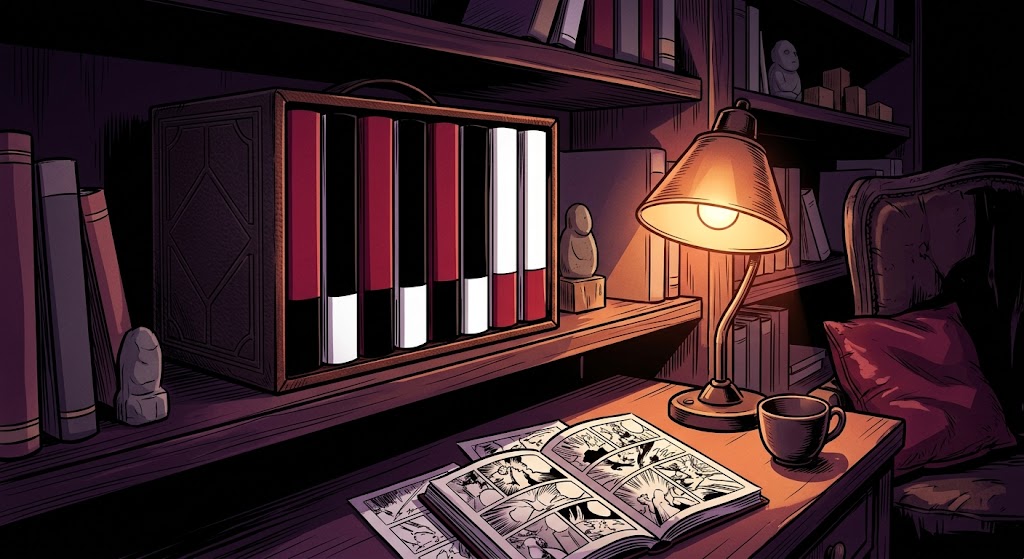
What the Death Note Manga Box Set Includes
The Death Note Complete Box Set gives you the entire manga series in one package — a collection of individual books housed together in a display box. Inside you get all 12 story volumes (108 chapters — every last page of the story from start to finish), plus Volume 13: How to Read, plus a “How to Use It” fold-out that you can’t get anywhere else.
Here’s something that trips people up all the time: the box set says “Volumes 1–13” on it, but only 12 of those are the actual story. Volume 13 is a companion guide — basically an encyclopedia for the series. More on that below.
Written by Tsugumi Ohba and illustrated by Takeshi Obata, Death Note ran in Weekly Shōnen Jump (a weekly Japanese manga magazine) from December 2003 to May 2006. The English edition is published by VIZ Media, and the series is fully complete — no waiting around for future volumes. The box set has a list price of $114.99.
On a shelf, the whole set takes up about 9.6 inches in width. It looks great lined up, and the box itself doubles as a display piece.
Your choice between editions mostly comes down to one question: is the companion guide worth $65 to you? The breakdown below will help you decide.
Death Note Complete Box Set (Volumes 1–13)
What Volume 13 (How to Read) in the Box Set Actually Is
This is the single biggest misconception about the Death Note box set, so let’s clear it up right now: Volume 13 is not a continuation of the story. It doesn’t pick up after Volume 12. There are no new chapters, no new plot twists, no epilogue.
So what is it? It’s an encyclopedic companion guide stuffed with behind-the-scenes material. Here’s what’s inside:
- Complete character profiles — detailed breakdowns of every major and minor character
- Shinigami observation files — lore and data on the shinigami (the death gods from the series)
- In-depth creator interviews — long-form conversations with writer Tsugumi Ohba and artist Takeshi Obata about how the series came together
- All 108 chapter title origins — the story behind every chapter name
- Death Note rules encyclopedia — every rule of the Death Note, with case studies showing how they apply
- The original 55-page pilot chapter from 2003 — the very first test version of Death Note, created before it became a serialized manga (think of it as the “rough draft” that launched the series)
- A character card revealing L’s real name — yes, really
So who actually gets value from Volume 13? If you’re someone who looks up fan wikis after finishing a series, dives into creator commentary, or revisits lore details between rereads — you’ll use this constantly. It’s the kind of companion guide that rewards curiosity. On the other hand, if you usually just move on to the next manga once you’ve finished the story, it’ll sit unread on your shelf. That’s fine — but it’s worth knowing before you spend the extra $65 over the All-in-One Edition.
Death Note Box Set vs Every Other Edition
The box set isn’t the only way to read Death Note in English. There are three other editions, and they each have their own strengths. Here’s how they compare.
vs All-in-One Edition ($49.99)
The Death Note All-in-One Edition crams all 12 story volumes into a single 2,400-page book. At $49.99, it’s less than half the price of the box set — the best deal per page by a wide margin.
It also has something no other edition does: a 44-page standalone epilogue chapter (called a “one-shot” — a single self-contained story) set after the main series. This was originally published in Japan’s Shōnen Jump magazine in February 2008, and the All-in-One is the only way to read it in English.
The trade-off? You lose the How to Read guide, the four-panel comics, and the fold-out. And instead of 12 individual volumes on a shelf, you get one thick brick that takes up just 3.2 inches. Some people love that; others prefer the look of individual spines.
One thing to know: a 2,400-page book puts serious stress on the binding. Many readers report that the spine creases heavily with use, and some copies have pages loosen over time with repeated reading. It holds up fine for a single read-through, but if you plan to reread Death Note often, the box set’s individual volumes will last longer.
This is the edition to grab if you want to read Death Note for the lowest price possible, or if shelf space is tight.
Death Note All-in-One Edition
vs Black Edition (~$90 for all 6 volumes)
The Death Note Black Edition collects the series in a combined format — six volumes total, each containing two volumes’ worth of story (sometimes called an “omnibus,” meaning multiple books merged into one). At $14.99 per volume, the full set runs about $89.94.
The standout feature here is the exclusive color pages. No other Death Note edition includes them. You also get the four-panel comics that are missing from the All-in-One. The volumes themselves are a larger format than the standard singles, so the art gets a bit more room to breathe.
What you don’t get: the How to Read companion guide and the fold-out. If you want Volume 13, you’d need to buy it separately — which would push the total cost above the box set price.
The Black Edition is the pick if you care most about how the manga looks and feels in your hands. The larger pages and color content make it a premium reading experience.
vs Buying Individual Volumes (~$130 for all 13)
You can buy each Death Note volume on its own for $9.99. All 13 volumes (including How to Read) would run you about $129.87 — roughly $15 more than the box set for the exact same content, minus the box and fold-out.
The only real advantage is flexibility. If you’ve already started collecting and have a few volumes, it doesn’t make sense to rebuy them in a box set. But if you’re starting from zero, there’s no reason to go this route when the Death Note box set gives you the same thing for less money with extras on top.
Quick Comparison
| Edition | Price (List) | Exclusive Content | Best For |
|---|---|---|---|
| Complete Box Set | $114.99 | How to Read guide, “How to Use It” fold-out | Collectors and dedicated fans who want everything |
| All-in-One | $49.99 | 44-page epilogue one-shot (standalone chapter) | Budget readers, minimal shelf space |
| Black Edition | ~$89.94 | Color pages, four-panel comics | Readers who want premium presentation |
| Individual Volumes | ~$129.87 | None | Completing an existing collection |
Is the Death Note Box Set Worth It?
Let’s break it down by the numbers first. The box set costs $114.99. Buying the same 13 volumes individually would cost about $129.87 — so the box set saves you roughly $15 and throws in a display box and an exclusive fold-out on top. Purely on value, it beats buying singles.
But the real question is whether you need what’s inside the box set that other editions don’t offer. And that comes down to one thing: Volume 13: How to Read.
If you’re the kind of reader who wants the creator interviews, the pilot chapter (the original test version of the manga), the full rules encyclopedia, and the deep-dive character profiles — the box set is the only edition that bundles it all together. You could buy How to Read separately, but at that point you’re spending more than the box set costs anyway.
On the other hand, if you just want to read the Death Note story and you’re not too concerned about bonus lore, the All-in-One Edition at $49.99 is genuinely hard to beat. It’s less than half the price, it includes an exclusive epilogue chapter that the box set doesn’t have, and it takes up a fraction of the shelf space. The trade-off is that you lose the companion guide, the collectible factor, and long-term durability.
Here’s how to think about it:
- You want the full Death Note experience with all the extras → get the box set. It’s the most complete package available and a great display piece.
- You want the story at the best price → get the All-in-One. You’ll save over $60 and still get an exclusive bonus chapter.
- You care most about art quality and presentation → look at the Black Edition. The color pages and larger format are worth it for visual readers.
- You already own some volumes → just buy the ones you’re missing individually. No need to double up.
For the latest pricing, please check Amazon.