If you’ve been wondering whether the Fire Force manga is finished or still ongoing — good news. The series is done, the whole thing is out in English, and you can read it start to finish right now. Here’s when it ended, how the finale lands, and whether it’s worth picking up.
Yes — The Fire Force Manga Is Finished (Here’s When It Ended)
Fire Force (炎炎ノ消防隊) by Atsushi Ohkubo is a completed manga. No cliffhangers to worry about, no indefinite hiatuses, no “will they ever finish this?” anxiety. It’s done.
The series ran its full course across 34 volumes. It was serialized — meaning its chapters were published weekly in a magazine before being collected into book form — in Weekly Shonen Magazine from September 2015 until February 2022, with the final collected volume following in May 2022. That’s roughly six and a half years of serialization, a solid, focused run that told its full story and wrapped up.
All 34 English volumes are available from Kodansha Comics, the publisher that translates and releases the series in English. There’s nothing left to wait for. Every chapter, every story arc (a self-contained section of the larger narrative), every bizarre and terrifying twist is sitting on shelves — physical and digital — ready to go. If you’ve been holding off until the series was complete, this is your green light.
For a horror-action manga that gets progressively darker and weirder as it goes, having the complete picture available is a genuine advantage. You won’t have to sit with a stomach-churning cliffhanger for months wondering what happens next. You can just grab the next volume.
How the Ending Wraps Up Fire Force’s Darkest Themes
Fire Force starts as a fairly straightforward action series about firefighters battling people who spontaneously combust into flame monsters called Infernals — ordinary humans who have been consumed and transformed by flames into mindless, burning creatures. But the series doesn’t stay in that lane. It gets darker. A lot darker.
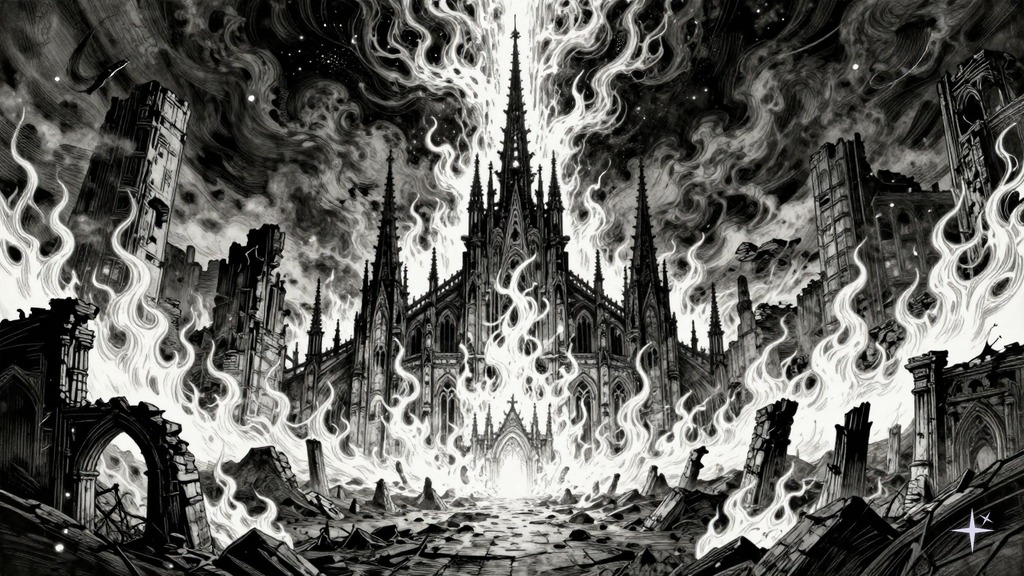
By its final arc, Fire Force has escalated into full-blown cosmic horror and apocalyptic territory. Cosmic horror, for the unfamiliar, is a tradition built around dread of vast, incomprehensible forces beyond human understanding — and Fire Force commits to it. The Evangelist (the series’ true antagonist pulling strings from the shadows), the Great Cataclysm (an extinction-level event threatening the world), the nature of the Adolla dimension (a mysterious parallel realm connected to the flames) — these mythology threads that have been weaving through the series all come together in the closing stretch. The stakes aren’t “save a building” anymore. They’re “save the fundamental nature of reality.”
The ending addresses the existential dread that defined the second half of the manga. If you felt the series shift from action-horror into something more unsettling and philosophical around the midway point, the finale leans into that hard. It doesn’t retreat to safe ground. It pushes further into the abstract, the cosmic, and the deeply strange.
Without giving away specifics — the finale is about more than just defeating a villain. It grapples with questions about creation, destruction, and what reality itself is made of. For a manga that started with firefighters punching flame zombies, that’s a wild trajectory. And it’s one of the things that makes Fire Force such an unusual reading experience.
⚠️ Spoiler Discussion — How It Actually Ends
Skip to the next section (“Was the Ending Rushed or Satisfying?”) if you haven’t read the ending yet.
The final volume’s central confrontation, per Kodansha’s own description, pits Haumea’s despair — her wish for extinction — against Shinra’s hope. The stakes are cosmic: what kind of world, if any, comes after.
And then the real reveal, the one that reframes Atsushi Ohkubo’s whole career: Fire Force ends by connecting directly into the world of Soul Eater, Ohkubo’s earlier series. The remade world Fire Force leaves behind becomes the world where Soul Eater takes place — the final chapter makes the link explicit, closing on a “NEXT IS SOUL WORLD” send-off (exactly how much in-world time separates the two series is a favorite fan debate). Fire Force isn’t just by the same author as Soul Eater; it’s the prequel era of the same universe.
The payoff is continuity, not commentary: long-time Ohkubo readers get to watch one world literally become the other.
The tone in these final chapters moves from action-horror into something closer to existential science fiction. Whether that landing works for you will depend heavily on what you were looking for from the series.
Was the Ending Rushed or Satisfying?
This is where things get honest: in this writer’s read, the ending is divisive.
Plenty of readers online feel the final arc’s pacing accelerated quickly. Plot threads that had been building across dozens of volumes get resolved in rapid succession, and some character arcs feel compressed in the closing stretch. If you were deeply invested in specific characters’ storylines, you may feel like some of them didn’t get the breathing room they deserved.
The biggest dividing line is the ending’s final-stretch reveal — the one discussed in the spoiler section above. Some readers found it brilliant, a bold swing that recontextualizes everything. Others felt it pulled focus from the emotional stakes they’d been invested in, or that the cosmic scale of the finale left character threads underserved. Either way, it’s a big, committed swing.
What’s not really up for debate is that the horror and body-horror imagery remains strong through the finale. Body horror — disturbing imagery involving the transformation, distortion, or destruction of the human body — is central to Fire Force’s visual identity, and the series doesn’t soften its intensity just because it’s wrapping up. The Infernals are still nightmarish, the cosmic horror elements are still genuinely unsettling, and the art maintains its energy through the final chapters.
For readers who gravitated toward Fire Force’s dark, existential side — the creeping dread, the questions about what’s real, the sense that something fundamentally wrong lurks beneath the surface of the world — the ending does deliver on those themes. The execution is debated, but the thematic ambition is real.
If you’re someone who needs a tidy, crowd-pleasing finale to feel satisfied, be prepared for something different. If you’re open to a story that takes a sharp creative turn at the finish line and asks you to sit with something strange, you might find it rewarding.
Fire Force at a Glance — Volumes, Publisher, and Formats
Here’s the quick reference breakdown:
| Detail | Info |
|---|---|
| Title | Fire Force (炎炎ノ消防隊) |
| Author | Atsushi Ohkubo |
| Total Volumes | 34 (Japanese and English) |
| Total Chapters | 304 (across 34 volumes) |
| Magazine | Weekly Shonen Magazine (a Japanese magazine targeting teen boys) |
| English Publisher | Kodansha Comics |
| Serialization Period | September 2015 – February 2022 |
| Status | Completed |
| Anime Adaptation | Yes — three seasons (2019–2026); the anime is complete and adapts the full manga |
A few things worth noting from this table:
34 volumes puts Fire Force in moderate-length territory for a manga series. Each volume collects roughly 8–10 chapters into a single book, so you’re looking at 34 individual paperbacks if you go physical. It’s not a quick weekend read, but it’s also not the multi-year commitment of something like One Piece or Naruto. You’re looking at a focused, complete story that doesn’t overstay its welcome.
The series comes from Atsushi Ohkubo, the same creator behind Soul Eater — an earlier action-horror manga known for its gothic visual style and blend of dark themes with dynamic fight sequences. Readers familiar with Soul Eater will recognize a similar DNA in Fire Force: the dark aesthetic, the blend of horror and action, the willingness to get weird. Fire Force pushes further into horror territory than Soul Eater did, especially in its second half.
The anime adaptation is now complete — three seasons aired between 2019 and 2026, with the third and final season concluding in April 2026. The anime reaches the manga’s ending, giving viewers another route to the story’s conclusion (as with any adaptation, not every page makes it to screen). That said, the manga remains the original source material, and readers who want Ohkubo’s artwork and pacing exactly as drawn will find the volumes worth owning regardless.
Where to Buy the Complete Fire Force Manga
All 34 English volumes are published by Kodansha Comics and available through major retailers in both physical and digital formats. The series has been out long enough that availability is generally good — you shouldn’t have trouble finding individual volumes.
For the physical editions, you’re looking at standard manga-sized paperbacks. At 34 books, this is a meaningful shelf commitment, so keep that in mind if space is a consideration. They look great lined up together, though — the spine artwork and cover designs have a cohesive visual identity across the full run.
Digital editions are a strong option if shelf space is tight or you prefer reading on a tablet. They’re available through platforms like Kindle, BookWalker, and other major digital manga storefronts, offering the advantage of instant access to the complete series.
Volume 34, the final volume, wraps up the entire story.
Fire Force
At 34 volumes, think about whether you want to grab a few volumes to test the waters or commit to larger chunks at a time. Each volume carries a typical manga retail price. Starting with the first few will give you a clear sense of whether Fire Force’s blend of horror, action, and increasingly strange mythology clicks with you before you’re deep into the series.
Since the series is complete, you’ll occasionally find volumes available at sale pricing through various retailers — worth keeping an eye out if you’re planning to collect the full run.
Should You Start Fire Force Now That It’s Complete?
This is genuinely one of the best times to pick up Fire Force, precisely because it’s finished. Here’s who this series is for:
You’ll love it if you enjoy:
- Horror-action hybrids — spontaneous human combustion, Infernals, body horror, and escalating cosmic dread
- Apocalyptic mythology that builds and deepens across the full series
- Dark manga that starts accessible and gets progressively more intense and unsettling
- Complete stories — no waiting, no hiatuses, no uncertainty about whether you’ll get an ending
- The aesthetic and tone of Atsushi Ohkubo’s Soul Eater, pushed further into horror territory
Be aware going in if:
- You strongly prefer manga that stays in one genre lane (Fire Force shifts significantly as it progresses)
- You need endings that wrap everything up neatly and conventionally
- You’re sensitive to graphic body horror and disturbing imagery — Fire Force has plenty of both, especially in its second half
The beauty of picking up a completed series is that you control the pace. You can binge it over a few weeks or spread it out over months. You can pause after a particularly intense arc and come back when you’re ready. There’s no external schedule dictating your experience.
Fire Force is a self-contained story with a definitive ending. It takes you from a relatively grounded premise — special firefighters battling people who’ve turned into living flames — to something cosmic, strange, and deeply unsettling. That journey is one of the most interesting things about the series. Watching it transform from volume to volume is part of the experience.
If you’ve been waiting for confirmation that the Fire Force manga is finished and the whole thing is available in English — it is. All 34 volumes, beginning to end. Grab volume 1 and see if the world of Special Fire Force Company 8 — Shinra’s squad of misfit firefighters battling Infernals — pulls you in. For a lot of readers, it does, and it doesn’t let go.