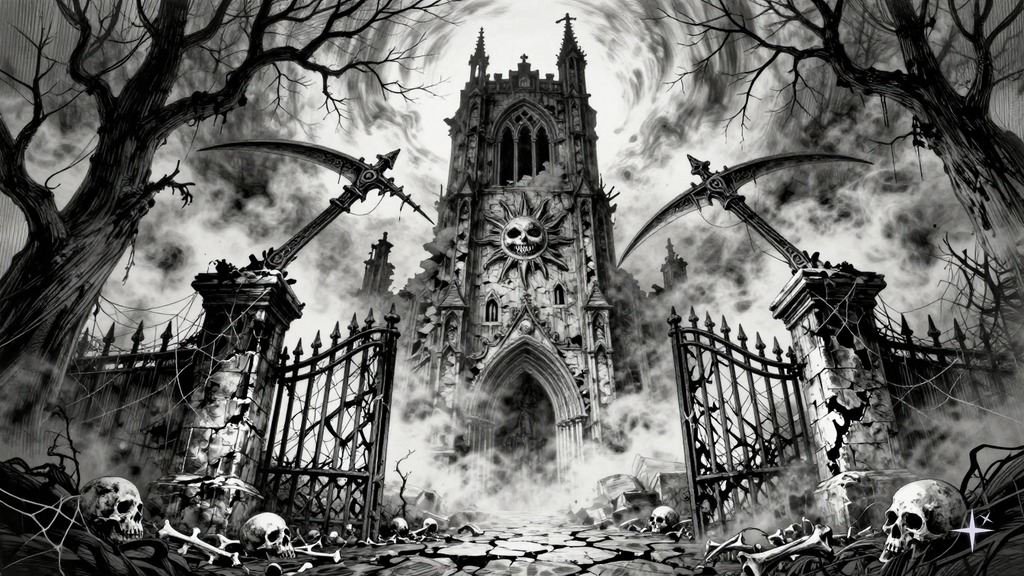
So you watched the anime, loved the vibe, and now you want the full story. Or maybe you’ve never touched Soul Eater at all — maybe you found it through a horror manga search, keep seeing that iconic grinning moon everywhere, or just want a dark, atmospheric series to sink into. Either way, the first question is always the same: how many soul eater manga volumes are there, and where do I start?
The answer: 25 volumes, and the series is fully complete. No waiting for new chapters, no catching up on a sprawling backlog that’s still growing, and no cliffhangers without resolution. You can read the whole thing from start to finish right now.
Before we get into it — if you’re brand new to manga, here’s one thing worth knowing up front: manga volumes are printed in the Japanese reading style, which means you open the book from what would be the “back” cover in a Western book and read panels from right to left. Every English-language manga volume includes a note explaining this, and it becomes second nature within a few pages. Don’t let it intimidate you.
Let’s break it all down.
Soul Eater Manga Volumes: The Full 25-Book Breakdown
Soul Eater, created by Atsushi Ohkubo, is a completed manga series spanning 25 volumes and 113 chapters. It was originally published chapter-by-chapter in a Japanese magazine called Monthly Shonen Gangan (published by Square Enix) from 2004 to 2013 — a process called serialization, which is how most manga is created before being collected into the book-format volumes you buy. “Shonen” refers to a category of manga aimed at a young male readership, though Soul Eater’s appeal extends well beyond that demographic. All 25 volumes have been released in English by Yen Press.
Here’s what that looks like at a glance:
| Detail | Info |
|---|---|
| Total Volumes | 25 |
| Total Chapters | 113 |
| Japanese Publisher | Square Enix (Monthly Shonen Gangan) |
| English Publisher | Yen Press |
| Serialization Period | 2004–2013 |
| Status | Completed |
The series follows Maka Albarn and her weapon partner Soul Eater Evans as students at the Death Weapon Meister Academy (DWMA), a school run by Death himself. In this world, certain people can transform their bodies into weapons — swords, scythes, guns — and they partner with fighters called meisters who wield them in battle. Together, these meister-weapon pairs hunt corrupted souls and witches in a world steeped in gothic horror imagery — think Halloween as an entire aesthetic universe, complete with a grinning crescent moon that bleeds.
For horror readers specifically: Soul Eater isn’t a pure horror manga in the way that something like Uzumaki or Gantz is. But it goes far beyond surface-level spookiness. The series deals with madness as a literal, infectious force that warps minds and bodies. Disturbing physical transformations — a subgenre sometimes called body horror, where the human form is twisted or broken in unsettling ways — appear throughout. And the atmosphere gets genuinely dark, especially in the second half. If you’re drawn to horror-adjacent manga with real teeth behind the style, this delivers.
At 25 volumes, Soul Eater sits in a sweet spot. It’s long enough to tell a properly epic story with deep character development and escalating stakes, but short enough that you’re not looking at years of reading to finish. For context, that’s roughly half the length of something like Naruto and a fraction of One Piece. You can realistically binge the entire series in a few weeks of casual reading.
And because the manga is finished, every plot thread gets resolved. Every question gets answered. That’s a luxury that ongoing series simply can’t offer.
Editions Available in English
When you go looking for Soul Eater in English, here’s what you’ll actually find on shelves and online.
Standard Single Volumes
The primary English edition is the 25 individual single volumes published by Yen Press. These are standard manga-sized paperbacks, and they represent the most widely available way to read Soul Eater in English. Each volume collects several chapters of the original magazine run. As noted above, they’re printed in right-to-left reading format — you’ll read panels from right to left across each page, and turn pages from left to right. Every volume includes a guide page if you need a reminder.
These single volumes have been the backbone of Soul Eater’s English-language availability for years. They’re what you’ll find at bookstores, libraries, and online retailers.
What About Omnibus or Deluxe Editions?
Good news: English readers actually have two complete edition options.
In addition to the 25 standard single volumes, Yen Press publishes Soul Eater: The Perfect Edition — a 17-volume hardcover deluxe edition in a larger format. Each Perfect Edition volume collects roughly one and a half standard volumes’ worth of content, with original color pages restored, updated translation and lettering, and new cover art by Atsushi Ohkubo. The first volume launched in July 2020, and all 17 volumes have been released — meaning this edition is also fully complete.
The Perfect Edition is based on the Japanese kanzenban reprint that Square Enix published in the same 17-volume format. If you see the term “perfect edition” online, it may refer to either the Japanese or English release — both exist.
So you have a genuine choice: the 25-volume standard paperbacks if you prefer the classic manga size and lower per-volume price, or the 17-volume Perfect Edition hardcovers if you want a premium presentation with fewer books on the shelf. Both contain the complete story.
Soul Eater NOT! Is a Separate Series
One common point of confusion: Soul Eater NOT! is a spinoff — a separate series set in the same world, created by the same author, but telling its own self-contained story. It’s 5 volumes long, features the DWMA, but follows a different cast of characters in a lighter, more easygoing tone focused on daily life at the academy rather than high-stakes combat. It’s published separately and has its own volume numbering.
If you’re buying Soul Eater for the first time, you only need the 25 main volumes. Soul Eater NOT! is entirely optional — more on when to read it below.
Best Reading Order for New Readers
Here’s the beautiful thing about Soul Eater: the reading order is completely straightforward.
Start with Volume 1. Read through Volume 25. You’re done.
There are no prequels you need first, no side stories that are required for the main plot to make sense, no alternate timeline weirdness. Ohkubo wrote a single continuous story across 25 volumes, and it’s designed to be read in order.
What the Early Volumes Set Up
The first few volumes lay out the whole world for you. You’ll meet the three main meister-weapon pairs — Maka and Soul, Black☆Star and Tsubaki, and Death the Kid with Liz and Patty Thompson. You’ll get introduced to the DWMA, understand how the meister/weapon partnership system works, and start to feel the series’ distinctive blend of spooky atmosphere and high-energy action.
The tone in the early volumes leans a bit more comedic, with individual chapters telling relatively self-contained stories before the larger, multi-volume storylines kick in. Don’t mistake that for the series being lightweight — the darkness creeps in steadily, and by the midpoint you’re dealing with themes of madness, existential fear, and corruption that give the horror elements real weight.
Where Does Soul Eater NOT! Fit In?
If you’re curious about the spinoff, it works best after you’ve read the main series — or at least after you’re well into it. Soul Eater NOT! takes place chronologically during the events of Soul Eater and contains some references and brief appearances by familiar characters that land better if you already know the main cast and setting.
That said, it’s entirely optional. Many fans love Soul Eater and have never read NOT! at all. Read it if you want more time in the DWMA world after finishing the main story; skip it if you’re satisfied with the 25-volume experience.
What the Manga Covers That the Anime Doesn’t
This is the big one, and it’s the reason a huge number of people seek out the manga volumes in the first place.
The Soul Eater anime was produced by Studio Bones (known for several well-regarded action anime) and ran for 51 episodes from 2008 to 2009. It’s a beloved adaptation with fantastic animation and fight choreography. But there’s a major catch: the anime diverges significantly from the manga and ends with an original conclusion that’s completely different from the manga’s true ending.
Where the Split Happens
The anime began airing while the manga was still being published — the manga wouldn’t finish until 2013, years after the anime wrapped up. Because of this, the anime couldn’t adapt the full story. It follows the manga’s plot relatively faithfully through roughly the first half of the story, then increasingly charts its own course as it approaches its finale.
The anime’s ending is notoriously divisive among fans. Without spoiling specifics, many viewers found it rushed and thematically unsatisfying compared to what the manga eventually delivered.
What You’re Missing Without the Manga
The later volumes of the manga contain entire storylines that never appeared in the anime. These include some of the series’ most ambitious and darkest material — escalating conflicts tied to madness, major character revelations, and a final confrontation that’s vastly different from what the anime presented.
The manga’s true ending resolves character threads that the anime simply didn’t have time (or source material) to address. Characters who felt underused in the anime get significant development. The villain’s motivations and the nature of madness itself are explored with far more depth.
If you watched the anime and felt like something was missing — like the story had more to say than it got to — the manga is where that missing story lives. The later half of the series is some of Ohkubo’s strongest work, and it’s only available in the manga.
For anime fans specifically, starting from Volume 1 is still recommended rather than trying to pick up where the anime diverged. The anime made enough changes, reordered enough events, and omitted enough details along the way that jumping into the manga mid-series can leave you confused about what happened differently. Beyond that, the manga’s art and pacing have their own distinct appeal that’s worth experiencing from the beginning. Twenty-five volumes is a manageable re-read — it’s not asking you to retread hundreds of chapters.
Where to Buy Soul Eater Manga Volumes in English
Soul Eater’s English volumes are published by Yen Press and are available through major book retailers in both physical and digital formats.
Physical Copies
The 25 individual volumes are available at bookstores and online retailers. Because Soul Eater is a well-known series with an established fanbase, the volumes have generally remained in print and accessible. Stock can vary — some individual volumes occasionally go out of stock temporarily — but the series as a whole is not hard to find.
If you’re building the complete physical collection, buying a few volumes at a time is a reasonable approach. Individual volumes typically carry a cover price in the range common for standard manga paperbacks — check the publisher’s listing or your preferred retailer for current pricing. At 25 volumes, the full set is a meaningful but not excessive investment for a complete series, and there’s no rush since the story is finished. Check multiple retailers and compare availability, especially if a specific volume proves elusive at one shop.
Soul Eater
Digital Options
Soul Eater is also available digitally, which is a convenient option if you want to start reading immediately or prefer not to store 25 physical books. Digital volumes are available through platforms like Kindle, Kobo, and BookWalker, among others.
Buying Tips
- Don’t confuse Soul Eater NOT! with the main series when ordering. Double-check the cover art and volume numbering.
- Used copies can be a good option for building your collection at a lower total cost, especially for a completed series where demand is steady but not spiking.
- Library systems often carry Soul Eater — it’s popular enough that many public libraries stock at least some of the volumes. If your local branch doesn’t have every volume, ask about interlibrary loan, a free service where libraries borrow books from other branches or library systems on your behalf.
Is Soul Eater Worth Reading?
Short answer: yes, especially if you have any love for supernatural action with a heavy horror atmosphere.
Soul Eater occupies a unique space in manga. It’s an action series at its core — there are fights, characters gaining new abilities as the stakes rise, and intense showdowns — but it wraps all of that in a gothic horror aesthetic that goes far beyond surface-level decoration. The themes of madness, death, and fear aren’t just plot devices; they’re woven into the fabric of the world. Characters grapple with insanity as a literal, infectious force. Disturbing physical transformations show up in ways that are genuinely unsettling. And the series’ version of Death is a central character, not a distant concept.
The Art Evolution
One of the most rewarding things about reading all 25 volumes is watching Ohkubo’s art evolve. The early chapters have a looser, more exaggerated style that perfectly matches the series’ quirky energy. By the later volumes, the art has become dramatically more detailed and ambitious, with action sequences and horror imagery that are downright stunning on the page. This visual progression alone makes the manga worth reading even if you’ve seen every episode of the anime.
A Manageable Commitment
At 25 volumes, Soul Eater is a complete story that respects your time. It doesn’t pad its length with unnecessary detours, and it doesn’t end abruptly. The pacing has natural ebbs and flows, but the overall trajectory moves with purpose toward a definitive conclusion.
For readers who want a finished horror-action manga that they can own and revisit — one with a distinctive visual identity, a memorable cast, and a story that actually ends — Soul Eater is one of the strongest picks available. Grab Volume 1 and see if that grinning moon hooks you. It probably will.