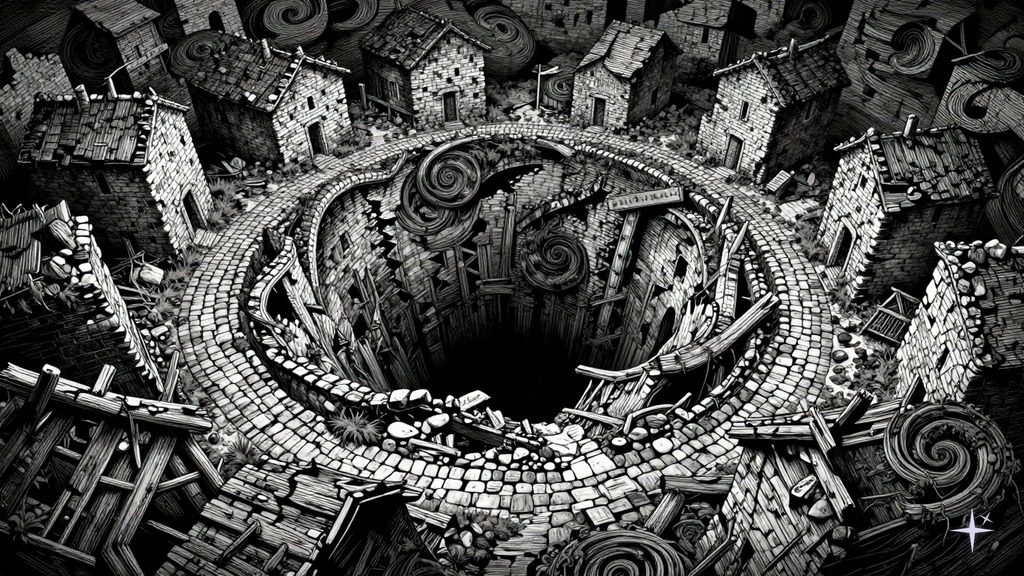
If you’re looking up the Uzumaki manga reading order, the answer is beautifully simple. This is a single, linear story with no branching paths, no alternate timelines, and no confusing publication gaps. Three volumes, front to back, and you’re done.
For anyone brand new to manga — Japanese comics, typically read right-to-left in their original format — Uzumaki is one of the most approachable starting points in horror. Below, we’ll walk through the reading order, explain why sequence matters for this particular story, cover the anime and film adaptations, and point you toward where to buy.
Uzumaki Manga Reading Order: All 3 Volumes, Start to Finish
Here’s the complete reading order:
Volume 1 → Volume 2 → Volume 3
That’s it. No side stories. No prequels (stories set before the main events). Uzumaki (うずまき) by Junji Ito is a self-contained horror manga published across exactly three volumes.
If you pick up the 3-in-1 Deluxe Edition published by VIZ Media — the largest English-language manga publisher in North America — all three volumes are collected in a single hardcover. The reading order doesn’t change — the content is arranged sequentially inside, so you just start on page one and keep going.
Here’s a quick comparison of your format options:
| Format | What You Get |
|---|---|
| Original 3 individual volumes | Volumes 1, 2, 3 as separate paperback books — read 1 → 2 → 3 |
| 3-in-1 Deluxe Edition | All 3 volumes in one oversized hardcover — start at page one, read straight through |
No matter which format you choose, the reading experience is identical. There are no bonus chapters exclusive to one edition or the other. The Deluxe Edition simply packages everything together with larger pages.
Why Order Matters in Uzumaki
You might wonder — if some early chapters work as standalone horror tales, does it really matter if you read them in order? It does, and here’s why.
Junji Ito originally published Uzumaki chapter by chapter in Big Comic Spirits, a Japanese manga magazine. That serialized format — where individual chapters came out over months and were later collected into book form — means the story was designed to build gradually. The story follows Kirie Goshima and Shuichi Saito as their small coastal town of Kurôzu-cho falls under an increasingly devastating spiral curse.
Volume 1 sets the stage. The early chapters introduce the curse through relatively contained incidents — a man’s obsession with spiral patterns, strange physical transformations, unsettling events at school. These chapters almost feel like independent horror short stories connected by the same setting and characters. They’re creepy, inventive, and they establish the rules (or lack of rules) governing the spiral’s influence.
Volume 2 is where the horror starts bleeding together. The isolated incidents of Volume 1 give way to something systemic. The spirals aren’t just affecting individuals anymore — they’re warping the town itself. The body horror — a genre term for horror built around disturbing physical transformations of the human body — intensifies, the environment distorts, and the sense of inescapable dread tightens. Characters you met in earlier chapters reappear in worsening circumstances. The connections between events become impossible to ignore.
Volume 3 drives everything toward a subterranean climax. The town’s transformation reaches its endpoint, and the mystery behind the curse reveals itself. This volume hits as hard as it does because you’ve spent two volumes watching the slow escalation. The ending lands with full weight only if you’ve experienced the buildup.
Skipping ahead — even accidentally — undercuts the deliberate pacing Ito constructed. Each chapter tightens the tension further. The cumulative effect is the entire point.
First-Time Reader Recommendation
If you’re new to Junji Ito or horror manga in general, Uzumaki is a fantastic starting point. Here’s why it works so well as a first read:
- It’s complete. The series ran from 1998 to 1999 in Japan and is fully finished. No waiting for new volumes, no indefinite hiatus anxiety. The Deluxe Edition runs roughly 648 pages — most readers finish it in a weekend.
- It’s self-contained. You don’t need to have read any other Junji Ito work. Uzumaki shares no universe, no characters, and no continuity with Ito’s other manga. You can walk in completely cold.
- It’s only three volumes. That’s a low commitment compared to longer horror series. If you love it, great — there’s a whole collection of Ito’s work waiting. If horror manga turns out not to be your thing, you haven’t invested in a 20-volume run.
For the format, the 3-in-1 Deluxe Edition is the most straightforward way to experience the story. It’s a single hardcover with larger pages, which makes a real difference for Ito’s artwork. His intricate, finely drawn details and horror imagery benefit enormously from the bigger format — subtle elements that might get lost on smaller pages become impossible to miss.
One pacing note: the early chapters of Volume 1 can feel somewhat self-contained, almost like a horror collection set in one town. That’s by design. Resist the urge to stop partway through thinking you’ve “gotten the idea.” That self-contained structure gradually dissolves into something much more connected and apocalyptic. The full story — its complete shape from beginning to end — is what makes Uzumaki special, not any single chapter in isolation.
Where the Anime and Film Fit In
Uzumaki has been adapted twice outside of manga: once as a live-action film and once as an anime.
The UZUMAKI anime arrived in 2024 as a four-episode series co-produced by Production I.G USA and Adult Swim and aired on Toonami, Adult Swim’s late-night anime programming block in the US. It adapts the manga’s story in animated form. If you’ve already read the manga, the anime offers a chance to see the spirals in motion — literally. If you haven’t read the manga yet, the anime can work as a gateway to get you interested, but it covers only four episodes’ worth of material from a story that fills three dense manga volumes. The manga gives you the complete, unabridged experience.
A live-action film directed by Higuchinsky was released in 2000. It covers only a portion of the manga’s story and takes creative liberties with the source material. It’s worth watching if you’re curious after finishing the manga, but it’s not a substitute for reading the original. You can find it through specialty streaming services or physical media.
Neither adaptation replaces the manga. This isn’t a knock on the anime or film — it’s just the nature of Ito’s work. So much of Uzumaki’s horror lives in the drawn detail. The impossibly intricate spirals carved into human flesh, the warped architecture, the expressions of dawning terror on characters’ faces — these are rendered with a precision that still images on the page showcase better than any moving image. The manga is the definitive version of this story.
Recommended order if you want to experience everything:
- Read the manga (all 3 volumes)
- Watch the anime (4 episodes)
- Watch the live-action film if you’re curious
But if you only have time or budget for one, the manga is the one to choose.
Related Junji Ito Works Worth Reading Next
Finished Uzumaki and want more? Junji Ito has a deep collection of works, and none of it requires having read Uzumaki first (or vice versa). These are separate works by the same author — they share a creative sensibility, not a shared universe.
Tomie is often the next stop for readers who loved Uzumaki. It’s Ito’s other major long-form horror work, centered on a mysterious girl who cannot truly die and drives those around her to obsession and violence. Tomie was the first manga Ito ever published — it launched his career — and has a different structure. It’s more of a collection of connected stories than a single escalating narrative, but the horror is just as inventive.
Gyo is the other big one. Where Uzumaki is about spirals, Gyo is about the ocean turning against humanity in grotesque, physically horrifying ways. It leans harder into disturbing body transformations and large-scale catastrophe than Uzumaki. If the later volumes of Uzumaki were your favorite part, Gyo cranks that energy up.
Ito’s short story collections — including works like Shiver, Smashed, and Frankenstein (his adaptation of the classic novel by Mary Shelley) — offer self-contained horror tales. These are great if you want variety. Each story is its own thing, often only a single chapter long, and they showcase Ito’s range. Some are terrifying, some are darkly funny, and a few are both at once.
The key thing: none of these are required reading for Uzumaki, and Uzumaki is not required reading for any of them. Read whatever sounds interesting. There’s no wrong order with Ito’s broader body of work — only with Uzumaki’s own three volumes.
Where to Buy Uzumaki in English
The current standard English edition is the Uzumaki 3-in-1 Deluxe Edition, published by VIZ Media. It’s a hardcover that collects all three volumes in one book with larger-format pages. This is the edition you’ll find most easily at bookstores, manga retailers, and online shops.
The original three individual English volumes may still be floating around on secondhand markets, but the Deluxe Edition is what’s readily available and actively stocked. For most readers, the Deluxe is the way to go — one purchase, complete story, done.
Digital editions are also available through platforms like Kindle, Kobo, and Apple Books if you prefer reading on a tablet or dedicated reading device. The larger screen of a tablet is recommended over a phone for Ito’s detailed artwork, but any digital format will give you the complete story.
The Deluxe Edition hardcover is a satisfying physical object to own. The oversized pages do justice to Ito’s art in a way that smaller paperback volumes can’t quite match. If you care about the visual experience (and with Uzumaki, you really should — the art is half the horror), the physical Deluxe Edition is worth considering.
Uzumaki (3-in-1 Deluxe Edition) / Junji Ito (Viz Media)
Frequently Asked Questions
How many volumes is Uzumaki?
Three volumes in the original Japanese edition, published by Shogakukan between 1998 and 1999. In English, VIZ Media publishes a 3-in-1 Deluxe Edition that collects all three volumes in a single hardcover. Whether you read three separate books or one collected edition, the content is the same.
Do I need to read anything before Uzumaki?
No. Uzumaki is completely standalone. It doesn’t connect to any other Junji Ito manga, and no prior knowledge of Ito’s work or horror manga in general is needed. Just pick it up and start reading.
Is Uzumaki finished?
Yes — the series is complete. It was originally published chapter by chapter in Big Comic Spirits magazine in Japan and collected into volumes between 1998 and 1999. The story has a definitive beginning, middle, and ending. No cliffhangers, no ongoing releases, no waiting.
Is the Deluxe Edition the same content as the 3 individual volumes?
Yes. The 3-in-1 Deluxe Edition collects all three volumes into a single larger-format hardcover. The story content is identical — you’re not missing anything by choosing one format over the other. The Deluxe Edition presents the same manga with physically bigger pages and a hardcover binding, which gives Ito’s detailed artwork more room to breathe.