What Is Uzumaki About?
Uzumaki (meaning “spiral” in Japanese) is a horror manga written and illustrated by Junji Ito. It was originally published chapter by chapter in Shogakukan’s Big Comic Spirits magazine from 1998 to 1999, then collected into 3 volumes totaling 19 chapters (the deluxe edition adds a bonus “lost chapter”). The series is complete — no waiting for new volumes, no cliffhanger limbo. The whole story exists and it has an ending.
The setting is Kurozu-cho, a fictional small coastal town in Japan. On the surface, it’s an ordinary, sleepy place. But something is wrong. The town is becoming obsessed with spirals.
It starts small. A man begins collecting spiral-shaped objects, then can’t stop staring at them. A girl notices a spiral-shaped scar growing on her forehead. A potter’s kiln produces ceramics with impossible spiral patterns. Each chapter introduces a new way the spiral manifests — in human bodies, in nature, in the town’s architecture — and each one is worse than the last.
The story is told through the eyes of Kirie Goshima, a high school student trying to hold onto normalcy as everything around her unravels. Her boyfriend, Shuichi Saito, is the first to sense that something is deeply wrong, but nobody listens to the quiet kid warning everyone about spirals. That dynamic — Kirie witnessing, Shuichi knowing, neither able to stop it — carries the emotional weight of the entire series.
Here’s what makes Uzumaki special as a first horror manga: it’s completely self-contained. One story, one town, one curse, beginning to end. You don’t need to know anything about manga conventions, Japanese culture, or Junji Ito’s other work. You just need to open the book.
And you only need one book. The 3-in-1 Deluxe Edition from VIZ Media (the publisher that releases this manga in English) collects the entire series in a single 648-page hardcover. One purchase, full story.
Why Uzumaki Is the Spiral Into Horror Manga Every Beginner Needs
Plenty of horror manga exist. Uzumaki endures because of four specific things it does better than almost anything else in the genre.
The Art Makes the Impossible Look Real
Junji Ito draws with obsessive, hyper-detailed linework. Every strand of hair, every crack in a wall, every fold of skin is rendered with the precision of an anatomical illustration. This matters enormously for horror. When a human body begins twisting into a spiral shape, Ito draws it with such meticulous realism that your brain accepts it as physically plausible. It doesn’t look like a cartoon exaggeration. It looks like something that could happen to a real body, and that’s what makes it unbearable.
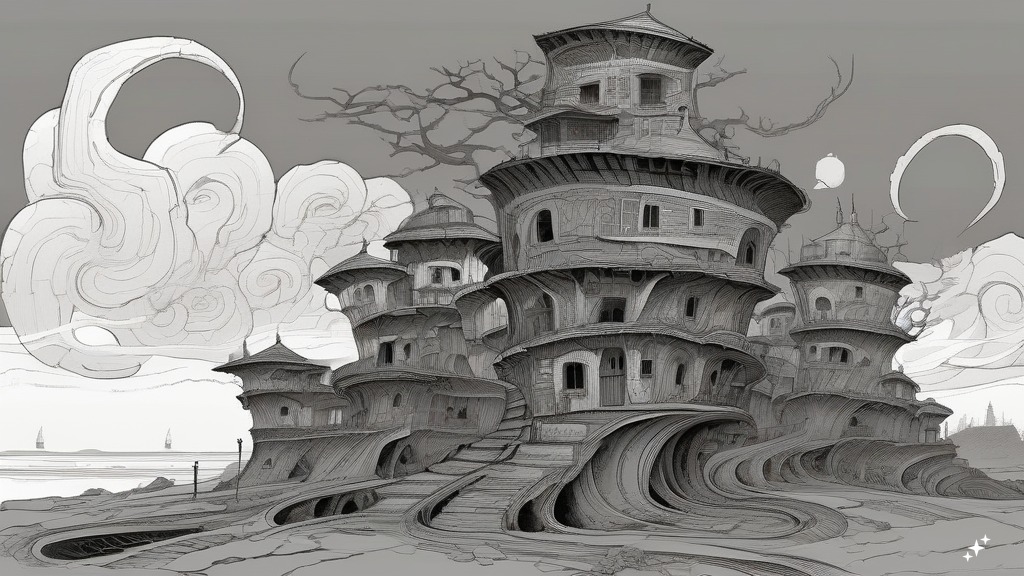
The spiral motif isn’t just in the plot — it’s embedded in the panel compositions, the way hair flows, the shape of clouds, the curve of a staircase. Once you start noticing, you see spirals everywhere in the artwork. Ito trains your eye to be paranoid about a shape.
The Horror Comes From Dread, Not Shock
Uzumaki is not a slasher. There’s no masked villain, no jump scares, no race against a killer. The horror is atmospheric and existential: a familiar, universal shape — the spiral — becomes a source of cosmic terror. You’ve seen spirals your whole life. Snail shells. Whirlpools. The inner ear. Fingerprints. Uzumaki makes you realize how inescapable that shape actually is, and then it asks: what if a spiral could think? What if it wanted something?
The body horror — meaning horror focused on disturbing transformations of the human body — in Uzumaki feels inevitable rather than gratuitous. Characters don’t get attacked — they get changed. The spiral doesn’t destroy from outside; it rewrites from within. That distinction is what elevates it from gross-out horror to genuine psychological dread.
The Structure Is Brilliant for New Readers
Each of Uzumaki’s 19 chapters works as a standalone horror short story. Chapter 3 is a complete, satisfying horror tale. So is Chapter 5. So is Chapter 10. You can read one chapter before bed (if you dare) and feel like you got a full experience.
But — and this is the clever part — the chapters also connect. Characters recur. The town’s situation worsens. Details from early chapters become significant later. By the final volume, the standalone episodes have accumulated into something much larger: a full apocalypse. It’s like a collection of separate horror stories that secretly shares a single plot.
This structure is perfect for beginners. You’re never lost, you’re never overwhelmed by continuity, and you always have a natural stopping point. But you won’t want to stop.
It Opened the Door for Horror Manga in English
Uzumaki was one of the first manga to prove that horror comics could succeed in English-speaking markets. VIZ Media’s early English release introduced Western readers to a style of horror they’d never encountered in American comics — slow-burn, art-driven, body-focused, and deeply weird. Its success helped make English translations of other horror manga possible and directly influenced Western horror comics that followed.
When people say “horror manga,” they often mean “manga that feels like Uzumaki.” It’s the reference point.
Chapter-by-Chapter Reading Guide (Spoiler-Free)
Uzumaki’s 19 chapters were originally published across 3 volumes. All of them — plus the bonus lost chapter “Galaxies” — are collected in the Deluxe Edition. Here’s what to expect from each section without spoiling the specifics.
Think of the series as three acts: infection, sickness, collapse.
Volume 1 — The Infection Begins (Chapters 1–6)
Volume 1 introduces Kurozu-cho as a normal town and then peels back that normalcy one chapter at a time.
- Chapters 1–2 (“The Spiral Obsession”) set up the core premise. A specific character becomes obsessed with spirals to a terrifying degree. These two chapters are the hook — if they grab you, the rest of the series will too.
- Chapters 3–6 explore individual cases of spiral infection: a mysterious scar that won’t stop growing, a potter’s kiln producing impossible work, two lovers whose bodies intertwine in ways that shouldn’t be possible, and hair that takes on a life of its own.
Kirie and Shuichi’s relationship is established as the emotional anchor. Shuichi grows increasingly desperate to leave town; Kirie isn’t ready to believe things are as bad as he says. That tension drives the first volume.
Tone: Creeping unease. The incidents still feel isolated. You can almost convince yourself each one is a coincidence. Almost.
Volume 2 — The Town Sickens (Chapters 7–12)
This is where Uzumaki shifts from individual horror to communal nightmare. The spiral curse stops picking off people one by one and starts infecting systems — nature, weather, infrastructure, social order.
- Chapter 7 turns a sudden accident into one of Ito’s most impossible corpse images — the chapter title, “Jack-in-the-Box,” says it all.
- Chapter 8 features one of the series’ most grotesque transformations. It involves classmates and a very slow change — you’ll know it when you see it.
- Chapters 9–11 bring the horror to the town’s environment: a lighthouse that warps light in impossible ways, a swarm of insects drawn to spiral patterns, and a deeply unsettling chapter about pregnancy and birth that is not for the squeamish.
- Chapter 12 begins the town’s isolation: a storm that spirals rather than passes — and seems to be hunting.
Kirie steps up as a more active protagonist here. She stops being an observer and starts trying to survive. Shuichi’s earlier warnings now look like understatements.
Tone: Escalating dread. The realization that this isn’t going to stop. The town is a closed system, and the spiral is inside it.
Volume 3 — The Spiral Consumes Everything (Chapters 13–19)
The final volume is full apocalypse. Society in Kurozu-cho has collapsed. The town itself is physically reshaping.
- Chapters 13–17 close the trap: houses twist and compress their inhabitants, escape routes fail one by one, and the geometry of the town itself becomes a maze.
- Chapter 18 plunges into darkness — literally. Light behaves differently, and the survivors are pushed underground.
- Chapter 19, “Completion,” reveals what’s been beneath Kurozu-cho all along. The source of the spiral curse is cosmic in scale, ancient beyond comprehension, and completely indifferent to human suffering. Think of horror in the tradition of H.P. Lovecraft — stories where the terror comes not from a villain but from realizing that the universe contains forces so vast and old that humanity is irrelevant to them. That’s where Uzumaki lands.
- Bonus: the Deluxe Edition also includes Galaxies, an unnumbered standalone “lost chapter.”
The ending is deliberately bleak. Some readers find it perfectly fitting — the only honest conclusion to a story about an unstoppable force. Others feel it’s abrupt. Either way, it stays with you. The final image is one of the most haunting panels in manga.
Tone: Apocalyptic. There is no fighting this. There is only witnessing.
How to Buy Uzumaki — Editions Explained
Good news: buying Uzumaki is simple. There’s really only one edition you need to consider.
The Recommended Edition
The Uzumaki 3-in-1 Deluxe Edition is the way to go. Published by VIZ Media as a single hardcover volume, it collects all 3 original volumes (all 19 chapters, plus the lost chapter “Galaxies”) in 648 pages. It was released on October 15, 2013, and has remained in print and widely available ever since.
Uzumaki (3-in-1 Deluxe Edition)
The Deluxe Edition features:
- Hardcover binding with a beautiful, sturdy design
- All 19 chapters plus the bonus lost chapter — the complete story in one book
- Original right-to-left reading orientation (Japanese reading direction preserved)
- Clean print quality that does justice to Ito’s detailed linework
This is the edition most readers own, most reviewers reference, and most stores carry. It’s also the best value — one book instead of three.
What About the Original Individual Volumes?
VIZ Media originally released Uzumaki as 3 separate paperback volumes in English. These are out of print and tend to be overpriced on the secondhand market. There’s no advantage to hunting them down unless you’re a collector. The Deluxe Edition has the same content in better packaging at a lower combined price.
Uzumaki is also available as a digital edition through platforms like Kindle, Apple Books, and other ebook stores — a good option if you prefer reading on a tablet or want instant access.
Reading Direction — A Quick Note for First-Time Manga Readers
If you’ve never read manga before: Uzumaki reads right-to-left. This means you open the book from what would be the “back” cover of an English novel — the spine will be on your right side. On each page, start reading from the top-right panel and move left, then drop down to the next row of panels and do the same. Speech bubbles within a panel also read right to left.
It feels odd for about five minutes, then it becomes completely natural. The Deluxe Edition includes a brief guide about this inside the front cover. Don’t worry about it — your brain adjusts faster than you’d expect.
Uzumaki Beyond the Manga — Anime and Film
If you’re wondering whether to watch the anime instead of reading the manga: read the manga. It’s the definitive version of the story. That said, here’s the honest breakdown on both adaptations.
The 2024 Anime (Adult Swim)
The long-awaited Uzumaki anime debuted on September 28, 2024, airing its four episodes weekly through October 19, 2024 on Cartoon Network’s Adult Swim late-night programming. It was produced by Adult Swim together with Production I.G USA.
Episode 1 was genuinely stunning. Animated in black and white to match Ito’s art style, it faithfully adapted the early chapters with care and craft. The animation community celebrated it. For a brief moment, it looked like Uzumaki had finally received the adaptation it deserved.
Episodes 2 through 4 told a different story. The animation quality dropped dramatically — a consequence of the production’s troubled, years-long development cycle. Characters were drawn inconsistently compared to their established designs, movement became stiff, and the atmospheric dread that Episode 1 captured so well largely evaporated. Reception was mixed to negative for the remaining episodes.
Verdict for newcomers: Episode 1 is worth watching as a companion piece after you’ve read the manga. It’s a gorgeous 22-minute love letter to Ito’s art. But the anime as a whole is not a substitute for reading Uzumaki. The manga remains the definitive way to experience the story.
The 2000 Live-Action Film
A live-action Uzumaki film was released in 2000, directed by Higuchinsky (Akihiro Higuchi). It’s a low-budget adaptation that covers material from the early chapters, reimagining the story with real actors and physical effects rather than CGI.
It’s an interesting curiosity — some of the spiral imagery translates to live action in fun, creepy ways — but it can’t replicate what makes the manga work. Ito’s horror lives in his drawings: the impossible detail, the way a body contorts across a still image that you can stare at for as long as you want (or can bear to). Film, by nature, moves on. The page doesn’t.
Worth a watch if you become a fan. Not where you should start.
Who Should Read Uzumaki (and Who Should Be Warned)
This Is Perfect For You If…
- You’re new to horror manga. Uzumaki is the single best entry point into the genre. Self-contained, one book, no prerequisites. If you only ever read one horror manga, this is the one. It’s the spiral into horror manga that hooks readers for life.
- You love cosmic horror. Cosmic horror is a style where the terror comes from ancient, incomprehensible forces that exist beyond human understanding — and don’t care about us at all. The spiral curse in Uzumaki is exactly that kind of threat. If you’ve read H.P. Lovecraft or enjoyed films where the horror is about how small and powerless humanity really is, you’ll feel right at home.
- You prefer atmosphere and dread over slasher violence. Uzumaki isn’t about a killer hunting victims. It’s about a shape that becomes inescapable. The horror is slow, creeping, and deeply psychological.
- You want something you can finish. 648 pages — most readers get through it over several evenings or a dedicated weekend. No 40-volume commitment, just one complete story at your own pace.
Content Warnings
Uzumaki earned its T+ (Older Teen / 16+) rating from VIZ Media, and honestly, the imagery pushes beyond what that rating might suggest to some readers. Here’s what to be aware of:
- Extreme body horror (graphic, disturbing transformations of the human body): Human bodies twist, contort, stretch, merge, and transform in detailed, unflinching artwork. This is the core of the horror. If body distortion deeply disturbs you, this manga will be challenging.
- Disturbing insect imagery: Chapters involving mosquitoes and snails are intensely unpleasant for readers with bug-related phobias.
- Suicide depiction: Present in early chapters, depicted graphically.
- Claustrophobic scenarios: Later chapters feature people trapped in confined, shrinking spaces.
- Pregnancy/birth horror: One chapter involves deeply disturbing body horror related to pregnancy. It’s one of the most upsetting chapters in the series.
None of this is gratuitous — it all serves the story’s escalation — but sensitive readers deserve a heads-up. This is not a casual, light read. It earns its place in the horror genre.
If Uzumaki Clicks, Read These Next
Loved Uzumaki and want to spiral further into horror manga? Here’s where to go from here:
- Tomie (Junji Ito) — Ito’s other masterwork. A beautiful girl who cannot die and drives everyone around her to obsession and murder. More character-focused than Uzumaki, equally disturbing.
- Gyo (Junji Ito) — Ito’s other major series. Sea creatures with mechanical legs invade land. Faster-paced and more visceral than Uzumaki, with a bizarre sci-fi edge.
- Junji Ito short story collections — If you loved Uzumaki’s chapter-by-chapter structure, Ito’s standalone short stories deliver the same quality in bite-sized doses. Collections like Lovesickness, Deserter, Alley, and Moan are all worth exploring — each contains several unrelated horror stories, so you can pick any one to start. (Stitches is a different kind of book: nine spook tales written by horror author Hirokatsu Kihara, with illustrations by Ito.)
- Dissolving Classroom (Junji Ito) — A shorter, more accessible Ito work focused on two deeply creepy siblings. Great for a quick read.
Beyond Ito, the wider world of horror manga awaits: Dorohedoro by Q Hayashida for surreal dark fantasy set in a grim, violent world; Blood on the Tracks by Shuzo Oshimi for slow-burn psychological horror centered on a toxic family relationship; or Homunculus by Hideo Yamamoto for reality-bending horror about a man who begins seeing people’s inner selves as physical deformities.
A note on Goodnight Punpun by Inio Asano — it’s often recommended alongside horror manga for its crushing emotional weight disguised as a coming-of-age story. It is brilliant, but be aware that it contains extremely graphic depictions of sexual violence, suicide, and abuse. It requires a very different kind of content warning than Uzumaki. Go in informed.
But start with Uzumaki. Grab the Deluxe Edition and see for yourself. Six hundred and forty-eight pages later, you’ll understand why every horror manga conversation eventually spirals back to this one.