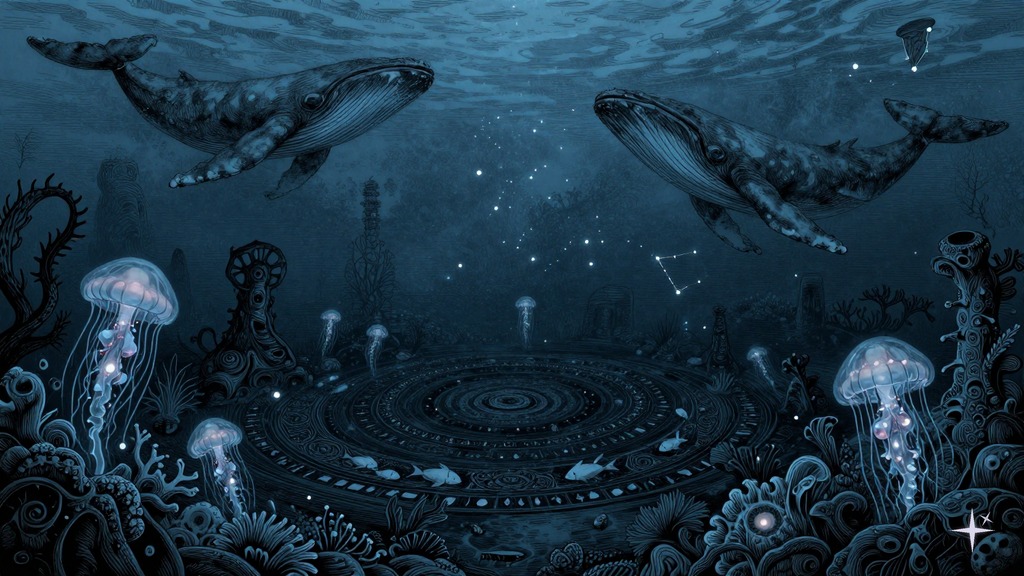
If you’ve stumbled across the breathtaking ocean imagery of Children of the Sea (海獣の子供) and you’re wondering how many volumes there are, here’s the short answer: Children of the Sea manga volumes total 5, and the series is complete. Below you’ll find what each volume covers, the reading order, where to buy, and whether this cosmic ocean manga is worth your time.
Let’s get into the details.
Children of the Sea Manga Volumes — All 5, Complete Series
Children of the Sea is a completed manga with 5 volumes total, both in the original Japanese edition and the English edition published by VIZ Media, the primary English-language publisher of Japanese manga in North America. The series contains 43 chapters spread across those five books.
The manga was written and illustrated by Daisuke Igarashi (五十嵐大介). It was originally serialized — meaning its chapters were published one at a time in a magazine before being collected into book form — in Monthly IKKI (月刊IKKI), a seinen (manga aimed at young adult men) publication from Shogakukan. The Japanese volumes were published between 2007 and 2012.
So if you’re planning a purchase, you’re looking at exactly five books to own the complete story from start to finish. No waiting for future volumes, no cliffhanger endings that never get resolved. The whole thing is done.
Here’s the quick overview:
| Detail | Info |
|---|---|
| English Title | Children of the Sea |
| Japanese Title | 海獣の子供 |
| Author/Artist | Daisuke Igarashi |
| English Publisher | VIZ Media |
| Total Volumes | 5 |
| Total Chapters | 43 |
| Status | Complete |
| Original Serialization | Monthly IKKI (2005–2011) |
Five volumes is a very manageable commitment. You could physically get through the entire series in a weekend — though as you’ll see below, this is the kind of manga that rewards slowing down and spending time with the art rather than racing to the finish.
What Each Volume Covers
Each volume of Children of the Sea builds on the last, escalating from a grounded summer story into something vast and cosmic. Cosmic horror, for the unfamiliar, is a style of horror built around the idea that the universe is ancient, vast, and fundamentally beyond human comprehension — less about jump scares, more about existential dread and awe. That’s the territory this manga moves into.
Here’s a spoiler-light breakdown of what to expect from each book.
Volume 1 — The Ocean Calls
The story begins with Ruka, a middle school girl having a rough summer. Suspended from her handball team and disconnected from her parents, she drifts toward the aquarium where her father works. There she meets two mysterious boys — Umi and Sora — who were raised by dugongs (large, gentle marine mammals related to manatees) in the ocean and seem to share a supernatural bond with marine life.
Volume 1 establishes the manga’s core elements: Ruka’s loneliness, the strange pull of the sea, and the first hints that something enormous and inexplicable is happening beneath the waves. Igarashi’s detailed illustrations of ocean life are immediately striking — this is a manga that makes you feel the weight and texture of water on every page.
Volume 2 — The Mystery Deepens
The supernatural elements intensify in Volume 2. Marine life around the world begins behaving in bizarre, unexplained ways. Scientists are baffled. The connection between the boys and the ocean grows more unsettling and more wondrous at the same time.
Igarashi pulls the camera back here, widening the scope from Ruka’s personal story to something global. You start to sense that Umi and Sora aren’t just unusual children — they’re connected to something ancient and vast. The unease builds steadily, and the art begins stretching toward the surreal imagery that defines the later volumes.
Volume 3 — Cosmic Escalation
By the third volume, the story has moved well beyond a coming-of-age tale — a story centered on a young person’s growth and transition toward adulthood. Cosmic and oceanic events intensify. Ruka is drawn deeper into the supernatural mystery surrounding the boys, and the manga’s artwork becomes increasingly abstract and surreal.
This is where readers who came in expecting a conventional narrative might feel the ground shifting under them. Igarashi’s storytelling becomes more visual and less verbal — entire sequences unfold through dense, intricate art rather than dialogue. The ocean itself feels alive, ancient, and aware.
Volume 4 — The Festival Begins
Volume 4 is where Children of the Sea hits its most intense and challenging stretch. A cosmic event referred to as “the festival” begins, and reality starts bending. The ocean’s deeper purpose — and its connection to all life — becomes clearer, but the telling is abstract, dreamlike, and often overwhelming in the best possible way.
Expect surreal artwork that spans two facing pages, cosmic imagery, and sequences that blur the boundary between disturbing physical transformation and transcendence. This volume demands patience and rewards close attention to every panel — each individual framed illustration on the page. The art here is some of the most ambitious you’ll find in any manga, period.
Volume 5 — The Climax and Resolution
The final volume brings the cosmic event to its peak and resolves the central mysteries about life, the ocean, and humanity’s connection to the universe. Without spoiling the specifics, the ending is contemplative rather than action-driven — it’s an experience closer to meditation than a traditional climax.
Volume 5 wraps up the series completely. There are no loose threads left dangling for a sequel. Whether the ending satisfies you will depend heavily on how comfortable you are with abstract, interpretive storytelling — but it’s undeniably a bold and memorable conclusion.
Reading Order and Where to Start
Good news: the reading order for Children of the Sea is completely straightforward.
Read Volume 1 through Volume 5 in order. That’s it.
There are no spin-offs, no prequels, no alternate versions of the story, and no side stories you need to track down. There are also no confirmed omnibus editions (multiple volumes bound into one thicker book) or deluxe editions — the series is available in standard single-volume format only.
A few things worth noting about the reading experience:
- Read slowly. This manga has some of the most intricate, detailed artwork you’ll encounter. Igarashi uses dense line work — layers of fine overlapping lines that create shading and texture — to render marine life and ocean environments with extraordinary depth. If you rush through, you’ll miss a huge part of what makes the series special.
- Don’t expect traditional pacing. Especially from Volume 3 onward, the story becomes more visual and abstract. Panels sometimes communicate through imagery and atmosphere rather than plot. That’s intentional — let the art wash over you.
- Re-reads are rewarding. Many readers report that a second read-through reveals details and connections they missed the first time. At only five volumes, this is easy to do.
If you’ve watched the 2019 anime film adaptation (also titled Children of the Sea, directed by Ayumu Watanabe) and are wondering whether to read the manga — the manga is the complete, uncompressed version of the story. The film covers the broad strokes, but Igarashi’s original art and pacing are a fundamentally different experience. The film is available through major anime streaming platforms if you want to check it out alongside the manga.
Where to Buy Children of the Sea Manga Volumes in English
All five volumes of Children of the Sea are published in English by VIZ Media and are available through major online retailers. Each volume is priced at a typical manga retail price — five volumes won’t break the bank, and the full set is a modest investment for a complete series.
Children of the Sea
A few practical tips for buying:
- Start with Volume 1. The ASIN link above may point to a specific volume in the series, but make sure you begin your reading with Volume 1 — that’s where Ruka’s story starts.
- Check multiple sellers. Availability for individual volumes can fluctuate, especially for older VIZ titles. If one retailer is out of stock on a particular volume, another may have it.
- Look for the full set. Since it’s only five volumes, some sellers offer all five together, which can simplify the buying process.
- No special editions to worry about. There’s only one English edition format — standard VIZ single volumes. You won’t accidentally buy the wrong version.
The series is complete and has been for years, so you won’t run into the frustration of waiting for future releases. Everything you need to read the full story is already published.
Is Children of the Sea Worth Reading?
Short answer: yes, with one important caveat about what kind of reader you are.
What Makes It Special
Children of the Sea is a visually stunning, one-of-a-kind manga that blends supernatural and cosmic horror with a deep sense of oceanic wonder. There really isn’t anything else quite like it.
Daisuke Igarashi’s artwork is the single biggest reason to read this series. His dense, intricate line work, his surreal full-spread illustrations of marine life, and his ability to make the ocean feel both beautiful and terrifying are extraordinary. Every page is packed with detail. The art alone elevates this manga into something rare and remarkable.
The story explores themes of human connection to the natural world, the vastness of the cosmos, and the mysteries of the ocean with a scope that feels genuinely cosmic. It’s contemplative manga — the kind that asks big questions about existence and lets the imagery do much of the answering.
At only 5 volumes and 43 chapters, it’s a compact and complete experience. There’s no unnecessary padding and no stretched-out storylines. Every volume pushes the story forward.
Who Might Find It Challenging
This is not a conventional horror manga with clear scares and a tidy plot. The storytelling — especially in the second half — is deliberately abstract. If you prefer manga with straightforward narratives, clear villain-versus-hero structures, or explicit explanations of what’s happening, Children of the Sea may test your patience.
That said, if you find yourself confused or disoriented while reading, that’s completely normal — many readers feel the same way on a first read. The manga is designed to be felt as much as understood, and a lot clicks into place on reflection or a second read-through. Don’t let the abstract quality scare you off before giving it a chance.
Who Will Love It
This manga is a fantastic pick if you enjoy:
- Cosmic horror — the ocean-as-unknowable-entity angle captures that sense of ancient, incomprehensible vastness without relying on the problematic elements found in some older cosmic horror fiction
- Art-forward manga — if you appreciate manga primarily for its visual artistry, this is a showcase
- Surreal storytelling — readers who enjoy interpretive, dreamlike narratives will feel right at home
- Complete short series — five volumes, done, no commitment anxiety
- Nature and the ocean — the depictions of marine life are gorgeous and detailed enough to appeal even outside the horror context
If any of those descriptions resonate with you, grab Volume 1 and see for yourself. At five volumes, the investment is small and the payoff is a manga experience you genuinely won’t find anywhere else.