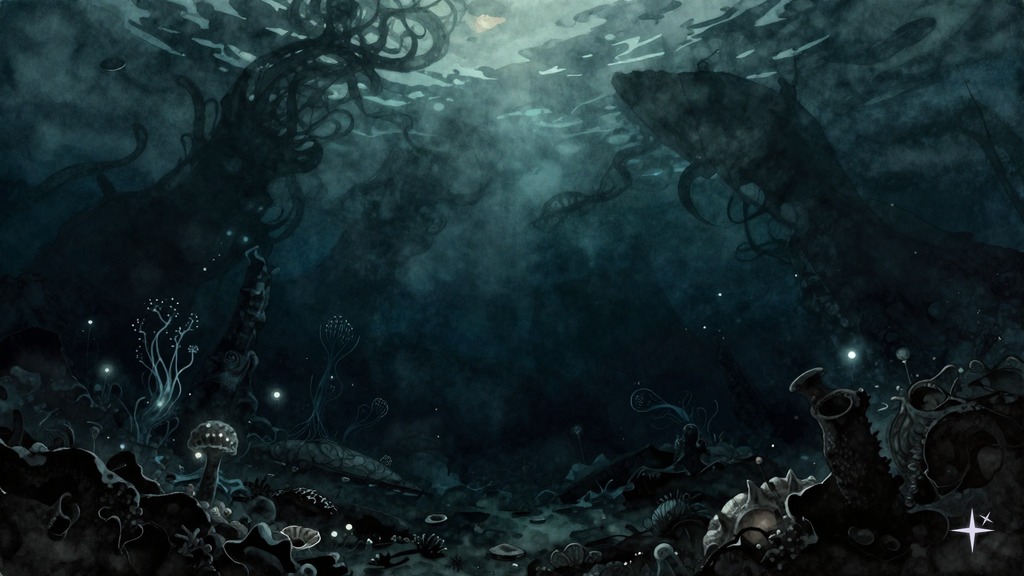
If you’re looking for the Children of the Sea manga reading order, the good news is that it’s straightforward. The series — a manga (Japanese comic) by Daisuke Igarashi — is complete at 5 volumes and 43 chapters. There are no spin-offs, no alternate timelines, no branching paths. You read Volume 1 through Volume 5, in order, and you’re done.
Children of the Sea is one of the most visually distinctive series in the horror and supernatural space. Igarashi’s art is dense and detailed, blending something close to scientific illustration with dreamlike abstraction — pages of ocean life that feel alive on the paper. The storytelling is atmospheric and deliberately paced, building from a grounded summer mystery into something vast and surreal. It’s a commitment to a specific kind of experience, and it rewards patience.
But if you’re here, you probably want more detail than just “read them in order” — what each volume covers, why sequence matters so much for this particular story, and where to actually get your hands on the books. Let’s get into it.
Children of the Sea Manga Reading Order: All 5 Volumes
This is the complete reading order. The series originally ran in Monthly IKKI, a manga magazine published by Shogakukan (a major Japanese publishing company), from December 2005 to September 2011. Each chapter was released individually in the magazine, then collected into bound volumes — 5 in total. VIZ Media, one of the largest English-language manga publishers, released all 5 volumes in English.
Here’s the full sequence:
- Volume 1 — Introduces Ruka, a middle schooler spending her summer near the ocean. She meets two mysterious boys, Umi and Sora, who were raised by dugongs — large, gentle marine mammals related to manatees — and seem to share a deep, inexplicable connection with the sea. The tone is grounded but eerie. Something is off beneath the surface, both literally and figuratively.
- Volume 2 — The supernatural elements begin to sharpen. Strange phenomena in the ocean accelerate, marine life behaves in impossible ways, and the bond between Ruka and the two boys deepens. Igarashi’s art starts pulling the reader further from solid ground.
- Volume 3 — The story’s scope expands dramatically. What started as a summer mystery becomes something much larger — questions about the ocean, about life itself, about forces that dwarf human understanding. The visual storytelling grows denser and more layered.
- Volume 4 — The narrative escalates into increasingly surreal and cosmic territory. The line between the physical and the metaphysical blurs. This is where readers who’ve been patient with the slow build start to see the full shape of what Igarashi has been constructing.
- Volume 5 — The conclusion. Everything converges in a finale that is equal parts beautiful, overwhelming, and deliberately ambiguous. The emotional and thematic threads from Volume 1 pay off here — but only if you’ve experienced the journey in sequence.
That’s the entire series. No side stories, no prequels, no companion volumes. Five books, one continuous story, start to finish.
The series totals 43 chapters across these 5 volumes, and the story is complete — Igarashi told the story he wanted to tell, and it has a definitive ending.
Why the Order Matters — How the Story Builds
With some manga, you can jump in at a later volume and piece things together. Children of the Sea is absolutely not that kind of series.
The narrative is layered and cumulative. The early volumes establish a very specific atmosphere — a seaside town in summer, the smell of salt water, the particular loneliness of a girl who doesn’t quite fit in. Igarashi takes his time grounding you in this world before he starts pulling the rug out. If you skip that grounding, the later surreal sequences won’t land the way they’re meant to.
The art itself builds in complexity. Igarashi’s drawing style in this series is extraordinary — dense, detailed, and increasingly abstract as the story progresses. He plants recurring visual patterns early on — the way water moves, the way light shifts through the ocean, images of marine life that reappear in transformed ways — that resurface and deepen in later volumes. Reading out of order means missing these connections entirely.
The supernatural elements intensify gradually. Volume 1 plays things relatively straight. By Volume 5, you’re in territory that feels genuinely alien — a sense that the universe is vast and indifferent and full of things beyond human comprehension. That escalation is the entire point. The story earns its stranger moments by building trust with the reader first. Jumping ahead to the “weird parts” without the foundation is like walking into the last twenty minutes of a film and wondering why everyone in the theater is crying.
The emotional core depends on early investment. Ruka’s journey — her relationship with Umi and Sora, her fractured family life, her growing awareness of something vast and unknowable in the ocean — is the thread that holds the entire series together. That thread starts in Chapter 1 of Volume 1. There is no shortcut.
This is one continuous, carefully structured story. Volume 1 is the only entry point.
Where to Start If You’re New to Daisuke Igarashi
If you’ve never read anything by Daisuke Igarashi before, Children of the Sea is a great place to start — but it’s also a commitment to a very specific kind of storytelling. Here’s how to approach it.
Test the Waters with Volume 1
Volume 1 works well as a standalone test. It introduces the protagonist Ruka, the enigmatic boys Umi and Sora, and the ocean-as-something-alive atmosphere that defines the entire series. By the end of Volume 1, you’ll know whether Igarashi’s style clicks with you.
What to pay attention to: the art. Igarashi’s linework has an almost hand-painted quality — detailed and layered in a way that’s rare in manga. Panels of ocean life feel like scientific illustration crossed with dreamlike abstraction. If that visual density excites you, you’re in the right place. If it feels overwhelming or inaccessible, the series only gets more visually intense from here.
The Commit Decision
If Volume 1 hooks you — if the slow-burn mystery, the unsettling beauty of the ocean sequences, and the feeling that something enormous is lurking just out of frame pull you in — the remaining 4 volumes will deliver on that promise. The story doesn’t plateau or lose its way. It builds.
If Volume 1 leaves you cold, that’s a fair signal. The pacing stays deliberate throughout, and Igarashi’s storytelling becomes more abstract, not less. This isn’t a series that suddenly shifts gears into action or conventional plot resolution.
Who This Series Is For
Children of the Sea will resonate most with readers who enjoy:
- Cosmic horror — a subgenre built not on jump scares or gore, but on the creeping realization that the universe is vast and indifferent and full of things humans cannot comprehend. Think existential dread rather than monsters.
- Surreal, nature-driven storytelling — the ocean here is not a backdrop, it’s practically a character
- Atmospheric dread — the tension comes from mood and mystery, not from violence
- Visually ambitious manga — if you appreciate manga as an art form and want pages you’ll stare at for minutes, this delivers
You don’t need to have read any of Daisuke Igarashi’s other works before starting this series. Children of the Sea is entirely standalone.
Where to Buy Children of the Sea in English
All 5 volumes were published in English by VIZ Media. The series is complete, so you can read the whole thing without waiting for future releases.
Format
The English edition was released as individual volumes — 5 standard-size paperbacks. As of this writing, there are no omnibus editions (multiple volumes collected into one larger book) or deluxe editions for the English release.
Availability
Because the series finished its English run several years ago, individual volumes may vary in availability. Some volumes occasionally go in and out of stock between print runs, and prices on the secondhand market can fluctuate. If you find all five volumes available at once, it’s worth picking them up rather than waiting.
Volume 5 — the series finale — is available through major retailers. This is where Igarashi’s story reaches its breathtaking, surreal conclusion, and it’s the volume you’ll be most eager to get your hands on once you’ve read the first four.
Children of the Sea
For the complete set, check major online retailers and your local bookstores. Because VIZ is one of the largest English-language manga publishers, restocks do happen — but older titles aren’t guaranteed to stay in print indefinitely.
Other Places to Look
- Local libraries — A 5-volume completed series is exactly the kind of thing libraries stock. Check your local library system’s catalog before buying.
- Used booksellers — Because the series is complete and has a dedicated following, used copies circulate regularly through secondhand bookshops and online resellers.
- Digital — Check whether digital editions are available through your preferred manga platform if you want instant access.
Since this is a series you’ll likely want to revisit — the art rewards re-reading, and the later volumes genuinely reveal new details on a second pass — physical copies are worth considering if that matters to you.
Frequently Asked Questions
Is Children of the Sea a horror manga?
Yes, though it defies easy genre classification. It’s best described as supernatural and cosmic horror blended with literary fiction and nature writing. The horror isn’t about monsters jumping out at you — it’s about the ocean as an incomprehensibly vast and alien environment, and about humans confronting forces that dwarf their understanding. There’s psychological and existential unease throughout, and the mood grows increasingly unsettling as the story progresses. If you’re coming from more conventional horror manga, expect something quieter, stranger, and more contemplative.
How many volumes of Children of the Sea are there?
The series is 5 volumes total, containing 43 chapters. It is fully complete — the story has a definitive ending. It was originally published chapter-by-chapter in Monthly IKKI magazine from December 2005 to September 2011, then collected into the 5 volumes that are available today.
Is there an anime adaptation?
Yes. A feature-length animated film adaptation of Children of the Sea was released in 2019, produced by Studio 4°C. The film covers the manga’s story in a single movie. The animation is visually striking, but the manga contains significantly more detail, nuance, and narrative depth. If you’re choosing between the two, read the manga first. The film works best as a companion piece after you’ve experienced the full story on the page.
Do I need to read Daisuke Igarashi’s other works first?
No. Children of the Sea is completely standalone. You don’t need any prior familiarity with Igarashi’s work to understand or appreciate it. That said, if you finish the series and want more of his art and storytelling, he has other works worth exploring — but none of them are prerequisites for this one.
Is Children of the Sea appropriate for younger readers?
Despite featuring young protagonists, Children of the Sea deals with mature and complex themes — existential dread, the indifference of nature, loss, and transformation. The art, while beautiful, includes imagery that can be unsettling and disorienting, particularly in later volumes where the visuals become increasingly abstract and intense. There’s no explicit gore or sexual content, but the emotional and philosophical weight of the story is aimed at older teens and adults. Some of the imagery could be genuinely disturbing for sensitive readers.