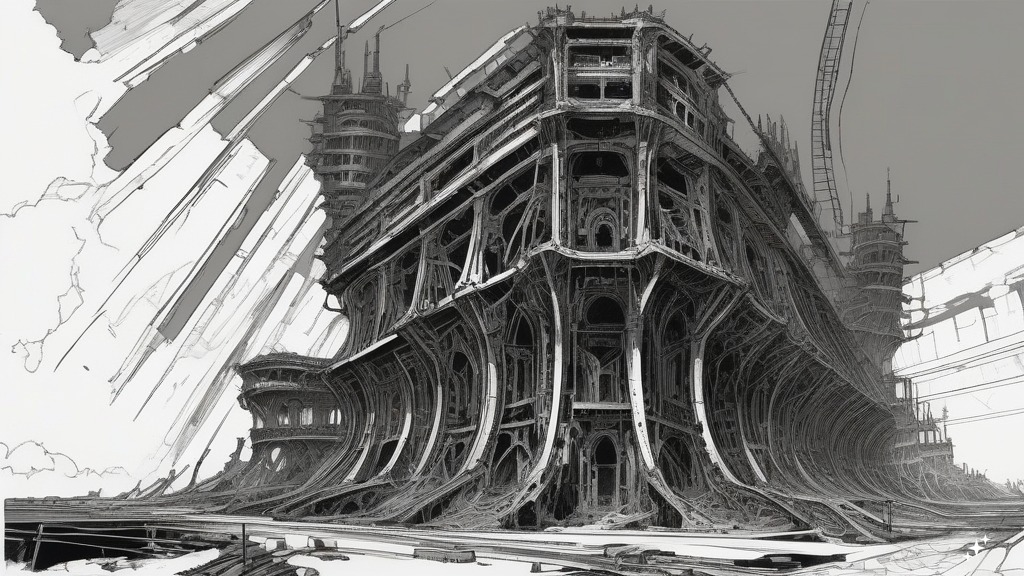
Every Tsutomu Nihei Manga, Ranked (Plus a Deep Dive on Blame!)
Every Tsutomu Nihei manga ranked, from the silent megastructure horror of Blame! to his newest ongoing series. Nihei is the architect-turned-manga artist behind some of the most visually striking science fiction manga ever put to paper. His catalog is small — nine titles across nearly three decades — but fiercely consistent. Every series shares the same DNA: impossible scale, biomechanical horror (think bodies fusing with machines), and a silence that makes your skin crawl.
Important: this list is ranked by quality, not by recommended reading order. Nihei’s titles are standalone — you can start anywhere. If you want a personalized reading path, jump to the “Where to Start” section below.
Here’s the full ranked list:
- 1. Blame! — The magnum opus. Ten volumes of silent megastructure horror that redefined what manga panels could do.
- 2. Knights of Sidonia — Nihei at his most accessible. Giant robot warfare, alien biology, and actual dialogue.
- 3. Biomega — A motorcycle, a gun that builds itself, and a zombie apocalypse that goes planetary.
- 4. Aposimz — Nihei’s most polished artwork wrapped around a slow-burn body horror mystery.
- 5. NOiSE — A one-volume prequel to Blame! that shows the City before it ate the sky.
- 6. Abara — Two volumes of beautiful chaos. Visually incredible, structurally unhinged.
- 7. Wolverine: Snikt! — Wolverine dropped into a Nihei dystopia. A fun curiosity.
- 8. Kaina of the Great Snow Sea — High fantasy instead of cyberpunk, with a softer touch from co-artist Itoe Takemoto.
- 9. Tower Dungeon — Ongoing since 2023. Too early to place definitively, but the early volumes are promising.
The Blame! deep dive starts in section three. If you already know the rest of Nihei’s work and just want to go deep on the megastructure, skip ahead.
All Tsutomu Nihei Manga, Ranked and Reviewed
#1 — Blame!
10 volumes (original) / 6 volumes (Master Edition) — 1997 to 2003
Blame! is the work that everything else in Nihei’s catalog grows from. A silent gunman named Killy walks through an infinite, self-replicating City, searching for humans who carry the Net Terminal Genes — the only thing that might stop the City’s runaway expansion. That’s the entire premise. There’s almost no dialogue for chapters at a time. The storytelling happens through architecture, through spaces so vast that characters become specks, through beam-weapon impacts that carve through entire districts.
It’s not easy reading. The plot moves by inference. Characters appear and vanish. But that difficulty is the point. Blame! puts you inside a world that has completely outgrown the people who built it, and it makes you feel that smallness on every page.
The Master Edition from Kodansha collects the series in six oversized hardcover volumes. The larger format is a genuine improvement — Nihei’s double-page spreads were drawn for this kind of presentation. The original Tokyopop 10-volume English edition is out of print and commands collector prices. The Master Edition is the version to get.
Who it’s for: Anyone who wants manga that feels more like wandering through a nightmare cathedral than reading a story. If you like atmosphere over plot, this is the peak.
BLAME! 1 (Master Edition)
#2 — Knights of Sidonia
15 volumes — 2009 to 2015
Knights of Sidonia is where most people should start with Nihei. It has everything that makes his work distinctive — biomechanical design, alien threats that feel genuinely alien, a deep sense of cosmic vulnerability — but wrapped in a structure that actually explains itself. There are characters with names and motivations. There’s dialogue. There’s a plot you can follow without looking things up as you go.
The setup: humanity survives on massive seed ships after Earth’s destruction. The Sidonia is one such ship, and its population fights an ongoing war against the Gauna, shape-shifting alien organisms that absorb and replicate human forms. Nagate Tanikaze, raised in isolation deep in the ship’s underground, emerges to become a giant robot pilot and gets pulled into the war.
What makes Sidonia special isn’t the robot combat, though Nihei draws that beautifully. It’s the world-building. The ship’s society has engineered itself — photosynthesis for food, a third gender, cloning as standard reproduction. Nihei treats these details as background texture rather than plot points, which makes the world feel lived-in.
The series is complete at 15 volumes. It also spawned a two-season anime by Polygon Pictures (2014–2015) and a concluding film, Knights of Sidonia: Love Woven in the Stars (2021). Kodansha USA offers both the original paperbacks and a Master Edition hardcover reissue.
Who it’s for: People who want a complete, satisfying sci-fi manga with strong character development and alien warfare. Also the best on-ramp to Nihei’s stranger, more experimental work.
Knights of Sidonia Master Edition 1
#3 — Biomega
6 volumes — English release by Viz Media, 2010 to 2011
Biomega is what happens when Nihei takes the Blame! formula and injects it with adrenaline. Zoichi Kanoe rides a motorcycle through a world being consumed by a zombie-like virus. He carries a gun that synthesizes itself from surrounding matter. And the whole thing escalates from street-level zombie survival to a planetary-scale confrontation with a bioweapon that wants to reshape the Earth.
Six volumes, no filler, constant forward momentum. Where Blame! lets silence stretch across whole chapters, Biomega fills those gaps with motorcycle chases, building-scale firefights, and body horror — disturbing scenes of human forms twisting into something unrecognizable — that rank among Nihei’s most grotesque. It’s his most kinetic work.
Viz Media released the complete series in six paperback volumes, reliably in print.
Who it’s for: Action-first readers who want Nihei’s visual style without the slow-burn pacing. Also anyone who thinks “motorcycle versus zombie apocalypse” sounds like a good time.
Biomega Vol.1
#4 — Aposimz
9 volumes — 2017 to 2021
Aposimz is Nihei’s most technically refined manga. The linework is cleaner than anything he’d done before. The panel layouts are more deliberate. The character designs are sharper. It’s the work of an artist with twenty years of experience and complete control of his tools.
The story takes place on the artificial planet Aposimz. On the surface, people survive in brutal cold. Below, an empire expands its control using a substance that can transform humans into biomechanical beings — or, if the process goes wrong, mindless creatures. Etherow, a young man from a surface settlement, gets caught up in the conflict after gaining the ability to transform himself.
The concept gives Nihei a new angle on his favorite theme: bodies becoming architecture, flesh becoming machine. It’s handled with more narrative clarity than Blame! — you always know what’s happening and why — but the mystery of Aposimz’s true nature keeps you turning pages across all nine volumes.
Available in nine paperback volumes from Kodansha. If you want a finished modern Nihei series with his best artwork, this is the cleanest buy in his catalog.
Who it’s for: Readers who want Nihei’s themes and visual style but with a more conventional narrative structure. Also a great pick if you want to see his art at its most polished.
APOSIMZ 1
#5 — NOiSE
1 volume — 2000 to 2001
NOiSE is a single-volume prequel to Blame! set in a period when the City was still recognizable as a human creation — before the construction systems went haywire, before the defense network turned lethal, before the megastructure swallowed everything. It follows a detective investigating murders connected to a religious group entangled with the City’s nascent control systems.
At one volume, it’s necessarily slight. What NOiSE does best is provide context. Read before Blame!, it’s a moody sci-fi mystery that doesn’t fully pay off. Read after Blame!, it’s haunting — you know exactly what’s coming, and every moment of normalcy is loaded with dread.
Who it’s for: Blame! fans who want more context on the City’s origins. Not a standalone recommendation, but a companion piece.
NOiSE
#6 — Abara
2 volumes (original) / 1 volume (Viz Complete Deluxe Edition) — 2005 to 2006
Abara is Nihei at his most unrestrained. Two volumes of biomechanical body horror and urban destruction. The premise involves creatures that share a clear design lineage with Knights of Sidonia’s Gauna, and humans who can transform into black, armored beings to fight them. The city gets torn apart. Bodies twist into architectural nightmares.
Structurally, it’s the weakest entry in Nihei’s catalog — the plot is hard to follow, not in the deliberate way that Blame!’s silence works, but in the “this might not have been fully planned out” way. But visually? Some of Nihei’s most dynamic page compositions live in these two volumes.
The Viz Complete Deluxe Edition collects both volumes in a single hardcover. One book, one sitting, pure visual spectacle.
Who it’s for: Nihei completionists and anyone who reads manga primarily for the artwork.
Abara: Complete Deluxe Edition
#7 — Wolverine: Snikt!
5 issues — Marvel Comics, 2003; Viz Deluxe Edition 2023
A five-issue Marvel limited series where Nihei takes Wolverine and drops him into a dystopian future that looks exactly like his own manga. The landscape is a ruined biomechanical wasteland. The enemies are towering, insectoid creatures. As a Wolverine story, it’s thin — Logan gets transported to the future, fights monsters, and goes home. As a Nihei showcase, it’s more interesting — you get to see his aesthetic applied to an existing property.
Who it’s for: Nihei completionists and Wolverine fans who want to see Logan filtered through a sci-fi horror lens.
#8 — Kaina of the Great Snow Sea
4 volumes — Story by Tsutomu Nihei, art by Itoe Takemoto — 2022 to 2024
Kaina is the odd one out. Nihei created the story and world, but the art is by Itoe Takemoto, and that changes everything. The linework is softer. The character designs are rounder. The tone leans toward high fantasy adventure rather than sci-fi horror. The setting is a frozen world where humanity survives in the canopy of enormous trees, and the story follows a boy and a princess drawn into a conflict over dwindling water resources.
An anime adaptation by Polygon Pictures aired in 2023.
Who it’s for: Readers who like Nihei’s world-building concepts but want something gentler and more traditionally structured.
#9 — Tower Dungeon
Ongoing since October 2023; 6 Japanese volumes as of March 2026; first English volume from Kodansha USA released July 2025
Tower Dungeon is too early to rank definitively, but Nihei is back to working solo, and the early volumes feel like a return to what he does best. The setting is a massive vertical structure — familiar territory — and the story follows characters navigating its levels. Six volumes in Japan and one English volume available so far.
Who it’s for: Existing fans who want to follow Nihei’s current work as it develops.
Blame! Deep Dive: The Megastructure, Killy, and the Net Terminal Genes
Blame! deserves more than a ranking blurb. It’s the foundation of Nihei’s entire body of work and one of the most singular manga ever created.
The Premise
Killy is a lone figure walking through the City — an incomprehensibly vast megastructure that has been expanding without limit. The City was built by autonomous construction systems called Builders, originally under human control through a network called the Netsphere. Access required a specific genetic marker: the Net Terminal Genes. When those genes were lost, the Builders had no authorized users to give them new instructions — so they just kept building. Forever. The City may have consumed the solar system.
Killy’s mission: find a human who still carries the Net Terminal Genes. He walks. He searches. He encounters scattered human settlements clinging to existence inside a structure that doesn’t know they’re there, and he encounters the Safeguard — an automated defense system that now treats all humans without the genes as intruders to be exterminated. His weapon, the Gravitational Beam Emitter, can punch holes through entire levels of the City.
Why It Became a Cult Classic
Almost no dialogue. Nihei lets entire chapters go by without a word. The storytelling is architectural — you understand the world through the spaces Killy moves through: corridors that stretch to vanishing points, chambers so large they have their own weather.
Nihei’s background matters here. Before manga, he worked at an architecture firm and studied architecture and design (Parsons School of Design). When he draws a space, he draws it with a sense of weight and material and the logic of construction. The City doesn’t look like a sci-fi set — it looks like something actually built, layer upon layer, over geological time. The horror comes from realizing the building process never stopped.
The influence shows up across media. Fans of FromSoftware’s Dark Souls and Elden Ring games see its DNA in those vertical, interconnected worlds. The NieR series shares its themes of automated systems outliving their purpose. In manga, the subgenre of architectural sci-fi horror traces back to what Nihei did here.
Volume Guide (Master Edition 1–6)
Each Master Edition volume compiles roughly two and a half of the original ten volumes. Light spoilers — enough to help you navigate, not enough to ruin the experience.
Master Edition 1: Killy enters the City. He meets Cibo, a scientist who becomes his most important companion. The rules establish themselves: the Safeguard kills unauthorized humans, the Builders keep building, and Killy’s weapon can carve through entire districts. If the nearly wordless storytelling and overwhelming scale grab you here, you’re in for the whole ride.
Master Edition 2: Cibo’s transformation begins — her attempts to interface with the City’s systems change her in increasingly dramatic ways. The Safeguard reveals itself as a layered defense system with different levels of response. Nihei introduces communities of survivors, and each encounter is brief, tense, and usually ends in loss.
Master Edition 3: The megastructure’s vertical scale becomes the antagonist. Extended chase sequences play out across levels that take pages to traverse. Nihei draws environments that genuinely disorient the reader. This is where many readers either fall in love with Blame! or give up.
Master Edition 4: The closest Blame! gets to conventional storytelling. Killy and Cibo spend an extended stretch with a community, and the relationships that develop give the series its most emotionally grounded moments — a deliberate contrast that makes what comes next hit harder.
Master Edition 5: The Silicon Life — beings who abandoned organic existence entirely and want to ensure the Net Terminal Genes are never recovered — escalate the conflict. The Toha Heavy Industries chapters introduce one of the series’ most memorable settings and push toward the conclusion. The violence intensifies. The stakes become personal.
Master Edition 6: The finale. A significant time skip recontextualizes everything. The ending is deliberately ambiguous — not in a lazy way, but consistent with the series’ commitment to showing rather than explaining. It’s meant to be argued about.
If you only have time for one volume: Master Edition 1. If that doesn’t grab you, the series won’t either, and that’s completely fine.
Tone and Content Notes
Blame! contains extreme violence and body horror — disturbing transformations and destruction of human bodies that are explicitly depicted. Long stretches of silence between the violence can be more unsettling than the violence itself.
If you’re sensitive to body horror or find long periods without dialogue frustrating, Knights of Sidonia covers many of the same themes in a more accessible package. Come back to Blame! after that.
Where to Start with Nihei (By Reader Type)
Not everyone should start with Blame!. Here’s a guide based on where you’re coming from.
New to manga in general: Start with Knights of Sidonia. It reads the way you’d expect — characters who talk, a plot that explains itself, clear visual storytelling. It’s the best introduction to both Nihei and his broader themes without requiring you to already know how manga works.
Coming from Western sci-fi (Dune, the Alien franchise, Annihilation): Go straight to Blame! Master Edition Volume 1. You already have the tolerance for slow-burn, atmospheric world-building where the environment is the story. You’ll either love it immediately or know within thirty pages.
You loved the Blame! anime film (Netflix, 2017): The film adapts a small slice of the manga. Master Edition Volumes 1 through 3 cover that ground and vastly more. Start at Volume 1 for the intended experience.
You want one self-contained taste: Grab the Abara: Complete Deluxe Edition. One hardcover book, two original volumes. You can read it in a sitting. Not Nihei’s best-written work, but visually spectacular.
You want Nihei’s most refined art: Aposimz Volume 1. His cleanest linework, his most controlled compositions, his most deliberate pacing.
Completionist path: NOiSE → Blame! → Biomega → Abara → Knights of Sidonia → Aposimz → Kaina → Tower Dungeon. This is roughly chronological by release and lets you watch Nihei’s art evolve. Be warned: NOiSE and Blame! back-to-back is a lot of silence. If you’d rather ease in, swap Knights of Sidonia to the front — it’ll give you a foundation in Nihei’s visual language before you tackle the challenging stuff.
What to Buy: Editions and Recommendations
Blame! Master Edition 1–6 (Kodansha, oversized hardcover): The definitive English edition. The larger format does justice to Nihei’s double-page spreads. The out-of-print Tokyopop 10-volume edition commands collector prices — the Master Edition is better in every way.
Knights of Sidonia (Kodansha USA): Available in both the original 15-volume paperback run and a newer Master Edition hardcover reissue. Both are good; the Master Edition is the nicer package.
Biomega Vol. 1–6 (Viz Media, paperback): The complete run. No deluxe edition exists.
Aposimz 1–9 (Kodansha, paperback): Nine volumes, complete. The cleanest full-series buy in his catalog.
Abara: Complete Deluxe Edition (Viz, single hardcover): Best-value single purchase — one book, one story, done.
Most of Nihei’s catalog is also available digitally if you prefer to start reading immediately rather than waiting for a physical copy.
First Three Books on a $60 Budget
- Blame! Master Edition Volume 1 — The foundation.
- Knights of Sidonia Master Edition Volume 1 — His most accessible work.
- Abara: Complete Deluxe Edition — A complete story in one book.
Three distinct entry points, all in hardcover, for right around sixty dollars.
FAQ
Do I need to read Nihei’s manga in a specific order?
No. Each series is standalone — there are no shared characters, timelines, or plot connections between them. The only direct narrative link is between NOiSE and Blame! (NOiSE is a Blame! prequel). Start with whichever title matches your taste from the “Where to Start” section above.
Has Blame! ended?
Yes. Blame! completed in 2003 and has a definitive ending. All six Master Edition volumes are available. It’s a finished work.
Is the Netflix Blame! movie a good substitute for the manga?
No. The 2017 film adapts only a small slice of the manga’s scope. If you liked the aesthetic, the manga delivers that at a hundred times the depth and scale.
Is Knights of Sidonia connected to Blame! or Biomega?
Thematically, yes — all three share Nihei’s visual language and interest in humanity surviving inside systems that have outgrown them. Narratively, no. Separate stories, no shared continuity.
Will there be more Knights of Sidonia?
The manga is finished at 15 volumes. The anime concluded with the 2021 film. No continuation has been announced.
Is Tower Dungeon a return to form?
It’s early — six Japanese volumes as of March 2026, first English volume released July 2025. But Nihei is working solo again, the setting plays to his strengths, and the early chapters feel like vintage Nihei with more refined art. Worth following, too soon to rank alongside completed works.