What Is Dragon Head About?
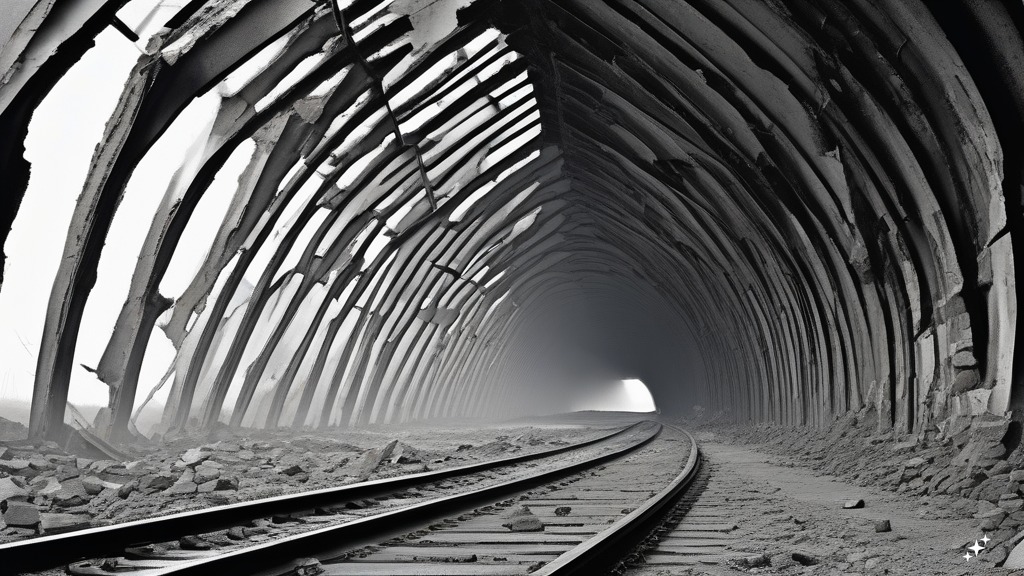
High schooler Teru Aoki wakes up in the wreckage of a bullet train (Japan’s high-speed rail network) that has crashed inside a tunnel. Almost every passenger is dead. The tunnel is sealed at both ends by cave-ins. There’s no light, no rescue, and no communication with the outside world.
Teru finds two other survivors: Ako Seto, a classmate, and Nobuo Takahashi, whose psychological state begins deteriorating rapidly in the darkness. What follows is a desperate fight to escape the tunnel — and then, once they do, a journey across a Japan that has been utterly transformed by an unexplained catastrophe.
The sky is black with ash. The land is scorched. Society has collapsed. And nobody knows what happened.
Dragon Head never gives you a neat explanation. It’s not that kind of story. It’s about what happens to people — ordinary, frightened, breakable people — when the world ends and there are no answers.
What Makes This Dragon Head Manga Review-Worthy? The Horror
Dragon Head doesn’t rely on monsters, ghosts, or supernatural threats. The horror here is almost entirely psychological — meaning it works through atmosphere, tension, and the characters’ mental states rather than through creatures or jump scares. And it works because Mochizuki understands something fundamental: the scariest thing in a disaster isn’t the disaster itself. It’s the not knowing.
The tension is relentless. In the tunnel sections, Mochizuki keeps you in near-total darkness alongside the characters. You can’t see what’s around the next corner. You don’t know if the ceiling is about to give way. Every sound could be rescue or further collapse. The manga forces you to sit in that uncertainty page after page, and it’s genuinely agonizing.
The human threats are worse than the environmental ones. Nobuo’s descent into madness in the tunnel is horrifying not because it’s exaggerated, but because it feels plausible. A scared teenager, trapped in the dark with corpses, with no hope of rescue — of course that breaks someone. Later, as Teru and Ako travel through the ruined landscape, the survivors they encounter are often more dangerous than the wasteland itself. Cults, power-hungry remnants of authority, people who have simply stopped caring about others — Mochizuki shows how quickly the rules and norms that hold society together can dissolve.
The body horror is grounded. There are graphic depictions of injury and death throughout Dragon Head, but they never feel gratuitous. Mochizuki draws wounds, burns, and physical deterioration with clinical realism. It hurts to look at because it looks real, not because it’s exaggerated for shock value.
Silence is a weapon. Some of the most effective sequences in Dragon Head contain no dialogue at all. Just panels — the individual framed images that make up a manga page — showing darkness, rubble, ash, and a character’s face registering what they’re seeing. Mochizuki trusts the reader to feel the dread without being told to feel it.
The Three Story Arcs — How the Story Evolves
Dragon Head divides naturally into three parts (often called “arcs” — distinct segments of a longer story, each with its own focus), each with a distinct tone and setting. Understanding this structure helps set expectations, because the manga you’re reading in volume 1 is very different from the one you’ll be reading in volume 9.
Part 1 — The Tunnel (Volumes 1–3)
This is the section that hooks most readers, and it’s where Dragon Head is at its most focused and consistently terrifying.
Teru, Ako, and Nobuo are trapped in the collapsed tunnel with no way out. The darkness is almost total. They scavenge supplies from the wrecked train, navigate flooded passages, and try to find an exit — all while Nobuo becomes increasingly unstable and dangerous.
The claustrophobia here is extraordinary. Mochizuki shrinks his panels, fills them with black ink, and gives you just enough visual information to understand how tight and hopeless the space is. You feel the weight of the rock above. You feel the air getting thinner.
This section works as a near-perfect survival horror story. If someone asks you what Dragon Head is “like,” this is the part you’ll describe first.
Part 2 — The Road (Volumes 4–7)
Teru and Ako escape the tunnel and discover that the world outside has been devastated. The sky is choked with ash. The landscape is scorched and barren. Civilization has effectively ended.
The tone shifts from claustrophobia to a different kind of dread — the open, empty, overwhelming dread of a world that’s simply… gone. Mochizuki swaps cramped tunnel panels for vast, desolate landscapes that are beautiful in a terrible way.
As Teru and Ako travel toward Tokyo, they encounter other survivors: a cult that has formed around a charismatic leader, remnants of military forces trying to maintain control, and desperate civilians who have resorted to violence. Each encounter expands the story’s scope from personal survival to a broader examination of how society responds to total collapse.
The pacing here is deliberately slower than the tunnel arc. Some readers find this section the most compelling because of its worldbuilding; others feel the momentum dips. Both reactions are valid.
Part 3 — Tokyo (Volumes 8–10)
Teru and Ako finally reach Tokyo, searching for Teru’s parents and hoping to find answers about what caused the catastrophe.
What they find is a ruined city and the remnants of a government response that failed. The themes escalate — mass psychology, the limits of human resilience, the question of whether hope itself is rational when everything you know has been destroyed.
This final section is the most ambitious and also the most divisive, largely because of how the manga chooses to end. More on that below.
Art Style — Why the Visuals Hit So Hard
Minetarō Mochizuki’s art is the engine that drives Dragon Head’s horror. Without these visuals, the story would still be compelling. With them, it’s unforgettable.
The atmosphere is oppressive. Mochizuki uses heavy shading techniques — layered tones and deep ink-wash blacks — to create a sense of weight and darkness that presses down on every page. The tunnel sections are genuinely dark — not stylistically dark, but visually starved of light in a way that makes reading them feel physically uncomfortable.
The character designs are realistic. There’s no exaggerated stylization here — no oversized eyes, no cute character quirks baked into the designs. Teru, Ako, and the people they meet look like ordinary people. This matters enormously, because it grounds the horror in reality. When these characters are hurt, scared, or exhausted, you believe it because they look like someone you might know.
The environments are the real star. Mochizuki draws rubble, ash clouds, cracked highways, and collapsed infrastructure with obsessive, almost architectural detail. The ruined Japan of Dragon Head is one of the most convincingly rendered apocalyptic settings in any manga. You can practically feel the grit of the ash between your teeth.
The contrast is masterful. The shift from the cramped, dark tunnel panels of Part 1 to the vast, empty landscapes of Part 2 is visually stunning and emotionally disorienting — which is exactly the point. Teru and Ako go from being crushed by confined space to being crushed by limitless, empty space. Mochizuki uses the layout of the page itself — how panels are sized, spaced, and arranged — to create that shift.
Silent sequences do the heaviest lifting. Some of the manga’s most powerful moments are wordless — just a character staring at a horizon of ash, or walking through a destroyed city street. Mochizuki trusts his art to communicate what dialogue can’t, and the result is a reading experience that feels more like watching a film than reading a traditional comic.
The Ending — Honest Take (Light Spoilers)
Let’s address this directly, because Dragon Head’s ending is its most polarizing element and something worth knowing about before you commit to 10 volumes.
Dragon Head deliberately withholds a tidy scientific explanation for the catastrophe. You will not get a definitive answer about what destroyed Japan. There are hints, theories within the story, and pieces of information scattered throughout — but the manga never sits you down and says “here’s what happened.”
Some readers feel cheated by this. After 10 volumes of survival and struggle, the lack of a clear “reveal” can feel like an incomplete story. That’s a legitimate reaction, and if you know you’re the kind of reader who needs plot mysteries fully resolved, this is important information.
Others see this ambiguity as the entire point. Dragon Head is fundamentally about how people respond to the unknown and the unknowable. The characters don’t get answers because the manga is arguing that the answers don’t matter — what matters is whether you keep moving forward. Withholding the explanation is a thematic choice, not a narrative failure.
The emotional arc does resolve. This is important: while the “what caused the disaster” question stays open, Teru and Ako’s personal journey has a clear thematic conclusion. Their story is about choosing to face an unknowable future rather than surrendering to despair. That arc is completed.
Setting this expectation upfront: if you go into Dragon Head expecting a mystery that will be solved, you may be frustrated. If you go in expecting a story about survival and human psychology that uses its unanswered mystery as a thematic tool, you’ll likely find the ending satisfying — or at least earned.
Who Should Read Dragon Head — And Who Should Skip It
Content warnings first: Dragon Head contains graphic depictions of death and injury, intense psychological distress, claustrophobic scenarios, depictions of mental breakdown and violence, and an overall tone of sustained despair. It’s appropriate for mature teens (16+) and adults. If claustrophobia or depictions of psychological deterioration are particularly difficult for you, be aware that both are central to the story.
Dragon Head is a great fit if you love:
- Psychological horror — the kind that gets under your skin through atmosphere and tension rather than gore or supernatural creatures
- Post-apocalyptic survival stories — “post-apocalyptic” meaning set after a world-ending disaster — especially ones focused on the human cost rather than action set pieces
- Atmospheric, slow-burn dread — if you appreciate manga that takes its time and lets silence do the talking
- Grounded, realistic horror — no supernatural elements, no monsters, just people and a broken world
- Manga similar to The Drifting Classroom, Blame!, or 20th Century Boys — Dragon Head sits comfortably alongside these titles (more on comparisons below)
You might want to skip Dragon Head if:
- You need clear plot answers and fully resolved mysteries
- You prefer fast-paced, action-driven horror
- You’re looking for supernatural horror elements (ghosts, demons, curses, etc.)
- Ambiguous endings frustrate you rather than intrigue you
How to Read Dragon Head in English
The good news: this used to be the biggest barrier to Dragon Head reaching a wider audience, and it has finally fallen.
Tokyopop — an American manga publisher that was once one of the largest in the English market — published all 10 volumes of Dragon Head in English between 2006 and 2008. Tokyopop later ceased most of its manga publishing operations, and those print volumes went out of print. But the story doesn’t end there: Kodansha now offers all 10 original volumes digitally in English, and a new print-and-digital omnibus edition is rolling out — Omnibus Volumes 1 and 2 are already available, with the first arriving December 16, 2025.
If you specifically want the original Tokyopop print editions, that still means hunting the secondhand market — complete sets are scarce and prices vary widely. But with the digital volumes and the new omnibus available, collectors are the only readers who need to go down that road.
For those interested in the original Japanese, Kodansha published the complete series in Japan, and those editions are generally easier to find.
Given Dragon Head’s quality, the new Kodansha editions are exactly the release English-speaking readers spent years asking for. There has never been an easier time to read this series legally in English.
A note on the 2003 live-action film: A live-action Dragon Head movie was released in 2003, and it was generally poorly received. It doesn’t capture what makes the manga effective, and it’s not a substitute for reading the original manga. If your only exposure to Dragon Head is the film, give the manga a chance — they’re very different experiences.
Dragon Head Manga vs. Similar Titles
If you’re trying to figure out whether Dragon Head is for you, comparing it to similar titles might help. Brief descriptions are included for each, since not everyone will know these series.
| Manga | What It Is | What They Share | Key Difference |
|---|---|---|---|
| The Drifting Classroom (Kazuo Umezu) | A horror manga about an elementary school that’s transported to a desolate wasteland, forcing children to survive on their own | School-age characters trapped in an apocalyptic scenario; survival horror focus; escalating societal breakdown | The Drifting Classroom is more surreal and expressionistic; Dragon Head is more grounded and realistic in its horror |
| Blame! (Tsutomu Nihei) | A sci-fi horror manga about a lone wanderer navigating a massive, decaying megastructure | Oppressive atmosphere; visual storytelling with minimal dialogue; hostile, incomprehensible environment | Blame! is futuristic science fiction set in a nightmarish architectural maze; Dragon Head is set in a recognizable real-world Japan |
| 20th Century Boys (Naoki Urasawa) | A sprawling mystery-thriller manga about ordinary people uncovering a conspiracy that threatens the world | Mystery and paranoia driving the plot; conspiracy elements; ordinary people facing extraordinary circumstances | 20th Century Boys has a much larger cast and a more complex, twisting plot; Dragon Head is bleaker, more focused, and more horror-forward |
| Gantz (Hiroya Oku) | A violent, action-heavy manga (aimed at adult men) about people forced into deadly alien-hunting games after death | Violent manga with apocalyptic themes; graphic content; dark tone | Gantz is more action-driven and spectacle-oriented; Dragon Head is slower, more psychological, and more focused on internal character experience |
The closest comparison is probably The Drifting Classroom — both are essentially “what happens when the world ends and you’re a kid” stories. But where Umezu’s classic leans into surreal, almost expressionistic horror, Mochizuki keeps everything painfully grounded. Dragon Head’s apocalypse looks like something that could happen on the news.
If you’ve read and loved any of the titles above, Dragon Head is absolutely worth your time. If you haven’t read any of them, and Dragon Head’s description appeals to you, the comparison table can also serve as a reading list — each of these manga is worth exploring in its own right.
Dragon Head occupies a unique space — more psychologically focused than Blame!, more horror-committed than 20th Century Boys, more realistic than The Drifting Classroom, and more character-driven than Gantz.
Final Thoughts
Dragon Head is a remarkable piece of horror manga. It’s not perfect — the pacing sags in places during the middle section, and the ending will always divide readers. But when it works, it works at a level that very few manga reach. The tunnel sequence alone is one of the most effective extended horror sequences in the medium.
Minetarō Mochizuki created something that feels genuinely dangerous to read. Not because of gore or shock value, but because of how effectively it puts you inside the headspace of people who have lost everything and don’t know why. That’s a rare achievement.
In print, Dragon Head still takes a little effort while the omnibus reissue rolls out — but digitally the whole series is a click away, and for horror manga fans it’s worth it. If you can track down a copy, start with volume 1 and see for yourself — just maybe don’t read it right before bed.
Dragon Head 1 (Omnibus Vol.1)
Dragon Head 2 (Omnibus Vol.2)
Dragon Head 3