How Hiroya Oku Made Gantz Manga Panels Look Like Nothing Else
Before diving into specific panels, it helps to understand why Gantz looks the way it does — because the technique behind it was genuinely groundbreaking.
Hiroya Oku used Shade 3D — a 3D modeling program — to build digital models of characters, aliens, environments, weapons, and suits. He would pose and light these 3D models, then trace and refine them by hand to create the final manga art. This hybrid workflow — part computer-generated modeling, part traditional manga draftsmanship — was essentially unprecedented for a manga serialization in the early 2000s. (Most manga are first published as weekly or monthly chapters in magazines before being collected into book-format volumes, meaning artists work under tight deadlines.)
The results speak for themselves. The photorealistic backgrounds, the precise mechanical detail on the Gantz suits and weapons, the impossibly complex alien designs — none of this would have been feasible with traditional techniques alone, at least not at a weekly pace.
Here’s something worth knowing: Oku originally planned for Gantz to run about 15 volumes. But the art kept getting more ambitious, the scope kept expanding, and the series ultimately stretched to 37 volumes (collected in 12 omnibus editions — multi-volume collected books — by Dark Horse Comics). The art drove the story’s expansion as much as the plot did.
This matters for understanding the panels below. You can literally watch Oku’s technique evolve across the series — the early chapters are impressive but relatively restrained, while the later arcs contain some of the most elaborate artwork in any manga, period.
Gantz Manga Panels From the Early Arcs (Chapters 1–113)
The first third of Gantz establishes its tone through shocking violence, eerie atmosphere, and a visual language that mixes mundane everyday detail with sudden brutality. These early panels are where many readers first realized this series was something different.
A content note before we go further: Gantz contains extreme graphic violence and mature sexual content, particularly in the early volumes. The series earned its mature rating. If you’re new to the manga, be aware that it goes significantly further than what we describe here.
The Train Impact — Opening Pages (Chapter 1)
Gantz doesn’t ease you in. In the very first chapter, Kei Kurono and Masaru Kato are hit by a subway train. It happens suddenly, without dramatic build-up, and it’s rendered with a matter-of-fact brutality that sets the entire series’ tone.
What makes this sequence work visually isn’t gore — it’s the ordinariness of the subway platform contrasted with the sudden violence. Oku draws the station with near-photographic detail. Commuters, tiles, fluorescent lighting. Then impact. The mundane world shatters, and nothing feels safe again for the rest of the series.
Appears in: Volume 1 / Omnibus 1
First Look at the Gantz Sphere (Chapter 2)
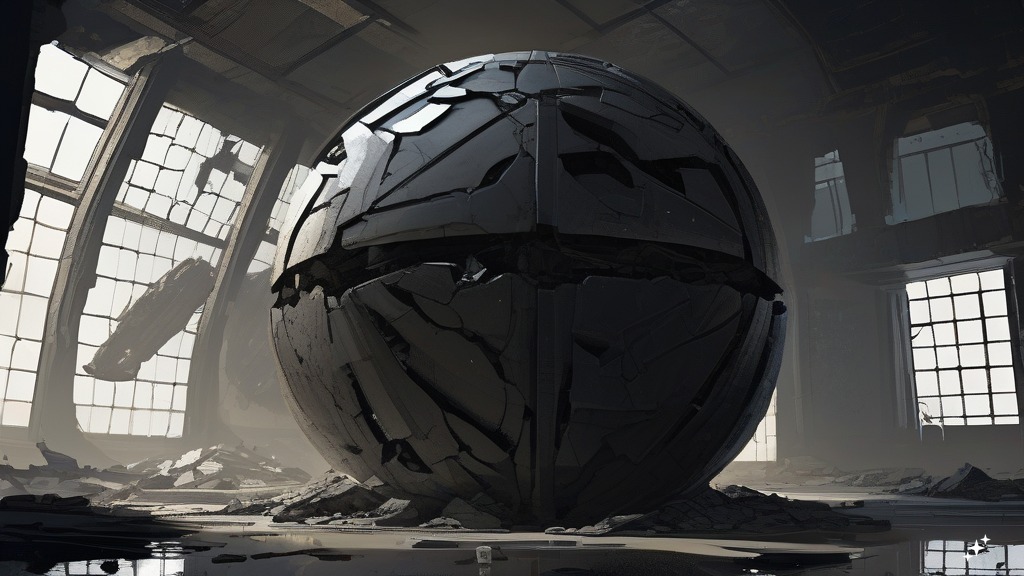
The mysterious black sphere sitting in a Tokyo apartment is one of the most recognizable images in the entire series. When the dead characters wake up in this bare room with this featureless orb, the visual is surreal and deeply unsettling. (This sphere is referred to throughout the series as “the Gantz sphere,” “the black sphere,” or simply “the sphere” — all the same object.)
The sphere’s design is deceptively simple — a smooth, black, oversized ball sitting on a floor. But its placement in an otherwise ordinary apartment creates a feeling of wrongness that’s hard to shake. The contrast between the mundane setting and this inexplicable object is pure visual storytelling. No exposition needed. You know immediately that something is very, very wrong.
Onion Alien’s Father — True Form Reveal (Chapters 20–30)
The early Onion Alien mission starts almost comically — the aliens look goofy, the participants don’t take it seriously, and the whole thing feels like it might be some kind of dark joke. Then the Onion Alien’s Father reveals its true form, and the series’ first major escalation hits.
This is where Oku’s creature design starts to flex. The father alien is genuinely threatening, and the panels showing its transformation demonstrate that the aliens in Gantz are not jokes — they’re lethal. For first-time readers, this is usually the sequence where the series sinks its hooks in. The shift from absurd to terrifying happens in just a few pages, and the art carries the entire tonal shift.
Kato’s Death in the Buddhist Temple Mission (Chapter 110)
This is widely regarded as one of the most emotional moments in the entire series. Kato’s death arrives as a full-page spread — a single image drawn across an entire page — that hits like a gut punch, especially because Kato has been established as the moral heart of the cast. He’s the one person who genuinely cares about protecting others.
The Buddhist Temple arc also contains a standout double-page spread (a single image drawn across two facing pages) of a giant Buddha statue coming alive. It’s one of Oku’s first truly massive-scale compositions, with the enormous statue looming over tiny human figures. The scale contrast is something Oku would return to again and again in later arcs, but this is where he first nails it.
The emotional weight of Kato’s death combined with the spectacle of the Buddha statue makes this arc a turning point — both for the story and for Oku’s ambition as a visual artist.
Mid-Series Gantz Manga Panels That Push Boundaries (Chapters 114–212)
The mid-section of Gantz is where Oku starts pushing in new directions. The violence becomes more transgressive, the action choreography gets more dynamic, and the quiet character moments hit harder because of how much chaos surrounds them.
Izumi’s Shinjuku Massacre
This is probably the single most shocking sequence in the series. Shion Izumi guns down civilians in broad daylight in Shinjuku. Not aliens. People.
What makes these panels so disturbing is the contrast. Oku renders the Shinjuku streets with his usual photorealistic detail — storefronts, crowds, crosswalks. It looks like a normal Tokyo afternoon. Then Izumi opens fire, and the mundane setting becomes a massacre. The panels don’t flinch. The gore is extreme, but it’s the normalcy of the setting that makes it truly horrifying.
This sequence is Gantz at its most provocative. It forces readers to confront the fact that the Gantz suits — which have been used against aliens — are just weapons, and weapons can be turned on anyone. The visual storytelling here is doing heavy thematic lifting.
Kurono Dual-Wielding Against Dinosaur Aliens (Chapters 170–180)
If the Izumi massacre is the mid-series’ most shocking moment, the Dinosaur Alien fight is its most thrilling. Kurono dual-wielding swords against massive dinosaur-type aliens is peak action manga — dynamic, kinetic, and rendered with an almost cinematic sense of motion.
The full-page spreads in this sequence showcase Oku’s 3D modeling at its most ambitious. The dinosaur aliens are incredibly detailed, with textures and anatomy that would look at home in a creature design portfolio for a Hollywood film. And Kurono moving through them at speed, blades cutting, suit straining — it’s the kind of action choreography that makes you flip pages faster.
The 100-Point Menu (Chapter 200)
After all the spectacle and violence, one of the series’ most discussed images is surprisingly quiet. When a player reaches 100 points, the Gantz sphere reveals a menu with three options:
- Freedom — leave the game entirely, memories erased
- A powerful weapon — stay in the game with better equipment
- Revive a dead person — bring someone back to life
The panel itself is visually simple — just text on the sphere’s surface. But its impact is enormous. This single image reframes everything that’s happened in the series. Every death, every battle, every point scored — it all leads to this choice. And the choice is agonizing.
This is a rare case where a panel becomes memorable not for its visual spectacle but for its moral weight. It’s one of the most discussed images among Gantz fans, and it changes how you read every arc that follows.
The Osaka Mission — Where Gantz Manga Panels Reach Their Peak (Chapters 213–279)
The Osaka arc is where many readers agree: Oku’s art reaches another level entirely. The scale expands, the cast multiplies, and the creature designs become breathtaking. If someone asks “what’s the best-looking arc in Gantz?” — the Osaka Mission is the most common answer.
Both Teams Assembled
Early in the Osaka arc, a double-page spread shows the Tokyo and Osaka Gantz teams together for the first time. Dozens of characters, all in full Gantz suits, all rendered in complete detail. The sheer number of bodies, suits, weapons, and individual faces crammed into a single composition is staggering.
This is a flex. There’s no other word for it. Most manga artists would simplify — reduce detail on background characters, use speed lines to obscure the crowd. Oku renders everyone. Every suit seam, every weapon, every face. The 3D modeling workflow makes this possible, but it’s still an incredible amount of work to assemble and refine into a coherent composition.
Nurarihyon Boss Reveal
The Nurarihyon is the final boss alien of the Osaka arc, and it’s widely considered one of the most impressive creature designs in all of seinen manga (seinen meaning manga aimed at adult readers, typically men in their late teens and older).
The design draws on the yokai — supernatural creatures from Japanese folklore — of the same name, but Oku pushes it into something entirely his own. Massive, grotesque, detailed beyond reason. The 3D modeling is visible in every surface texture, every organic curve, every horrifying detail. When Nurarihyon appears in full, across a double-page spread, the level of craft on display is extraordinary.
This is the kind of panel that makes other manga artists stare. The amount of detail packed into a single creature, rendered at scale, with human figures nearby for reference — it’s a showcase of what Oku’s hybrid technique can achieve when pushed to its limits.
Osaka Team’s Last Stand
The Osaka arc ends with desperate battle panels featuring mass casualties on a scale Gantz has never attempted before. Characters you’ve spent dozens of chapters getting to know are cut down in rapid succession. The art shifts between wide shots — showing the battlefield in all its chaotic horror — and tight close-ups on faces in their final moments.
This is the emotional and visual peak of the mid-series. The combination of scale, detail, and genuine emotional devastation makes the Osaka Team’s Last Stand one of the most talked-about sequences among Gantz readers. It’s brutal, it’s beautiful, and it’s heartbreaking.
The Invasion Arc — The Most Ambitious Gantz Manga Panels Ever Drawn (Chapters 304–383)
The final major arc of Gantz — the Invasion arc, depicting the full-scale alien invasion that engulfs the planet — goes full apocalypse. The scale jumps from city blocks to the entire Earth. Oku’s art, already operating at an extraordinary level, somehow finds another gear.
The Invasion Begins — Alien Ships Over Earth
Massive double-page spreads show alien vessels descending on cities worldwide. Tokyo, New York, major cities across the globe — rendered with photorealistic backgrounds being destroyed by impossibly detailed alien armies.
These panels represent Oku’s art at its absolute technical peak. The cityscapes are recognizable and realistic. The alien ships and armies are rendered with the same obsessive detail. And the destruction — buildings crumbling, streets torn apart, entire skylines transformed — is visualized with a scale and precision that feels more like concept art for a blockbuster film than a manga page.
If you’ve ever seen Gantz panels shared online with no context and thought “there’s no way that’s from a manga,” these are probably the ones.
Giant Aliens in Tokyo Streets
Building-sized aliens stomping through recognizable Tokyo landmarks — this is scale contrast taken to its maximum extreme. Tiny human figures, rendered at Oku’s usual level of detail, stand in the shadow of creatures that dwarf skyscrapers.
The horror here isn’t just the aliens themselves. It’s the juxtaposition. You recognize these streets, these buildings, these crosswalks. And there’s a 200-foot tall alien standing in the middle of them. The mundane and the monstrous, which Oku has been playing with since Chapter 1, reaches its ultimate expression in these panels.
Kurono’s Choice to Revive Kato
After reaching 100 points, Kurono chooses to bring back Kato. This emotionally charged character moment arrives amid the sci-fi spectacle of the Invasion arc, and it lands with enormous weight.
The panel is powerful because of everything that precedes it. Kato’s death back in Chapter 110 — that gut-punch full-page spread — finally gets its payoff nearly 200 chapters later. Kurono could choose freedom. He could choose a weapon. He chooses his friend. After hundreds of chapters of escalating violence and moral compromise, this is the moment that reminds you what Gantz is actually about underneath all the spectacle.
The Final Battle in the Mothership
The climactic sequence of Gantz features the most elaborate and detailed artwork in the entire 37-volume run. Inside the alien mothership, Oku constructs environments and creatures that push his technique to its absolute limits.
Every surface has texture. Every alien has unique anatomy. Every panel is crammed with detail that rewards close examination. The mothership interiors look genuinely alien — not just “weird rooms” but spaces that feel designed by non-human intelligence. It’s the culmination of a decade-plus of artistic evolution.
Whether you love or hate the story’s ending (readers are divided), the art in these final chapters is undeniably Oku at his most ambitious.
Why These Gantz Manga Panels Still Influence Manga Today
Gantz ended its serialization in 2013, but its visual impact continues to ripple through the manga industry.
Oku’s hybrid technique was ahead of its time. In the early 2000s, using 3D modeling as a foundation for manga art was almost unheard of. Today, many manga artists use similar digital workflows — 3D backgrounds, digital posing references, computer-assisted mechanical designs. Oku didn’t invent digital manga tools, but Gantz was one of the first major series to prove they could work at the highest level of visual quality.
Gantz proved that seinen manga could achieve cinematic visual scale. Before Gantz, manga with this level of visual ambition typically required a slower publication schedule. Oku demonstrated that a series serialized on a weekly basis could deliver movie-quality spectacle through smart use of technology. That lesson has been absorbed by a generation of artists.
The series influenced later works in sci-fi and horror manga aesthetics. The specific Gantz look — photorealistic urban settings disrupted by grotesque alien creatures, rendered with obsessive surface detail — shows up in various forms across modern seinen manga. Whenever you see a manga that mixes real-world photography-level backgrounds with fantastical creature designs, there’s a decent chance Gantz is somewhere in its DNA.
Reading These Panels Yourself
If this article has you curious about experiencing Oku’s art firsthand, the most accessible way to read the complete series in English is the Dark Horse Comics omnibus edition. There are 12 omnibus volumes, each roughly 636–848 pages, covering the entire 37-volume series.
The oversized omnibus format is particularly well-suited to Gantz because the larger page size lets Oku’s detailed art breathe. Those double-page spreads that we’ve been talking about? They look significantly better at omnibus scale than in the standard single-volume editions.
A Final Note on Context
Gantz manga panels are incredible as standalone images. That’s why they go viral — a single panel can stop you mid-scroll with its detail and impact. But the panels hit so much harder in context.
Kato’s death means more when you’ve spent 110 chapters watching him try to be a good person in an impossible situation. The 100-Point Menu is more agonizing when you’ve watched characters die to earn those points. The Katastrophe invasion is more terrifying when you’ve seen how dangerous single aliens are, and suddenly there are thousands.
The art is the hook. The story and characters are what make it unforgettable. If even one panel in this article made you think “I want to see that in context” — this is a series worth starting. Grab the first omnibus and see for yourself. You’ll know within the opening chapters whether Gantz has its hooks in you.
Lone Wolf and Cub Deluxe Edition Volume 1
Planetes Deluxe Edition Book 1
Oldboy Deluxe Edition: Book One