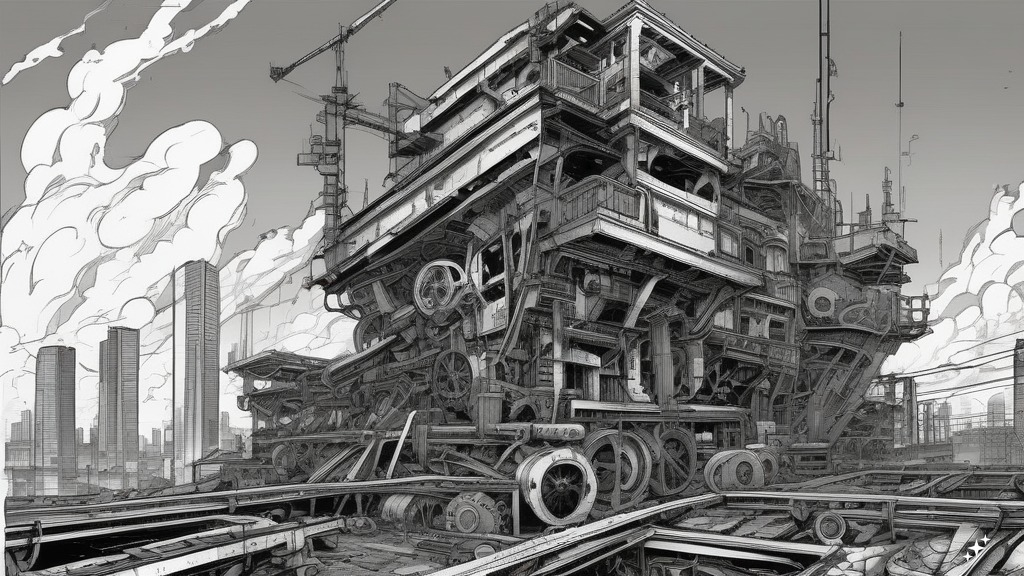
Hiroya Oku’s 3D-Assisted Art Process
Most manga artists sketch their layouts, ink them by hand (or digitally), and use studio assistants — junior artists who help fill in backgrounds, screen tones, and other detail work under the lead artist’s direction. Oku’s process is fundamentally different.
Step 1: He constructs full 3D environments in Shade 3D — a standard 3D modeling program used widely in Japanese creative industries — building digital recreations of real Tokyo buildings, streets, and interiors. He also poses 3D character models for reference.
Step 2: He renders those 3D scenes from the exact camera angle he wants for each panel.
Step 3: He draws over those renders, adding linework (the actual pen strokes that define shapes, edges, and shading), detail, and texture by hand.
This is why Inuyashiki manga panels look so different from other manga aimed at adult readers. The perspective is always geometrically precise. The buildings have correct proportions. The lighting feels consistent across a scene. When Oku draws a Shinjuku street, it looks like that actual street — because he essentially photographed a 3D recreation of it.
The evolution from GANTZ: Oku used this same technique throughout GANTZ’s 37-volume run, but by the time he started Inuyashiki, the integration was noticeably smoother. In early GANTZ, the 3D-traced figures sometimes clashed with hand-drawn elements. In Inuyashiki, the line quality is more consistent, and the transitions between modeled backgrounds and hand-drawn foreground elements feel more natural.
The uncanny valley trade-off: There’s an interesting side effect to this process. “Uncanny valley” describes the unsettling feeling you get when something looks almost human but not quite — think early CGI faces in movies. Oku’s characters occasionally have that quality, looking slightly stiff in certain poses because they were traced from posed 3D models rather than drawn from imagination. But the environments are so stunningly detailed that most readers don’t notice or don’t mind. If anything, the slight stiffness adds to the unsettling tone of a story about humans who aren’t quite human anymore.
7 Types of Inuyashiki Manga Panels That Define the Series
Not all manga art is created equal, and not all of Oku’s panels serve the same purpose. Here are the seven distinct visual modes that make Inuyashiki’s artwork so memorable.
Photorealistic Tokyo Cityscapes
Shinjuku. Shibuya. Quiet residential neighborhoods with narrow streets and utility poles. Oku renders all of these with near-photographic accuracy, and he uses real locations — meaning his panels function almost like street photography of Tokyo.
This matters for the story because Inuyashiki is grounded in the mundane. Ichiro Inuyashiki is an ordinary elderly man living in an ordinary neighborhood. When extraordinary things start happening to him, the realistic setting makes the fantastical elements hit harder. You believe this is happening in a real place because, visually, it is a real place.
For readers who’ve visited Tokyo, there’s an added layer of recognition. For those who haven’t, these panels build a sense of place that most manga only gesture at.
Mechanical Transformation Sequences
These are the panels that tend to go viral.
When Ichiro’s or Hiro’s bodies open up to reveal the alien machinery hidden inside them — weapons, thrusters, mechanical components — Oku draws every single piece. Every gear. Every articulated plate. Every joint and hinge. The mechanical detail is obsessive, almost fetishistic in its precision.
These sequences typically unfold across multiple panels in a slow reveal: skin splits, layers peel back, and the machinery underneath is rendered with the same photorealistic attention Oku gives to Tokyo’s skyline. The contrast between soft human flesh and hard mechanical internals is deeply unsettling, and that’s entirely the point.
If you’ve ever seen an Inuyashiki panel shared out of context online, it was probably one of these.
Flight Scenes Over Tokyo
Inuyashiki features some of the most breathtaking flight sequences in manga. Oku combines his photorealistic city backgrounds with dynamic figure work for full-page and double-page spreads — layouts where the art fills an entire page or stretches across two facing pages — showing characters soaring above Tokyo’s skyline.
These panels work because of the scale contrast. A small human figure — rendered with loose, energetic linework suggesting speed and freedom — set against a massive, meticulously detailed cityscape below. You feel the height. You feel the wind. The first time Ichiro flies is one of the most genuinely joyful moments in the series, and the artwork carries at least half of that emotional weight.
Physical volumes are particularly rewarding here, since these spreads often cross the center crease between two facing pages and lose something on a phone screen.
Extreme Violence With No Filter
Inuyashiki does not flinch.
The Shinjuku massacre scenes — where Hiro goes on killing sprees — are drawn with the same photorealistic precision Oku applies to everything else. Point-blank gunshots. Body damage depicted in clinical detail. Oku does not cut away. He does not use speed lines or abstract splatter to soften the impact.
This is a deliberate artistic choice. By rendering violence with the same unflinching realism he uses for cityscapes and quiet domestic scenes, Oku makes the horror feel genuinely disturbing rather than cartoonish. There’s no aesthetic distance. The violence looks like it hurts because the art style insists on showing you exactly what’s happening.
It’s not for everyone, and that’s completely fine. But if you can handle it, the artistic commitment is undeniable.
Quiet Emotional Close-Ups
Here’s where Oku’s range as an artist really shows. Amid all the spectacular action and brutal violence, some of the most powerful panels in Inuyashiki are simple close-ups of faces.
Ichiro crying. His family reacting to him with a mixture of embarrassment and concern. Hiro’s mother processing what her son has become. These quieter panels gain enormous power from the photorealistic style — the faces look like real people experiencing real emotions, and the contrast with the surrounding spectacle makes them land even harder.
Oku understands something important: spectacle without emotional grounding is just noise. These intimate panels are the emotional anchors that make the transformation sequences and flight scenes matter.
Splash Pages and Double-Page Spreads
A splash page is a single image that fills an entire page — no panels, no divisions, just one big moment. A double-page spread stretches that image across two facing pages. Oku saves these for his biggest visual moments and deploys them strategically:
- The initial alien explosion that transforms Ichiro and Hiro — a massive, chaotic spread establishing that something cosmic and incomprehensible has just happened.
- Ichiro’s first flight — pure joy rendered at maximum scale.
- The asteroid climax in the final chapters — apocalyptic in scope, with Oku’s attention to scale making the threat feel genuinely world-ending.
What makes these work isn’t just size. Oku uses negative space — intentionally empty areas within the composition — effectively. Sometimes the most powerful part of a splash page is what he leaves blank. And the scale contrast between tiny human figures and enormous environments or cosmic events reinforces the story’s central theme: ordinary people caught up in forces vastly larger than themselves.
2channel / Internet Screen Panels
This is the most visually unusual element of Inuyashiki, and it’s something you won’t find in most other manga.
Throughout the series — particularly during Hiro’s public attacks — Oku inserts panels showing internet forum reactions modeled on 2channel, an anonymous Japanese message board similar to what Reddit or 4chan is for English-speaking users. Anonymous posters react in real time to unfolding events, functioning as a collective voice commenting on the action — panicked, confused, sometimes callous.
These panels are visually distinctive because they completely break the photorealistic style. Flat text on simple backgrounds. No depth, no 3D modeling, no carefully rendered environments. Just raw, unfiltered public reaction.
The effect is jarring in the best way. You go from a hyper-detailed panel of destruction to a wall of anonymous text, and the sudden shift in tone mirrors how modern audiences actually experience disasters: through screens, at a remove, with commentary scrolling alongside the horror.
It’s a brilliant formal choice that feels increasingly relevant with each passing year.
Key Scenes Every Reader Remembers
⚠ SPOILER WARNING — This section discusses specific plot events and endings from Inuyashiki. If you haven’t read the series yet and want to go in fresh, skip ahead to “Inuyashiki Panels vs. the Anime.” ⚠
The alien explosion and first transformation (Volume 1, Chapter 1): Oku opens with a quiet, almost depressingly mundane setup — Ichiro is an elderly man whose family barely acknowledges him — then detonates the premise in a sudden, violent burst. The contrast between the understated early pages and the explosive transformation makes the moment land like a punch. Compositionally, Oku pulls the camera way back to show how small Ichiro and Hiro are relative to the cosmic event overtaking them.
Ichiro healing a terminally ill patient: This is the emotional core of the entire series. The paneling slows down dramatically — close-ups on hands, on faces, on the light emanating from Ichiro’s body. There’s a gentleness to the linework here that Oku rarely deploys, and it’s devastating. After so many panels of destruction and violence, watching this quiet old man use his impossible power to simply help someone hits with enormous force.
Hiro’s first killing: The tonal shift that defines the series. Up to this point, you might think Inuyashiki is a story about an underdog gaining superpowers. This scene tells you it’s also a story about what happens when a teenager with no empathy gains those same powers. Oku draws the violence matter-of-factly, which makes it worse. There’s no dramatic buildup. It just happens, like flipping a switch.
The Shinjuku mass shooting: The most brutal extended sequence in the manga. Oku draws it across multiple chapters, unrelenting in its detail. The internet forum panels appear throughout, creating a horrifying parallel narrative — the violence and the public’s real-time consumption of it, side by side. It’s hard to read, and it’s supposed to be.
Ichiro vs. Hiro — the final confrontation: Two characters with identical powers, opposite moralities. Oku stages this fight across Tokyo’s skyline, combining his photorealistic cityscapes with dynamic action choreography. The scale is huge, but the emotional stakes — established through all those quiet close-up panels earlier — keep it grounded.
The asteroid ending — Ichiro’s sacrifice (final chapter): Oku pulls all the way out to cosmic scale for the finale. An asteroid threatens Earth, and Ichiro’s response brings the series full circle — from a man whose life felt meaningless to one whose death saves everyone. The final panels are restrained, almost silent. After ten volumes of spectacle, Oku ends on quietness. It works beautifully.
Inuyashiki Panels vs. the Anime — What Changes
MAPPA — the Japanese animation studio behind Jujutsu Kaisen and Attack on Titan: The Final Season — adapted the full manga into an 11-episode anime in 2017. Given that Oku’s art process already involves 3D modeling, you might expect the anime — which uses extensive CGI (computer-generated imagery) — to feel like a natural extension of the manga’s visual style.
The reality is more complicated.
Where the anime struggled:
The CGI character animation drew mixed reactions from viewers. There’s an irony here: Oku’s manga uses 3D as a foundation but finishes with hand-drawn linework, creating a hybrid that feels grounded. The anime’s CGI sometimes lacks that hand-finished quality, making characters look plasticky in motion — triggering that same uncanny valley discomfort that Oku’s technique manages to avoid on the page.
The massacre sequences also lose something in animated form. In the manga, you control the pace. You can linger on a panel, absorb the detail, process the horror at your own speed. The anime moves at its own pace, and the quick cuts sometimes dilute the impact that Oku’s unflinching, static panels create.
The mechanical transformation details — all those individually drawn gears and plates — become somewhat generic CGI mechanical animation. Technically impressive, but lacking the obsessive hand-drawn quality that makes the manga panels so arresting.
Where the anime arguably improved:
Flight sequences. Movement through air, wind effects, the sensation of speed — animation is simply better at conveying these than static panels, no matter how dynamic. Ichiro’s first flight is genuinely magical in the anime.
The soundtrack adds enormous emotional weight. Ichiro’s healing scenes, already powerful on the page, become tear-inducing with music. The asteroid climax gains apocalyptic grandeur from its score.
The internet reaction panels translate surprisingly well to animation, with scrolling text overlaid on scenes in a way that captures the multimedia feel Oku was going for.
The verdict: The manga panels reward slow, careful reading in ways the anime fundamentally can’t replicate. The level of detail in each panel, the ability to pause and examine backgrounds, the impact of turning a page to find a massive double-page spread — these are inherently manga experiences. The anime is a solid adaptation worth watching, but if you’re here because you’re interested in Inuyashiki’s visual artistry, the manga is where that artistry lives.
How to Read Inuyashiki for the Art
All 10 volumes of Inuyashiki are available in English from Kodansha Comics (the publisher that handles the English release) in both print and digital formats.
Physical volumes are strongly recommended if you’re reading specifically for the art. The double-page spreads — flight scenes, the asteroid sequence, the Shinjuku massacre — are designed to be experienced across two physical pages. Reading on a phone compresses them into something much smaller and less impactful. Even a tablet loses the page-crossing effect that Oku clearly intended. Physical volumes are available on Amazon and in most bookstores. If you want to sample before committing to print, the Kodansha digital app has the series available as well.
Reading order is completely straightforward. Inuyashiki is a single continuous story — volumes 1 through 10, no spin-offs, no prequels, no alternate reading paths. Start at the beginning, read to the end.
Here’s a quick look at the Inuyashiki manga panels you’ll encounter by volume:
| Volumes | Content Overview |
|---|---|
| 1–2 | Setup, alien encounter, first transformations, establishing Ichiro and Hiro as parallel characters with opposite paths |
| 3–5 | Hiro’s descent into violence, escalating brutality, Ichiro discovering his healing abilities |
| 6–8 | The Shinjuku massacre, internet reaction sequences, confrontations |
| 9–10 | Final battle, the asteroid, Ichiro’s sacrifice and conclusion |
If Inuyashiki’s art style grabbed you, the natural next read is GANTZ by the same author. It uses the same 3D-assisted technique across a much longer run — 37 volumes — with even more extreme action sequences and a science fiction premise involving ordinary people forced to hunt aliens after death. You don’t need to commit to all 37 to appreciate the art; the first three or four volumes establish Oku’s technique and the series’ tone clearly enough to know if you want to continue.
For readers who love photorealistic manga art in general, Vagabond by Takehiko Inoue offers a completely different — and purely traditional — approach to hyper-detailed manga artwork. Vagabond is a historical drama following the legendary swordsman Miyamoto Musashi through feudal Japan, and it contains no horror or sci-fi elements. The methods are opposite from Oku’s (Inoue paints by hand with ink and brush), but the commitment to visual realism is a shared value, and the results are equally stunning.
Vagabond Vol. 4 (VIZBIG Edition)
Inuyashiki is only 10 volumes. You can read the entire series in a weekend. But the panels? Those will stay with you much longer than that. Grab volume 1 and see for yourself — the alien explosion hits before the end of the first chapter, and from there, it never lets up.