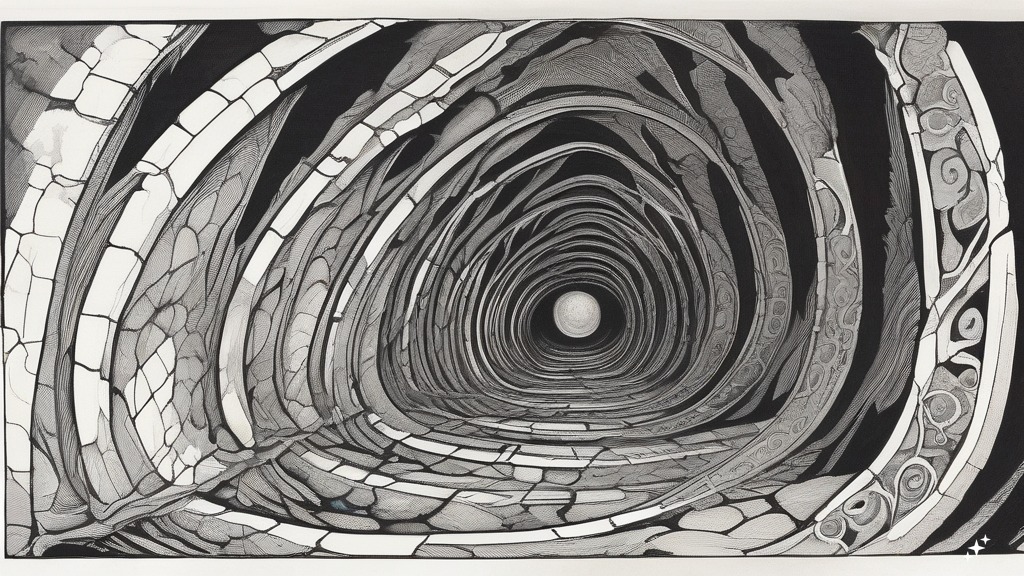
Junji Ito — The Modern Master of Horror Manga
If you’ve seen a creepy spiral image or a girl emerging from a crack in a rock wall floating around the internet, you’ve already encountered Junji Ito’s work. He’s the most internationally recognized horror manga artist alive today, and his influence on how people outside Japan think about manga horror is massive.
Background
Born in 1963, Ito worked as a dental technician starting in 1984 — a detail that suddenly makes a lot of sense when you see how often teeth, mouths, and bodies feature in his horror. He debuted in 1987 with Tomie, which won an honorable mention in the prestigious Kazuo Umezu Prize (named after the godfather of horror manga, more on him below). He continued working as a dental technician for years before transitioning to manga full-time.
What Makes His Art Distinctive
Ito’s style is defined by meticulous, almost obsessively detailed linework. His backgrounds and everyday settings look clean and normal — and then something shifts. Mundane objects warp into sources of cosmic dread — that particular flavor of horror where the universe itself feels hostile and incomprehensible, far beyond human understanding. A spiral staircase becomes a portal to madness. A hole in a cliff face becomes an irresistible invitation. Fish grow mechanical legs and walk onto land.
The contrast is what gets you. His art lulls you into normalcy and then pulls the rug out with body horror so intricately rendered that you can’t look away even when you want to.
Key Works
- Uzumaki — A town slowly consumed by an obsession with spirals. This is often recommended as the first Ito work to read, and the 3-in-1 Deluxe Edition collects the complete story in a single volume — you get the entire experience in one purchase. It’s a masterclass in escalating dread. The story starts with small, weird occurrences and builds into full cosmic horror.
- Tomie — His debut series about an immortal girl who drives everyone around her to obsessive madness and murder. It’s more episodic than Uzumaki, which makes it easy to pick up and read in short bursts.
- Gyo — Fish and sea creatures invade land using mechanical legs powered by a “death stench.” This one leans harder into gross-out body horror than his other major works.
Where to Find His Work in English
VIZ Media (one of the largest manga publishers in English) publishes Ito’s extensive catalog. His short story collections — including Dissolving Classroom, Stitches, Alley, and the recent Moan — are great entry points if you want to sample his range before committing to a longer series. Each collection contains several self-contained stories (meaning each story is complete on its own, no prior reading required).
The Junji Ito Story Collection 3 books set (which bundles Lovesickness, Deserter, and Fragments of Horror) is a solid way to dive into multiple collections at once.
Note: this is a multi-book set put together by a third-party seller, not an official publisher box set.
Junji Ito Story Collection 3 books set: Lovesickness, Deserter, Fragments of Horror
Kazuo Umezu — The Godfather of Horror Manga
Every horror manga artist working today owes something to Kazuo Umezu. He didn’t just create horror manga — he essentially invented the genre as a distinct category within the medium.
Background
Born September 3, 1936, Umezu debuted professionally in 1955 at just 18 years old. He passed away on October 28, 2024 at the age of 88, leaving behind a legacy that shaped decades of manga.
What made Umezu revolutionary was where he published his horror: in shojo magazines. Shojo means manga aimed at girls, and in the 1960s, no one was putting horror stories in those publications. Shonen magazines (aimed at boys) were considered the home for action and adventure — but horror in girls’ magazines was unheard of. Umezu broke that convention by combining the polished, commercial manga aesthetic readers expected with gruesome imagery drawn from Japanese folktales and his own nightmarish imagination. The result shocked readers — and created an entirely new audience for horror manga.
What Makes His Art Distinctive
Umezu’s art has a rawness and emotional intensity that still feels powerful today. His characters — often children — have wide, expressive eyes that make their terror feel immediate and personal. His panel compositions build claustrophobic tension, and he had a gift for making ordinary school and home settings feel deeply unsafe.
His storytelling was also ahead of its time. He blended horror with science fiction, social commentary, and surrealism in ways that manga artists are still learning from.
Key Works
- The Drifting Classroom — Published weekly from 1972 to 1974 in Weekly Shonen Sunday (a major weekly manga magazine aimed at boys), this is Umezu’s most famous work. An entire elementary school is suddenly transported to a barren, post-apocalyptic wasteland. The children must survive while the adults around them lose their minds. It won the 20th Shogakukan Manga Award (one of Japan’s most prestigious manga prizes), and its influence on survival horror in manga and anime is hard to overstate.
- My Name Is Shingo — A haunting science fiction horror story about an industrial robot that develops consciousness. The French translation won the Prize for Inheritance at the Angoulême International Comics Festival in 2018 — one of the largest and most respected comics festivals in the world, roughly the comics equivalent of the Cannes Film Festival. That recognition decades after publication is a testament to how Umezu’s work holds up.
- Orochi — A supernatural observer named Orochi watches human dramas unfold, each story exploring different aspects of human cruelty and fear.
Availability Note
Umezu’s work has had a complicated English publication history. Some titles have gone in and out of print. The Drifting Classroom is the easiest to find in English and the best starting point.
Hideshi Hino — Visceral Horror from Post-War Japan
If Junji Ito is meticulous precision and Kazuo Umezu is emotional intensity, Hideshi Hino is pure, unfiltered visceral impact. His work doesn’t creep up on you — it grabs you by the throat.
Background
Born April 19, 1946, Hino’s art was shaped by the devastated post-WWII landscape he witnessed as a child. That experience of growing up surrounded by ruins and suffering bleeds into everything he creates. His work obsessively returns to themes of childhood trauma, family dysfunction, bodily destruction, and the lives of societal outcasts.
What Makes His Art Distinctive
Hino’s drawing style is deliberately rough and almost childlike in its simplicity, which makes the extreme content even more disturbing. There’s a raw, self-taught quality to his work — the lines are thick, the compositions feel cramped and uncomfortable, and the gore is rendered with an almost gleeful lack of restraint.
Where Ito makes horror beautiful in its detail, Hino makes it ugly on purpose. His art doesn’t want you to admire it — it wants to make you feel something uncomfortable. And it succeeds.
Key Works
- Panorama of Hell (1984) — A single self-contained story told from the perspective of an artist who paints exclusively in blood. It’s autobiographical in the loosest sense, drawing on Hino’s own memories of post-war devastation. It’s short, intense, and genuinely unlike anything else in the medium.
- Hell Baby (1982) — A baby is abandoned in a garbage dump and survives by becoming something no longer quite human. It’s a brutal story about innocence destroyed by neglect and cruelty.
- Bug Boy — A child transforms into an insect (a premise that echoes Franz Kafka’s famous novella The Metamorphosis, where a man wakes up as a giant bug) in a story that uses body horror as metaphor for the alienation of childhood.
Beyond Manga
Hino crossed into film by directing two entries in the Guinea Pig horror film series — a notorious set of Japanese horror shorts from the 1980s known for extremely realistic gore effects. His entries were Flower of Flesh and Blood and Mermaid in a Manhole. One of these films was so realistic that a copy was reportedly turned over to the FBI as potential evidence of an actual crime. Hino’s manga is intense but operates at a different level than these films — if you can handle the artwork described above, his printed work is a manageable starting point. The films are a fascinating extension of his artistic vision for those who want to go further.
Suehiro Maruo — The Ero-Guro Revival Artist
Content warning: Suehiro Maruo’s work contains extreme sexual and violent imagery that goes far beyond what most manga readers are prepared for. If you continue reading this section, be aware that the descriptions below reference graphic content. He is an important figure in the genre, but approach with full awareness.
Background
Born January 28, 1956 in Nagasaki, Japan, Maruo emerged from the underground manga scene centered around Garo magazine — an independent manga publication founded in 1964 that gave a platform to experimental and transgressive artists who couldn’t publish in mainstream magazines.
Maruo’s great achievement was reviving the ero-guro movement for modern audiences. Ero-guro (short for “erotic-grotesque”) is a Japanese artistic tradition dating back to the early 20th century that combines eroticism, grotesque imagery, and decadence. Maruo didn’t just copy that tradition — he elevated it by combining extreme imagery with serious literary adaptation and stunning technical skill.
What Makes His Art Distinctive
Maruo’s art is stunningly beautiful in a technical sense. His linework is elegant, his compositions reference classical Japanese woodblock prints (traditional carved-and-printed illustrations from the Edo period) and flowing, ornamental European design, and his character designs have an almost porcelain-doll quality. The contrast between this beauty and the extreme content creates a deeply unsettling tension.
This isn’t horror that relies on sudden shocks or gross-out moments (though there’s plenty of graphic content). It’s horror as dark art — meticulously composed, deeply literary, and genuinely transgressive.
Key Works
- Mr. Arashi’s Amazing Freak Show (published August 1983 – July 1984 in a magazine called Manga Eros) — A young girl is taken in by a traveling freak show, and things go very badly from there. This is often cited as Maruo’s signature work and a defining text of the ero-guro revival.
- The Strange Tale of Panorama Island (published in book form 2008) — An adaptation of a story by Edogawa Rampo, a pioneering Japanese mystery and horror fiction writer active in the early 20th century. A failed writer fakes his death and assumes the identity of a wealthy lookalike to build a utopian island that descends into madness. This work won the Tezuka Osamu Cultural Prize in 2009 — one of the most prestigious awards in all of manga. That a work this transgressive won such a mainstream award speaks to its artistic quality. If you’re curious about ero-guro as an art movement, this is the most accessible entry point because its literary source material gives the extreme imagery a narrative framework.
More Manga Horror Artist Names Worth Reading
The artists above are the towering figures, but horror manga is a rich and diverse genre. Here are more creators whose work is absolutely worth your time.
Shintaro Kago
Born in 1969, Kago debuted in 1988 in COMIC BOX magazine with a style so distinctive it’s been called “fashionable paranoia.” His work combines extreme grotesque imagery with absurdist humor and sharp social satire.
Where other horror manga artists want to frighten you, Kago wants to make you laugh nervously while questioning reality. His stories often start with a mundane premise — a neighborhood, a school, a workplace — and then systematically dismantle the rules of physics, biology, and social convention until nothing makes sense anymore.
Key works:
- Dementia 21 — A home care worker visits increasingly surreal and disturbing elderly patients
- Super-Dimensional Love Gun — A collection of short stories that play with perception and reality
- Fraction — Short pieces that fragment narrative and visual structure itself
Kago’s work is published in English by smaller independent publishers and can be harder to track down than mainstream manga releases. It’s funny, smart, and deeply weird.
Gou Tanabe
If you love H.P. Lovecraft’s cosmic horror — stories where the terror comes from realizing humanity is insignificant in a vast, indifferent, and unknowable universe — Gou Tanabe is about to become your favorite artist. He specializes in atmospheric manga adaptations of Lovecraft’s stories, and his interpretations are stunning.
Tanabe’s gift is translating Lovecraft’s famously description-heavy prose into visual horror. Lovecraft’s stories are built on the idea that true cosmic horror is indescribable — and yet Tanabe finds ways to depict the indescribable without diminishing its power. His environments are vast and oppressive, his creature designs are genuinely alien, and his pacing captures the slow-burn dread that makes Lovecraft’s best stories work.
Key works:
- H.P. Lovecraft’s At the Mountains of Madness — An Antarctic expedition discovers the ruins of an ancient, inhuman civilization. Tanabe’s version is gorgeous and deeply unsettling.
- H.P. Lovecraft’s The Call of Cthulhu — The story that launched cosmic horror, rendered in Tanabe’s darkly beautiful style.
- H.P. Lovecraft’s The Colour Out of Space — A meteorite lands on a farm and warps everything around it. Tanabe captures the creeping wrongness perfectly.
- The Hound and Other Stories — More Lovecraft adaptations, each one a showcase for Tanabe’s atmospheric art.
H.P. Lovecraft’s At the Mountains of Madness Deluxe Edition (Manga)
H.P. Lovecraft’s The Call of Cthulhu (Manga)
H.P. Lovecraft’s The Colour Out of Space (Manga)
All of these are published in English by Dark Horse Comics (a major American comics publisher) in beautiful deluxe editions that do justice to Tanabe’s detailed artwork.
Shuzo Oshimi
Oshimi doesn’t draw monsters or supernatural threats. His horror lives entirely in the human psyche — in the gap between how people present themselves and what they actually feel, in the slow realization that something is deeply wrong with a person you trusted.
His art style is realistic compared to most manga artists, which makes the disturbing content land even harder. When a character’s face shifts from composed to unhinged in an Oshimi panel, it looks like watching a real person’s mask slip.
Key works:
- The Flowers of Evil (2009–2014, 11 volumes, published by Kodansha) — A middle school student’s secret obsession with a classmate is discovered by the class outcast, who begins to blackmail and manipulate him. What starts as a coming-of-age story curdles into something deeply unsettling. This is a masterpiece of psychological horror disguised as a school drama.
- Blood on the Tracks (2017–2023, published by Vertical/Kodansha) — A boy slowly realizes that his seemingly loving, overprotective mother is something far more dangerous. The horror builds so gradually that you’re deep into something terrifying before you realize what happened. This is one of the best psychological horror manga of the past decade.
Blood on the Tracks 1
Oshimi’s English releases are widely available through major retailers. Blood on the Tracks Vol. 1 is a perfect starting point.
Kanako Inuki
Known as the “Queen of Horror Manga,” Inuki brings a folklore-influenced visual style to horror stories often centered around children and school settings. Her art has a distinctive look — slightly retro, with an emphasis on wide-eyed characters and supernatural imagery drawn from Japanese urban legends and folk beliefs.
Key works:
- School Zone — Urban legends come to life in a school setting. Each chapter explores a different supernatural threat, making it easy to pick up and read in short sessions.
Inuki’s work has limited English availability — some titles have been translated, but finding them may require searching specialty manga retailers. She’s particularly interesting for readers who want horror that connects to Japanese folklore traditions rather than the body horror or psychological approaches that dominate the genre internationally.
Masaaki Nakayama
Nakayama is a master of the short-form horror story — pieces that are sometimes only a few pages long but leave you deeply unsettled. His approach is the opposite of Junji Ito’s elaborate body horror. Nakayama’s horror comes from brevity and ambiguity. Something is wrong in the image. You can’t quite identify what. And then the page ends, leaving you to sit with that unease.
Key works:
- Fuan no Tane (Seeds of Anxiety) — Short horror pieces, each only a few pages long. No explanations, no resolutions. Just wrongness. English availability is limited, so you may need to search specialty retailers.
- PTSD Radio — A series of interconnected horror shorts that was nominated for an Eisner Award (the most prestigious prize in American comics, often called the Oscars of the comics world). Fragments of stories create a cumulative atmosphere of dread. The PTSD Radio Omnibus 1 (collecting Vols. 1-2, with “omnibus” meaning multiple volumes bundled into one book) is a great way to experience Nakayama’s unsettling style.
PTSD Radio Omnibus 1 (Vol. 1-2)
If you enjoy short-form internet horror stories (sometimes called “creepypasta” — brief, unsettling fiction shared online), Nakayama’s manga captures that exact feeling — the quick hit of dread from an image or story that’s just slightly off.
How to Pick a Horror Manga Artist Based on Your Taste
Different fears call for different artists. Here’s a quick guide to matching your horror preferences with the right manga horror artist:
| What Scares You | Start With | First Pick |
|---|---|---|
| The universe is vast and doesn’t care about you | Junji Ito | Uzumaki (3-in-1 Deluxe Edition) |
| Apocalyptic survival against impossible odds | Kazuo Umezu | The Drifting Classroom |
| Brutal, unflinching physical horror (think Texas Chain Saw Massacre energy) | Hideshi Hino | Panorama of Hell |
| Beautiful, disturbing art with literary depth | Suehiro Maruo | The Strange Tale of Panorama Island |
| Nightmares that make you laugh nervously | Shintaro Kago | Dementia 21 |
| Ancient, unknowable things lurking beyond human understanding | Gou Tanabe | At the Mountains of Madness |
| Realistic people hiding dark secrets | Shuzo Oshimi | Blood on the Tracks Vol. 1 |
| Japanese ghosts, curses, and urban legends | Kanako Inuki | School Zone |
| Quick, unsettling reads that end before you’re ready | Masaaki Nakayama | PTSD Radio Omnibus 1 |
If You’re Brand New to Horror Manga
Start with Junji Ito. His work is the most widely available in English, the most frequently recommended, and strikes the best balance between accessible storytelling and genuine horror. Uzumaki is the usual recommendation for a reason — it’s a complete, self-contained story that showcases everything that makes horror manga special as a medium.
If You’ve Read Ito and Want to Go Deeper
Branch out based on what you liked most:
- Loved the cosmic scale? Try Gou Tanabe’s Lovecraft adaptations.
- Loved the body horror? Hideshi Hino takes it in a rawer, more visceral direction.
- Want something more psychologically grounded? Shuzo Oshimi’s Blood on the Tracks is a devastating read.
- Want something weirder? Shintaro Kago will break your brain in the best way.
If You Want Horror Manga Adjacent to Other Media
- Lovecraft fans — Gou Tanabe’s adaptations are genuinely the best visual interpretations of Lovecraft’s work in any medium. The At the Mountains of Madness Deluxe Edition and The Call of Cthulhu manga are beautiful objects that also happen to be deeply creepy.
- Horror film fans — Hideshi Hino’s Guinea Pig connections make his manga interesting as a companion to extreme horror cinema.
- Literary horror fans — Suehiro Maruo’s Edogawa Rampo adaptations bridge Japanese literary tradition and manga.
- Short-form internet horror fans — Masaaki Nakayama’s Fuan no Tane and PTSD Radio capture that exact quick-hit dread feeling.
What Makes Horror Manga Different from Horror Comics
A quick note for readers coming from Western horror comics: horror manga uses the medium differently, and understanding those differences helps you appreciate what these artists are doing.
Page count and pacing — Manga series run much longer than typical Western comic arcs. A manga series might span 10, 20, or even 30+ individual volumes (each roughly 180–200 pages), which means horror manga artists can build dread slowly over hundreds of pages. Blood on the Tracks doesn’t need to deliver a scare every chapter — it can spend entire stretches building unease through small, wrong details.
Panel layout and reveals — Because manga is read right to left, horror artists use that direction to control exactly when you see a reveal. Junji Ito is particularly brilliant at this — he’ll place his most disturbing images on left-hand pages so they hit you as a full-page shock when you turn.
Artistic control — Many horror manga artists both write and draw their work, giving them complete control over the horror experience. This is why horror manga feels so personal and distinctive compared to the writer/artist team structure common in Western comics.
Cultural context — Japanese horror draws on different fears than Western horror. Vengeful spirits with specific grudges, the horror of social shame, and a sense of wrongness in the spaces between familiar things all create scares that feel genuinely unfamiliar to Western readers. That unfamiliarity is part of what makes horror manga so effective — you can’t predict where the fear is coming from.
Horror manga artists aren’t just telling scary stories. They’re using every tool the manga medium offers — pacing, page turns, panel composition, visual contrast — to create experiences of fear that work differently from any other medium. Once you find a manga horror artist whose style of fear speaks to you, you’ll understand why people get obsessed with this genre.
Happy reading — and maybe keep the lights on.