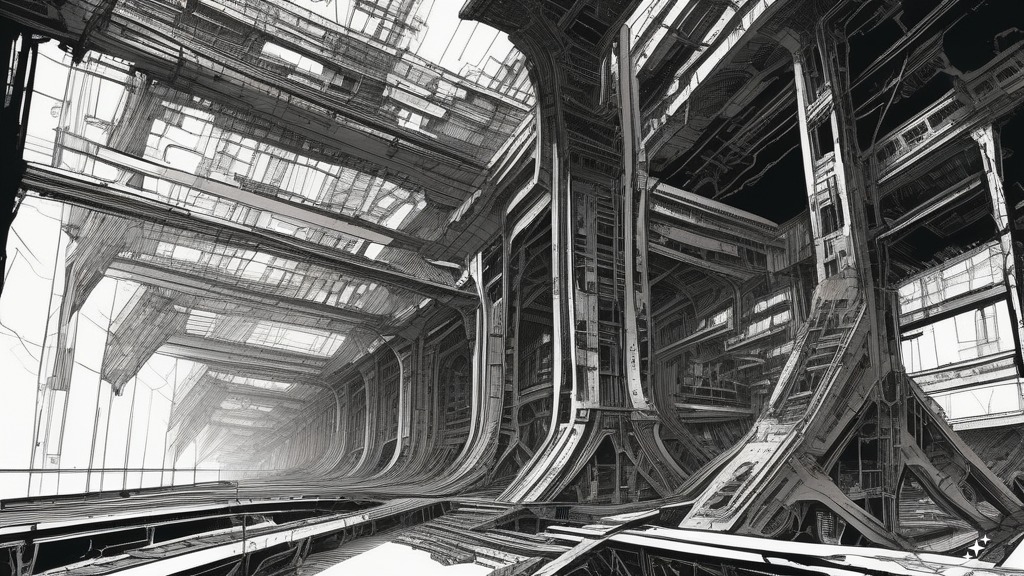
Every Manga by Tsutomu Nihei — The Complete List
Here’s the full picture at a glance. Every manga work Nihei has created, listed chronologically:
| Title | Years | Volumes | English Available? |
|---|---|---|---|
| Blame (debut short story) | 1995 | 1 chapter | Included in BLAME! Master Edition Vol. 6 |
| BLAME! | 1997–2003 | 10 | Yes — Master Edition (6 vols, Vertical) |
| NOiSE | 2000–2001 | 1 | Out of print (Tokyopop, 2006) |
| NSE: Net Sphere Engineer | 2000–2001 | 1 | No English edition |
| Wolverine: Snikt! | 2003 | 5 issues | Yes — Marvel collected edition |
| Biomega | 2004–2009 | 6 | Yes — Viz Media |
| Digimortal | 2004 | 1 chapter | No English edition |
| Blame! Gakuen and So On | 2004–2008 | 2 | Vol. 1 only (Tokyopop, out of print) |
| Abara | 2005–2006 | 2 (JP) / 1 (EN) | Yes — Deluxe Edition (Viz Media) |
| Zeb-Noid | 2005 | 1 chapter | No English edition |
| The Halo Graphic Novel | 2006 | 1 story | Yes — Marvel/Bungie |
| Knights of Sidonia | 2009–2015 | 15 | Yes — Vertical |
| Ningyou no Kuni | 2016 | 1 | No English edition |
| APOSIMZ | 2017–2021 | 9 | Yes — Vertical/Kodansha USA |
| Winged Armor Suzumega | 2019–2020 | 2 | No English edition |
| Kochu Gunkan | 2024–ongoing | TBD | No English edition yet |
That’s 16 distinct works spanning nearly 30 years. Some are massive multi-volume epics, some are single-chapter experiments. All of them share Nihei’s unmistakable aesthetic: hard sci-fi architecture (meaning science fiction that emphasizes technical plausibility and physical scale), designs that fuse organic and mechanical forms, and a sense of scale that makes your brain hurt (in the best way).
Now let’s break each one down properly.
A note on terminology before we go further: Manga chapters are typically published week-by-week or month-by-month in Japanese anthology magazines before being collected into bound volumes. This process is called “serialization,” and the magazine where chapters first appear is the serialization venue. You’ll see magazine names like Afternoon and Ultra Jump mentioned below — these are the Japanese magazines where Nihei’s chapters originally ran. The magazine matters because it often influences the style and target audience of the series.
Major Series — Detailed Breakdowns
These are Nihei’s four big works — the ones with substantial volume counts, ongoing storylines, and (in most cases) anime adaptations. (“Anime” refers to Japanese animation — TV series or films — and several of Nihei’s manga have been adapted into this format.)
BLAME! (1997–2003)
The one that started it all, and still Nihei’s most celebrated work.
BLAME! ran for 10 volumes in Kodansha’s Afternoon magazine. It follows Killy, a silent wanderer exploring an incomprehensibly vast megastructure called The City. He’s searching for a human who still carries the Net Terminal Gene — a genetic marker that could allow humanity to regain control of The City’s automated construction systems, which have been expanding without limit for millennia.
The City is the real star here. It’s a structure so enormous it stretches beyond Jupiter’s orbit, built by machines that never received a command to stop. Inside, you’ll encounter Silicon Life (sentient beings made of inorganic material who oppose humanity), Safeguard entities (security programs that have turned hostile), and tiny pockets of surviving humans clinging to existence inside the structure.
That’s the plot. But honestly? BLAME! is less about plot and more about experience. Nihei lets the architecture do the talking. Panels can go pages without dialogue. The scale is genuinely staggering. It’s atmospheric, it’s haunting, and the art is extraordinary.
English edition: The BLAME! Master Edition from Vertical collects the series in 6 oversized hardcover volumes. The larger format does wonders for Nihei’s detailed architectural spreads — these are premium-priced books (larger and more expensive than a standard manga volume), but the presentation is worth it. This is the version to get — it’s in print and widely available.
BLAME! 1 (Master Edition)
There’s also an older 10-volume edition from Tokyopop (one of several English-language manga publishers) that’s now out of print. It’s smaller format and the print quality isn’t as good, so the Master Edition is the way to go.
Anime: A CGI animated film was released in 2017 on Netflix by Polygon Pictures. “CGI” here means the animation uses 3D computer-generated imagery rather than traditional 2D hand-drawn animation — it gives the film a distinctive, somewhat stiff visual style that divides viewers. The film adapts a small self-contained story segment from the manga rather than the whole series. It’s a solid introduction to the world, but the manga is the real experience.
Awards: BLAME! earned Nihei the Nebula Award in 2016 (from the Science Fiction and Fantasy Writers of Japan, not the American Nebula).
Knights of Sidonia (2009–2015)
Nihei’s most reader-friendly series and his biggest commercial success.
Knights of Sidonia ran for 15 volumes in Kodansha’s Monthly Afternoon. It’s set aboard Sidonia, a massive seed ship carrying the remnants of humanity through space after Earth’s destruction by alien creatures called Gauna. Protagonist Nagate Tanikaze emerges from the ship’s underground levels and becomes a pilot of giant humanoid combat machines (called “mecha” in manga/anime terminology — think giant robots controlled by a human inside) to defend Sidonia against Gauna attacks.
Knights of Sidonia Master Edition 1
This one is much more conventionally structured than BLAME! — it has clear character arcs, dialogue-heavy scenes, romantic subplots, and mecha action sequences. If BLAME! is an art-house film, Knights of Sidonia is a blockbuster. That’s not a knock against it at all — it’s genuinely great sci-fi manga with Nihei’s signature design sensibilities applied to a more reader-friendly framework.
English edition: Published by Vertical in 15 volumes. All in print.
Anime: Knights of Sidonia received two anime seasons (2014 and 2015, both by Polygon Pictures) and a feature film, Knights of Sidonia: Love Woven in the Stars (2021). The anime is what brought many Western readers to Nihei’s work — it was one of Netflix’s early anime exclusives.
Awards: The series won the 39th Kodansha Manga Award in 2015 (General category).
Biomega (2004–2009)
Fast, violent, and weird. Nihei at his most action-packed.
Biomega ran for 6 volumes in Shueisha’s Ultra Jump magazine. It follows Zoichi Kanoe, a synthetic human who rides a motorcycle equipped with an AI companion, racing through a world being consumed by a zombie-like infection called the NS5 virus. His mission: find humans who are immune to the virus before a shadowy organization gets to them first.
What starts as a high-speed post-apocalyptic road trip escalates into something far stranger. Without spoiling too much, the story expands from street-level survival horror into cosmic territory involving planetary transformation, sentient bears with guns, and reality-bending stakes that dwarf the initial zombie premise. The tonal shift is jarring and intentional — it’s what sets Biomega apart from other outbreak/zombie stories. Nihei isn’t interested in the survival horror genre for its own sake; he uses it as a launchpad into something much weirder.
The art here is looser and more kinetic than in BLAME!, with massive action spreads and chase sequences. The pacing is breakneck. It’s a wild ride.
English edition: Published by Viz Media in 6 volumes. All in print.
Anime: None. Biomega has never been adapted into anime, which honestly feels like a missed opportunity given how cinematic the action is.
APOSIMZ (2017–2021)
Nihei’s most recent completed series, and his most conventionally structured.
APOSIMZ ran for 9 volumes in Kodansha’s Monthly Shōnen Sirius. “Shōnen” is a demographic label in manga publishing — it refers to series aimed at a young male audience, and shōnen manga typically features action, escalating battles, and a protagonist who grows stronger over time. The magazine’s target audience clearly influenced how this series was built.
APOSIMZ is set on a massive artificial celestial body where humans survive on the frozen surface while an empire controls the warmer interior. Protagonist Etherow gains the power of a Frame — a transforming combat exoskeleton — and fights against the Rebedoan Empire.
APOSIMZ has the most conventional battle-manga framework of any Nihei series: the protagonist gains new abilities over time, allies join the group one by one, villains escalate in threat level, and each chapter pushes the conflict forward with clear momentum. It still looks like a Nihei manga — the designs that fuse organic and mechanical forms and the environmental scale are all there — but the storytelling is noticeably more approachable for readers used to mainstream action manga.
English edition: Published by Vertical/Kodansha USA in 9 volumes. All in print.
Anime: A 12-episode TV anime aired in 2023, produced by Studio NAZ. It covers a good chunk of the manga’s story.
Important note: APOSIMZ uses the Japanese title 人形の国 (Ningyou no Kuni), which is the same title as a separate, earlier work Nihei published in 2016. They are completely different works. More on that below.
Short Series and Companion Works
Nihei has produced several shorter works — some connected to the BLAME! universe, some standalone. These range from one to two volumes each.
NOiSE (2000–2001)
A prequel to BLAME! set in the same megastructure.
NOiSE is 1 volume containing 8 chapters. It follows Musubi Susono, a detective investigating disappearances inside The City during an earlier era — before the events of BLAME!, when things hadn’t yet deteriorated as far. It provides context for how The City’s systems broke down and the Silicon Life emerged.
If you love BLAME! and want more of that world, NOiSE is the next place to go. It’s short enough to read in one sitting and adds meaningful backstory.
English edition: Published by Tokyopop in 2006, now out of print. Physical copies can be hard to find at reasonable prices. It may be available digitally depending on your region — worth checking digital manga storefronts before paying collector prices for a physical copy.
Do not confuse NOiSE with NSE: Net Sphere Engineer — they’re separate works despite both being set in the BLAME! universe and having similar-sounding names. This trips up a lot of people.
NSE: Net Sphere Engineer (2000–2001)
Another BLAME! companion piece, but much harder to find.
NSE is 1 volume with 6 chapters, also set in the BLAME! universe. It focuses on engineers working within the Net Sphere — the digital infrastructure that Killy is trying to access throughout BLAME!.
English edition: There is no official English edition of NSE. It was never licensed for English release.
Abara (2005–2006)
Short, brutal, and visually intense.
Abara is 2 volumes in the original Japanese edition. It’s an ultra-violent sci-fi horror story set in a claustrophobic urban environment where creatures called Gaunas — yes, the same name used later in Knights of Sidonia — wreak havoc. The connection between Abara’s Gaunas and Sidonia’s Gauna seems intentional; Nihei was clearly developing this concept here before expanding it into a full series later.
The art in Abara is some of Nihei’s densest and most detailed. It’s not an easy read — the storytelling is fragmented and the visual density is extreme — but if you like Nihei’s style cranked up to maximum, this delivers.
English edition: Viz Media published the Abara: Complete Deluxe Edition as a single oversized hardcover volume collecting both Japanese volumes into one book. It’s in print and looks great.
Blame! Gakuen and So On (2004–2008)
A comedic parody that reimagines BLAME! characters as high school students.
This one is genuinely surprising if you only know Nihei from his serious work. Blame! Gakuen ran for 2 volumes and recasts Killy, Cibo, Sanakan, and other BLAME! characters in a school comedy setting. It’s lighthearted, goofy, and clearly a passion project where Nihei got to have fun with characters he’d spent years depicting in grim silence.
English edition: Tokyopop released only Vol. 1 under the title Blame Academy!, and it’s now out of print. Vol. 2 was never released in English.
Ningyou no Kuni / Doll Country (2016)
A standalone work that shares a name (but nothing else) with APOSIMZ.
Ningyou no Kuni is 1 volume with 4 chapters, published in Ultra Jump. The title uses the Japanese characters 人形の国, which is also the Japanese title for APOSIMZ. Despite this, they are completely separate, unrelated works. This is one of the most confusing things in Nihei’s bibliography, so it’s worth repeating: same title, different stories.
English edition: There is no official English edition.
Standalone Stories and Collaborations
Beyond his series, Nihei has contributed to several standalone projects — including some unexpected crossovers with Western properties. (A “one-shot” in manga terminology means a standalone, self-contained story published as a single chapter rather than an ongoing series.)
Blame (1995 Debut Story)
This is where it all began. Nihei’s debut work was a short piece that served as the prototype for the full BLAME! series. The visual DNA is already there: massive structures, a lone wanderer, threats that blend organic and mechanical forms.
You don’t need to hunt this down separately — it’s included as a bonus in BLAME! Master Edition Vol. 6.
Digimortal (2004) and Zeb-Noid (2005)
Two standalone one-shots published in Ultra Jump. Both feature Nihei’s characteristic sci-fi aesthetic but are self-contained stories unconnected to his major series.
English edition: Neither has an official English edition.
Wolverine: Snikt! (2003)
Nihei draws Wolverine. Yes, really.
This is a 5-issue limited series published by Marvel Comics. Nihei brings Logan into a dystopian future world that looks… exactly like you’d expect a Nihei dystopian future to look. Massive structures, monsters that blend organic and mechanical forms, ruined landscapes. Wolverine fits surprisingly well in Nihei’s visual language — all claws and rage against an overwhelming, inhuman environment.
English edition: Available as a Marvel collected softcover edition. It’s in print and relatively easy to find. If you’re a Nihei fan who also reads Marvel, this is a fun crossover.
The Halo Graphic Novel (2006)
Nihei contributed a story called “Breaking Quarantine” to this anthology, published by Marvel Comics in collaboration with Bungie (the studio behind the Halo video game franchise). True to Nihei’s strengths, it’s a wordless action piece — pure visual storytelling depicting a devastating alien outbreak. If you know Halo’s setting, it’s a treat. If you don’t, it still works as a standalone piece of kinetic horror art.
Winged Armor Suzumega (2019–2020)
A 2-volume series published on Comic DAYs (a Kodansha digital platform). The notable thing here: Nihei wrote the story, but the art was handled by Yuki Moriya, a former assistant of his. The visual style is recognizably Nihei-adjacent but with Moriya’s own touch.
English edition: There is no official English edition.
Nihei’s Latest: Kochu Gunkan (2024–Ongoing)
Nihei’s newest series began in March 2024 in Kodansha’s Morning Two magazine. Kochu Gunkan is a space opera featuring massive ancient warships at the edge of the galaxy — which sounds exactly like the kind of enormous-scale sci-fi that Nihei does best.
The series is ongoing as of this writing, with no English release yet. It marks Nihei’s return to Kodansha after completing APOSIMZ, and for longtime fans, the premise is extremely exciting. Ancient warships at galactic scale? That’s Nihei’s wheelhouse.
Keep an eye on this one — given that Kodansha has published English editions of Nihei’s work through Vertical for years, an English release seems likely once enough volumes accumulate.
Suggested Reading Order for Beginners
If you’re new to Nihei and wondering where to start, here’s a path that works well:
Start here: BLAME! Master Edition
This is Nihei’s masterpiece and his most representative work. The Master Edition’s oversized format is perfect for appreciating his architectural art. Fair warning: it’s intentionally sparse on dialogue and exposition. That’s not a flaw — it’s the point. Let yourself get absorbed into the scale and atmosphere.
If that sounds intimidating, start with Knights of Sidonia instead. It has clear characters, plenty of dialogue, a structured plot, and an anime adaptation on Netflix if you want to sample the story before buying. You can always circle back to BLAME! once you’re comfortable with Nihei’s visual style.
Second (or first, if you started with Sidonia): The other one
If you began with BLAME!, move to Knights of Sidonia for something more conventionally structured. If you began with Knights of Sidonia, move to BLAME! once you’re ready for a more atmospheric, dialogue-light experience.
Third: Biomega
For faster-paced action. It’s only 6 volumes, so it’s a quick read. The escalation from “motorcycle chase through zombie apocalypse” to “cosmic weirdness” is genuinely fun.
Fourth: Abara
If you want something short and intense. The Deluxe Edition is a single hardcover, so it’s an easy pickup. Be prepared for dense, fragmented storytelling — this is Nihei at his most challenging.
Fifth: APOSIMZ
Nihei’s most recent completed series and his most conventionally structured. Good for readers who like action-manga progression (protagonist powers up, allies join, villains escalate) but want Nihei’s aesthetic.
After BLAME!: NOiSE and NSE
Read these after finishing BLAME!, not before. They expand the world’s backstory but land much harder when you already know the setting. NOiSE in particular adds meaningful context to BLAME!’s history.
Universe connections worth knowing:
- BLAME!, NOiSE, and NSE: Net Sphere Engineer all share the same setting (The City / Net Sphere)
- Abara features creatures called Gaunas, a name and concept Nihei reused in Knights of Sidonia, but the two series don’t share a setting
- All other works are standalone — no shared universe connections
English Availability Quick-Reference
This table covers every Nihei work and whether you can read it in English right now. Publisher names refer to the English-language manga publishers that licensed each work — they handle translation, printing, and distribution for the English market.
| Title | English Publisher | Format | In Print? |
|---|---|---|---|
| BLAME! Master Edition | Vertical | 6 oversized hardcovers | Yes |
| BLAME! (original) | Tokyopop | 10 standard vols | No (out of print) |
| Knights of Sidonia | Vertical | 15 vols | Yes |
| Biomega | Viz Media | 6 vols | Yes |
| APOSIMZ | Vertical/Kodansha USA | 9 vols | Yes |
| Abara: Complete Deluxe Edition | Viz Media | 1 oversized hardcover | Yes |
| Wolverine: Snikt! | Marvel Comics | Collected softcover | Yes |
| The Halo Graphic Novel | Marvel/Bungie | Anthology | Yes |
| NOiSE | Tokyopop | 1 vol | No (out of print) |
| Blame Academy! (Vol. 1 only) | Tokyopop | 1 vol | No (out of print) |
| NSE: Net Sphere Engineer | — | — | No English edition |
| Digimortal | — | — | No English edition |
| Zeb-Noid | — | — | No English edition |
| Ningyou no Kuni | — | — | No English edition |
| Winged Armor Suzumega | — | — | No English edition |
| Kochu Gunkan | — | — | No English edition (yet) |
The good news: Nihei’s four major series — BLAME!, Knights of Sidonia, Biomega, and APOSIMZ — are all fully available in English and in print. That’s the vast majority of his page count. The gaps in English availability are mostly one-shots and short companion works.
The frustrating gap: NOiSE being out of print is the biggest loss, since it’s a direct prequel to BLAME! and adds real value to that reading experience. Check digital manga storefronts for availability before paying inflated collector prices for a physical copy.
Tsutomu Nihei has been building impossible worlds for nearly three decades, and with Kochu Gunkan now running, he’s clearly not slowing down. Whether you start with the silent corridors of BLAME! or the mecha battles of Knights of Sidonia, you’re in for some of the most visually stunning sci-fi manga out there. The BLAME! Master Edition is a premium hardcover and priced accordingly, but grab Vol. 1 and see for yourself — those first few pages will tell you everything you need to know about whether Nihei’s work is for you.