What Is BLAME! — Tsutomu Nihei’s Cyberpunk Manga Masterpiece
Here’s the short version: BLAME! is a 10-volume cyberpunk manga by Tsutomu Nihei, serialized from 1997 to 2003 in Kodansha’s Monthly Afternoon (a Japanese manga magazine). In English, it’s available as 6 oversized Master Edition softcovers from Vertical (now an imprint of Kodansha USA). The series is complete — no waiting for new volumes.
Note: this is a multi-book set put together by a third-party seller, not an official publisher box set.
BLAME! Manga Complete Master Edition Vol. 1-6
It follows a lone wanderer named Killy through an impossibly vast megastructure — a man-made environment grown far beyond anyone’s control — called The City. That’s… kind of the whole pitch. A man walks through a building the size of a solar system, carrying a gun that can punch holes through continents, looking for something almost no one remembers exists.
If that sounds sparse, that’s because it is. BLAME! is one of the most visually overwhelming and narratively minimalist manga ever created. There’s very little dialogue. Chapters can pass with barely a word spoken. The architecture is the story. The emptiness is the atmosphere. It’s not for everyone — but for the people it clicks with, nothing else comes close.
This is Nihei’s debut long-form work, and it remains his most iconic. Everything he’s done since builds on the foundation laid here.
If you already know you want to try it and just need a buying recommendation: grab Master Edition Vol. 1 — that single oversized softcover collects the first two original volumes and will tell you within fifty pages whether this manga is for you. More on editions and format options further down.
BLAME! 1 (Master Edition)
Who Is Tsutomu Nihei?
Nihei is a trained architect — he studied at Parsons School of Design in New York before becoming a manga artist. That background isn’t trivia. It’s the single most important thing to know about his work. The sense of space, scale, and structural design in BLAME! doesn’t come from imagination alone. It comes from someone who thinks in load-bearing walls and structural voids.
His buildings feel real because they’re drawn by someone who understands how buildings work — and then he takes that understanding and stretches it into something nightmarish and infinite.
The Story — Killy’s Search Through the Endless City
The premise of BLAME! fits in a single sentence: Killy wanders The City, searching for a human who carries Net Terminal Genes.
That’s it. That’s the plot engine for all ten volumes. What makes it work is everything surrounding that simple quest.
The City
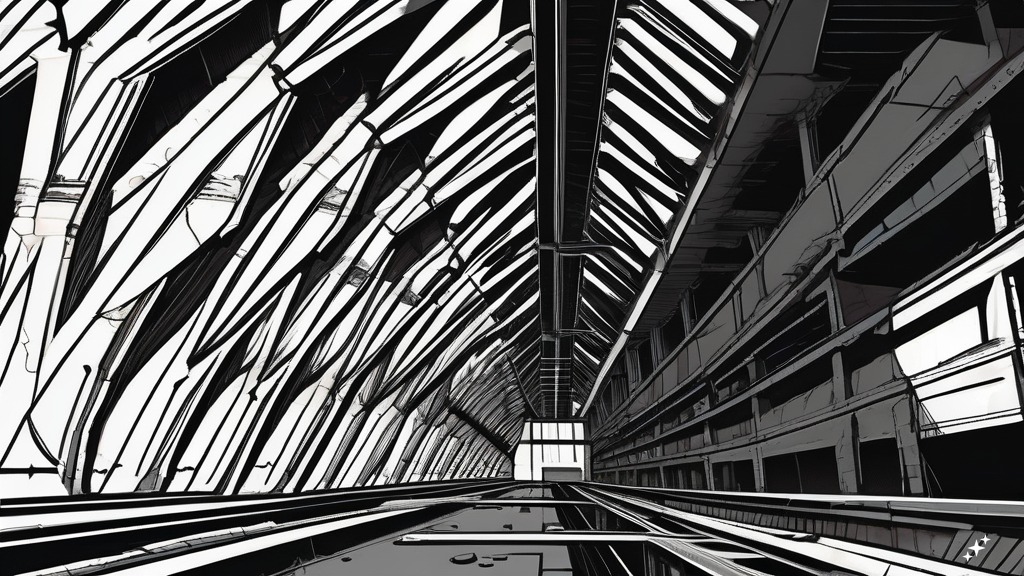
The City is a megastructure — a man-made environment that has grown far, far beyond anyone’s control. Automated construction drones called Builders have been adding to it endlessly, with no plan and no oversight. Walls, floors, pipes, corridors, and chambers stretch outward in every direction. Some estimates within the manga suggest The City may extend as far as the orbit of Jupiter.
No one governs it. No one designed it to be this way. It just kept building, and building, and building, long after the civilization that created it lost the ability to stop it. The result is an environment that feels both claustrophobic and infinitely vast at the same time — cramped tunnels open into caverns the size of countries, and then close back into suffocating corridors.
You are meant to feel lost reading it. That’s the point.
Net Terminal Genes
In the world of BLAME!, an AI network called the Netsphere — essentially a digital governing system that once managed all of human civilization — controlled access through a specific biological marker: Net Terminal Genes. Think of it like a genetic password built into human DNA.
At some point — the manga never spells out exactly when or how — humanity lost these genes. Without them, every human in The City is classified as unauthorized. And unauthorized users get dealt with.
What Killy Is Looking For
Killy’s mission is straightforward: find someone, anyone, who still carries Net Terminal Genes. If he can, there’s a chance to reconnect humanity to the Netsphere and stop the endless, purposeless expansion of The City. Stop the killing. Restore some kind of order.
Whether that’s even possible anymore is one of the questions the manga slowly, silently asks.
Key Characters — Killy, Cibo, and the Forces of The City
BLAME! has a small cast. Nihei isn’t interested in ensemble drama. He’s interested in figures moving through space — and the things that try to stop them.
Killy
Killy is the protagonist, and he is almost entirely silent. He has virtually no backstory. He rarely speaks. He walks, he fights, and he searches. His weapon — the Gravitational Beam Emitter — is a small, handgun-like device capable of catastrophic destruction. A single shot can carve through kilometers of megastructure.
His silence isn’t a flaw in the writing. It’s the writing. In a manga where the environment is the main character, Killy is your viewpoint — a figure dwarfed by impossible spaces, pushing forward with no guarantee of success. You learn about him through what he does, not what he says.
Cibo
Cibo is the closest thing BLAME! has to a traditional character. She’s a scientist Killy encounters relatively early in the story, and she becomes his companion. Where Killy is silent, Cibo provides context. She’s the one who explains — in fragments, in scattered moments — what the Netsphere is, what went wrong, and what they’re looking for.
Her arc is central to the emotional weight of the manga. Without spoiling anything: pay attention to Cibo. She carries more of the story’s heart than Killy does.
The Safeguards
The Safeguards are autonomous defense systems. Their purpose is simple: exterminate unauthorized humans. Since virtually no humans carry Net Terminal Genes anymore, the Safeguards treat nearly all human life as a threat to be eliminated. They range from small, humanoid units to towering, terrifying constructs.
They’re relentless. They don’t negotiate. They don’t stop.
Silicon Life
Silicon Life are post-human entities — beings that have evolved or modified themselves beyond biological humanity. They oppose both the humans and the Safeguards, and they actively work to prevent anyone from reconnecting to the Netsphere. They want humanity locked out permanently.
Their motivations are murky, which is fitting for a manga that rarely explains anyone’s motivations cleanly.
Builders
The Builders are the mindless construction drones responsible for The City’s endless expansion. They’re not villains in any traditional sense — they don’t think, they don’t hate, they just build. But their ceaseless, purposeless construction is arguably the most terrifying force in the entire manga. There are panels where Killy stands at the edge of a void and you can see Builders working in the distance — adding floors, extending walls, filling in open space — with the same indifference as a machine stamping parts in a factory. The horror is in the total absence of intent. The City isn’t growing toward anything. It’s just growing.
Why BLAME! Is Hard to Read — and How to Get Through It
Let’s address this directly: BLAME! is famously difficult for first-time readers. If you bounce off it on your first attempt, you are not alone. It’s one of the most common experiences people report with this manga.
Here’s why:
- Minimal dialogue. Some chapters have almost zero text. Entire story beats are told through panels of architecture and action with no narration, no thought bubbles, no explanation.
- No exposition dumps. There is no narrator explaining the lore. There is no character who sits Killy down and says “here’s how the world works.” You piece the setting together from fragments — a line of dialogue here, a visual clue there.
- Scale is disorienting by design. Nihei deliberately makes it hard to tell how far Killy has traveled, how big a room is, or where one level of The City ends and another begins. You’re supposed to feel lost. That disorientation is the atmosphere.
- Non-traditional pacing. If you’re used to manga that follows a clear chapter-by-chapter structure with cliffhangers and escalation, BLAME! will feel alien. It moves in long, quiet stretches punctuated by sudden, brutal violence.
How to Actually Enjoy It
Here’s what works for a lot of readers:
- Read slowly. This is not a manga you blitz through in an afternoon. Spend time with each page. Look at the backgrounds. Study the architecture. Nihei drew every corridor, every pipe, every impossible cavern with purpose.
- Don’t fight the confusion. You are not supposed to understand everything on the first read. Accept that some things will only click on a second pass — or never fully resolve. That ambiguity is part of the experience.
- Let the visuals carry you. BLAME! is closer to visual art than traditional comics storytelling. If you try to read it like a plot-driven manga, you’ll be frustrated. If you let it wash over you like a series of architectural paintings connected by a thin narrative thread, it becomes incredible.
- Re-reads are rewarding. Almost everyone who loves BLAME! loves it more on the second read. Details you missed become clear. Connections between scenes emerge. The world builds itself in your mind over time.
- Read the Master Edition if possible. The larger format makes a real difference. Nihei’s art is dense with detail, and the oversized softcover pages let you actually see it. Reading BLAME! on a phone screen is technically possible, but it’s like watching a nature documentary on a postage stamp.
Editions and How to Buy BLAME! Manga in English
There are two English editions of BLAME!. One is the one you want. The other is a collector’s curiosity.
Master Edition (Vertical/Kodansha) — The One to Get
The Master Edition is the current, in-print English release. It comes in 6 oversized softcover volumes with a newer translation. The concept is simple: each Master Edition book collects roughly 2 of the original smaller Japanese volumes into one big hardcover. Here’s how they break down:
| Master Edition | Approx. Original Volumes |
|---|---|
| Master Edition Vol. 1 | Vols. 1–2 |
| Master Edition Vol. 2 | Vols. 3–4 |
| Master Edition Vol. 3 | Vols. 5–6 |
| Master Edition Vol. 4 | Vols. 7–8 |
| Master Edition Vol. 5 | Vols. 9 (partial)–10 (partial) |
| Master Edition Vol. 6 | Vol. 10 (remainder) + extras |
BLAME! 1 (Master Edition)
The larger format is genuinely important for this manga. Nihei’s art demands space. Fine details — tiny figures against massive structures, the textures of corroded metal and organic growths — become visible in ways they simply aren’t in standard-sized editions.
The Master Edition is also available digitally (via Kindle/Comixology). If you primarily read manga on a tablet, the digital version works well — the large screen of a tablet preserves much of the detail that makes these pages striking. On a phone, you’ll lose a lot. If you have the choice, physical hardcovers or a large tablet are the best ways to experience this art.
If you want to start with a single volume to test the waters, Master Edition Vol. 1 is the obvious starting point.
BLAME! 1 (Master Edition)
Original Tokyopop Edition — Collector’s Item Only
The original English release was published by Tokyopop (a now-defunct manga publisher) as 10 standard-sized volumes. It used a different translation and is now out of print. Copies float around on the secondhand market, sometimes at steep prices.
There’s no practical reason to seek out the Tokyopop edition unless you’re a collector. The Master Edition is better in every way — better format, better translation, currently available.
The BLAME! Universe — NOiSE, the 2017 Movie, and Spinoffs
BLAME! spawned a small constellation of related works. None of them are required. All of them are better experienced after you’ve read the main manga.
NOiSE
NOiSE is a single-volume prequel manga set in an earlier era of the same megastructure. It follows a detective investigating strange events that tie into the origins of The City’s collapse. It’s short, it’s dense, and it adds context to the world Killy wanders through. It’s available in English from Vertical/Kodansha as one collected volume.
Read it after BLAME!, not before. It works as supplementary lore, not as an introduction. Going in cold, it would make even less sense than BLAME! itself.
BLAME! (2017 Netflix Film)
A CGI animated film was released in 2017 that adapts a small section of the manga. It focuses on a group of human survivors encountered by Killy and Cibo, and it gives them more characterization and dialogue than the manga does.
As a visual introduction to the feel of The City, it’s surprisingly effective. The animation captures the cavernous scale and oppressive emptiness well. As an adaptation of the full manga? It barely scratches the surface. It covers a fraction of the story.
If you’ve seen the movie and want to know what happens beyond that small slice — that’s exactly what the manga is for.
BLAME! Academy and So On
This is a comedic spinoff (a side story that reimagines the cast in a completely different setting) that puts the BLAME! characters into a school setting. It’s tonally the exact opposite of the main manga. It exists, it’s a curiosity, and it’s really only for people who already love the characters and want to see them in a completely different context.
Where to Go After BLAME! — Nihei’s Other Manga
One of the best things about discovering Nihei through BLAME! is that he has a full catalog of work. Each series has its own flavor, but all share his signature aesthetic: colossal structures, inhuman threats, and characters dwarfed by their environments. If you’re coming from a horror manga angle specifically, some of these lean harder into horror than others — noted below.
Biomega (6 Volumes)
Biomega has more conventional storytelling than BLAME! — there’s actual dialogue, clearer action sequences, and a plot you can follow without a magnifying glass. It’s set in a world dealing with a zombie-like infection, and it features motorcycles, synthetic humans, and yes, a talking bear.
It’s weird, it’s fast-paced, and it’s a good second Nihei read if you want something a bit more accessible. Horror factor: moderate — the body horror and zombie elements are present but secondary to the action. It leans more toward sci-fi action-thriller than pure horror.
Abara (2 Volumes)
Abara is short, dense, and the closest thing in Nihei’s catalog to BLAME!’s abstract, visual-first approach. It deals with human-monster hybrids in a dark industrial setting. At only 2 volumes, it’s a quick read — but “quick” for Nihei still means poring over hyper-detailed panels of organic-mechanical body horror.
If you loved BLAME!’s style and want more of exactly that, Abara is your pick. Horror factor: high — the creature designs and atmosphere are deeply unsettling.
Knights of Sidonia (15 Volumes)
Knights of Sidonia is Nihei’s most accessible work by a significant margin. It’s a sci-fi manga about the last humans surviving on a massive spaceship, fighting alien threats called Gauna — enormous, shape-shifting organisms that consume and mimic human forms. There’s more dialogue, clearer character development, romance subplots, and a traditional narrative structure with steady pacing.
It was adapted into a Netflix anime (two seasons), which is also a solid way to experience it.
If you want Nihei’s architectural grandeur and sci-fi worldbuilding but with a story that doesn’t require you to decode each page, this is the one. Horror factor: moderate — the Gauna designs are genuinely creepy and there are strong body horror elements, but the overall tone is more action-sci-fi.
(Note: the creatures in Knights of Sidonia are called “Gauna” — same romanization as the hybrids in Abara, but they’re entirely different entities in unrelated stories. Nihei reuses the name.)
APOSIMZ (9 Volumes)
Nihei’s most recently completed series (as of this writing). APOSIMZ is set on the surface of an artificial planet and leans more into action-adventure territory with clearer stakes and character arcs than BLAME!, while still featuring Nihei’s signature massive, mysterious structures. Horror factor: low — this is the most action-adventure-oriented work in his catalog, though it has some unsettling imagery.
Suggested Reading Order
If you want to explore Nihei’s full body of work, here’s a reading path that moves from most abstract to most accessible:
- BLAME! — Start here. It’s the foundation.
- Abara — Short, stylistically close to BLAME!, and the most horror-heavy of his shorter works.
- Biomega — More story, more action, still distinctly Nihei.
- Knights of Sidonia — His most structured and character-driven work.
- APOSIMZ — His latest, a nice capstone that blends his tendencies.
You can absolutely skip around — these aren’t sequels to each other (with the exception of NOiSE being loosely connected to BLAME!). But this order gives you a satisfying path through his evolution as a storyteller.
Final Thoughts — Is BLAME! Manga for You?
BLAME! is not a manga that holds your hand. It drops you into an incomprehensibly vast, hostile world with a silent protagonist, almost no exposition, and panels that prioritize atmosphere over clarity. For some readers, that’s alienating. For others, it’s exactly the kind of experience they’ve been craving without knowing it existed.
If any of this sounds appealing to you:
- You love atmospheric horror, cyberpunk, or sci-fi that prioritizes worldbuilding over plot
- You’re drawn to visual storytelling and don’t mind minimal dialogue
- You’ve enjoyed things like the Dark Souls games, the Alien films, or stark concrete architecture and thought “I want a manga that feels like this”
- You want something genuinely unlike anything else in manga
Then honestly, just grab Master Edition Vol. 1 and see for yourself. You’ll know within the first fifty pages whether this is your thing. And if it is? You’ve got one of the most unforgettable reading experiences in the genre ahead of you.
BLAME! 1 (Master Edition)