What Makes Junji Ito’s Horror So Effective
Before we get into specific titles, it helps to understand why Ito’s work hits so hard — especially if you’re still on the fence about whether horror manga is for you.
Hyper-Detailed Art That Amplifies the Grotesque
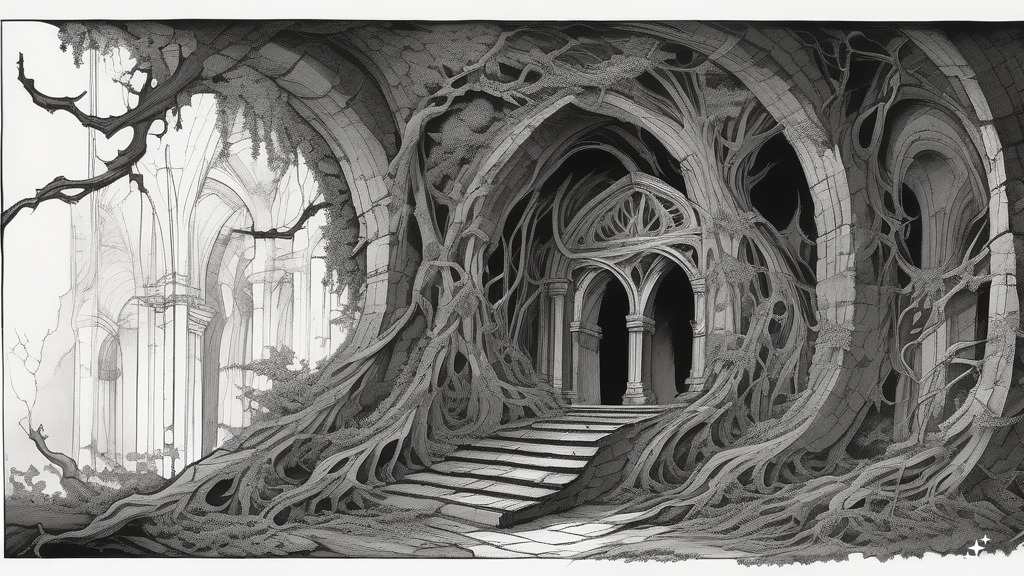
Ito’s linework — the actual drawn lines that make up his illustrations — is obsessively detailed. Every spiral in Uzumaki, every wound on Tomie’s body, every mechanical leg on the fish in Gyo is rendered with painstaking precision. This matters because horror lives in the details. A rough sketch of something scary is just a sketch. But when every pore, every tendril, every impossible biological detail is drawn with sharp, almost photographic clarity, your brain processes it differently. It becomes visceral.
Ordinary Settings Corrupted by the Impossible
Ito almost always starts in mundane reality. A small coastal town. A high school. A neighborhood. Then something impossible intrudes — spirals that shouldn’t move, a girl who can’t die, fish that walk on land — and the ordinary world bends around it. This gap between the normal and the impossible creates a deep sense of wrongness that’s hard to shake. You can’t explain it. The characters can’t explain it. It simply is.
Body Horror as Metaphor
Ito’s body horror isn’t just gross for the sake of being gross (though it’s definitely gross). The spirals in Uzumaki work as a metaphor for obsession — the way a single fixation can twist and consume your entire life. Tomie’s regeneration and multiplication mirror toxic desire — the way unhealthy attachment produces more pain no matter how many times you try to end it. The physical horror maps onto psychological and emotional experiences, which is why it resonates beyond the initial shock.
Slow-Build Dread
Most of Ito’s best work starts quiet. Characters notice something slightly off. They investigate. Things get a little weirder. Then a little weirder. Then the floor drops out and you’re in a full nightmare. This slow escalation — from “huh, that’s odd” to “oh no” to “OH NO” — is incredibly effective because by the time things go truly wrong, you’re already emotionally invested in the characters and their world.
Short Answer — The Best Junji Ito Manga Overall
If you only read one Junji Ito work in your entire life, make it Uzumaki.
It’s the consensus masterpiece. It’s the one that comes up in virtually every “best horror manga” conversation. And it’s available as a single 3-in-1 Deluxe Edition — a large-format, premium hardcover that collects all three original volumes (the individual books that make up the series) into one oversized book that really lets the art breathe.
After Uzumaki, the next tier includes:
- Tomie — his debut work and the other long-form classic
- Gyo — his second major series, with a wildly different kind of horror
- Shiver — the best short story collection, hand-picked by Ito himself
But each of those serves a different mood. Let’s dig into the specifics.
Before we do, a quick note on how this guide is organized. Ito’s catalog falls into three categories:
- Series — multi-chapter works that tell a longer, sustained story across multiple volumes
- Short story collections — single books containing several self-contained stories, each one its own separate nightmare
- Standalones — single volumes that tell one complete story from start to finish
We’ll cover each category in turn.
Best Junji Ito Series
These are his multi-chapter, long-form works — the ones with sustained narratives and the deepest world-building.
Uzumaki — The Spiral Masterpiece
Format: 3 volumes (19 chapters, plus the unnumbered bonus “Lost Chapter: Galaxies”), available as a 3-in-1 Deluxe Edition
Originally published in: Big Comic Spirits (a popular Japanese manga magazine), January 1998 – August 1999
English publisher: Viz Media (the main company that publishes Ito’s manga in English)
A small coastal town called Kurouzu-cho becomes infected by spirals. Not a virus. Not a curse in the traditional sense. Just… spirals. They appear everywhere. In snail shells. In pottery. In hair. In the human body itself.
What makes Uzumaki so brilliant is that it takes a simple geometric shape — something you see every day without thinking about it — and turns it into the most terrifying thing imaginable. Each chapter escalates the spiral obsession further, and Ito’s art becomes increasingly detailed and grotesque as the town falls apart.
The story structure is clever too. Early chapters work almost like connected short stories, each exploring a different way spirals corrupt the townspeople. But by the second half, everything converges into a single escalating nightmare that doesn’t let go.
This is peak Junji Ito. If you’re only going to read one thing, this is it.
Uzumaki (3-in-1 Deluxe Edition)
Tomie — The Immortal Girl
Format: 20 interconnected short stories, available as a Complete Deluxe Edition
Originally published in: Monthly Halloween (a Japanese horror manga magazine), 1987–2000
English publisher: Viz Media
Tomie was Junji Ito’s debut work, first published in 1987, and it’s remarkable how fully formed his horror instincts were from the very beginning.
Tomie Kawakami is a beautiful girl who inspires obsessive love in everyone around her — the kind of love that inevitably turns to murder. But Tomie can’t be killed. She regenerates. She multiplies. And she always comes back.
The structure here is different from Uzumaki. Rather than a single continuous narrative, Tomie is a collection of interconnected stories spanning over a decade of Ito’s career. Each story can be read on its own, but together they build an increasingly unsettling portrait of desire, possession, and the horror of something that simply will not die.
Because the stories were written over such a long period, you can see Ito’s art change over time — his earlier pages have a rougher, looser quality, while the later stories feature the incredibly dense, detailed style that became his signature. That evolution is fascinating to follow if you’re curious about how his craft developed.
Content note: Some Tomie stories contain scenes of sexual violence. Be aware of this if that’s a boundary for you.
Gyo — The Walking Fish Apocalypse
Format: 2 volumes, available as a 2-in-1 Deluxe Edition
Originally published in: Big Comic Spirits, 2001–2002
English publisher: Viz Media
Gyo is… a lot. Dead fish walk on land using mechanical legs. That’s the premise. And it only gets more extreme from there.
If Uzumaki is slow-build atmospheric dread, Gyo is a full-throttle nightmare that leans heavily into body horror and grotesque imagery. The pacing is relentless, and Ito pushes the concept to such absurd extremes that it becomes genuinely disturbing rather than silly.
Fair warning: Gyo is the most physically revolting of Ito’s major works. The “death stench” that permeates the story is practically something you can smell through the pages. Some readers absolutely love this about it. Others find it a tough read. Both reactions are valid.
Bonus: The Gyo Deluxe Edition includes The Enigma of Amigara Fault as a bonus story. This is the famous short story where people discover human-shaped holes in the side of a mountain — each one perfectly shaped for a specific person. The iconic line “this is my hole, it was made for me” has become one of the most widely shared horror manga images online. It’s only about 30 pages, but it’s unforgettable. Even if Gyo itself doesn’t click with you, the bonus story alone is worth having this book on your shelf.
Best Junji Ito Short Story Collections
Ito’s short stories are arguably where his genius shines brightest. Each one is a self-contained nightmare — a single horrifying concept, explored and resolved in under 40 pages. Here are the best collections.
Shiver — The Author-Curated Sampler
Format: Single volume, 9 stories
English publisher: Viz Media
This is the one short story collection every Ito fan points beginners toward, and for good reason: Junji Ito himself selected these 9 stories and wrote commentary for each one. You’re essentially getting his personal greatest-hits album, curated by the artist.
The stories here cover a wide range of his horror — from body horror to atmospheric dread to the uncanny and surreal. It’s also a single, manageable volume, so it won’t overwhelm you if you’re just testing the waters.
If you want to sample Ito’s range before committing to a full series, start here.
Fragments of Horror
Format: Single volume
English publisher: Viz Media
Fragments of Horror contains tightly constructed standalone tales, each built around a distinct nightmare concept. The stories here tend to be more compact and focused than in some of his other collections — there’s very little fat. Each story sets up its horror, delivers on it, and gets out.
This collection is included in the Junji Ito Story Collection 3-book set alongside Lovesickness and Deserter, which is a solid way to grab multiple collections at once.
Note: this is a multi-book set put together by a third-party seller, not an official publisher box set.
Junji Ito Story Collection 3 books set: Lovesickness, Deserter, Fragments of Horror
Venus in the Blind Spot
Format: Single volume, 10 stories
English publisher: Viz Media
This collection includes a reprint of The Enigma of Amigara Fault (the same story that appears in the Gyo Deluxe Edition), so keep that in mind if you’re trying to avoid double-buying. The other 9 stories are strong, and the collection as a whole showcases Ito’s ability to find horror in unexpected places.
Smashed
Format: Single volume, 13 stories
English publisher: Viz Media
With 13 stories, Smashed is one of the larger collections and includes fan favorites like “Earthbound.” It’s a great pickup once you’ve read one or two other collections and know you want more.
More Recent Collections
Ito continues to put out new story collections regularly. Recent English releases include:
- Alley — features tales connected by eerie urban spaces. The setting itself becomes a character, with dark alleyways and forgotten corners of cities harboring strange, unsettling things. A good pick if you liked the way Uzumaki made an entire town feel haunted.
Alley: Junji Ito Story Collection
- Moan — one of the newer collections, featuring a mix of horror styles. Includes some of Ito’s more recent short work that hasn’t appeared in earlier compilations.
Moan: Junji Ito Story Collection
- Stitches — a different kind of Ito book: nine true-story mysteries written by Hirokatsu Kihara, illustrated page after page by Ito, plus one bonus manga story. More an illustrated tale collection than a manga, but it slots naturally onto an Ito shelf.
Stitches (Junji Ito)
All three are Viz Media hardcover releases. They’re great for readers who’ve already gone through the classics and want to keep exploring.
Best Standalone Junji Ito Works
Beyond series and short story collections, Ito has several standalone volumes that tell a single complete story. These are some of the best.
Remina
Format: Single volume (released December 2020 in English)
English publisher: Viz Media
A newly discovered planet is named after the astronomer’s daughter, Remina. When the planet begins hurtling toward Earth at impossible speed — and appears to be alive — the public’s adoration of the girl turns to violent hatred. They blame her. Because of course they do.
Remina is sci-fi horror that deals with forces far beyond human understanding, combined with a sharp story about mob mentality and scapegoating. It’s not as tightly constructed as Uzumaki, but the horror imagery is spectacular, and the escalation is wild.
No Longer Human
Format: Single volume
English publisher: Viz Media
This is Ito’s manga adaptation of Osamu Dazai’s classic Japanese novel — a semi-autobiographical story about a man who feels fundamentally disconnected from other humans. Ito takes the original literary work and infuses it with his horror sensibility, adding grotesque visual metaphors that externalize the protagonist’s internal anguish. Things that are only emotional pain in the novel become visible, physical nightmares on the page.
It’s not a traditional horror manga. It’s more of a psychological character study with horror imagery. But it’s one of Ito’s most artistically ambitious works and shows a very different side of his talent.
Lovesickness
Format: Single volume
English publisher: Viz Media
At a foggy crossroads, a mysterious beautiful boy tells fortunes. But his predictions aren’t helpful — they’re destructive, sending an entire town spiraling into obsession and death. Lovesickness has a dreamy, almost fairy-tale quality that sets it apart from Ito’s more visceral work.
This one is included in the 3-book story collection set alongside Fragments of Horror and Deserter.
Junji Ito Story Collection 3 books set: Lovesickness, Deserter, Fragments of Horror
Sensor
Format: Single volume
English publisher: Viz Media
Sensor blends volcanic ash, golden hair, cosmic horror, and religious obsession into something genuinely strange. Cosmic horror — the idea that the universe contains vast, incomprehensible forces that make humanity seem tiny and insignificant — is a recurring thread in Ito’s work, and Sensor leans into it harder than almost anything else he’s done. Opinions are split on how well it sticks the landing, but the journey is worth taking, especially if you enjoy stories that reach for ideas bigger than any character can grasp.
Dissolving Classroom
Format: Single volume
English publisher: Kodansha
Dissolving Classroom follows a brother and sister whose relationship is deeply, disturbingly wrong. The brother apologizes compulsively — and his apologies somehow cause people around him to literally dissolve. It’s one of Ito’s more darkly comedic works, blending genuine horror with an absurdist streak. Shorter and more accessible than his major series, it makes a good palette change if you’ve been reading heavier material.
Dissolving Classroom (Junji Ito)
Where to Start Reading Junji Ito
Here’s a simple decision tree based on what kind of reader you are:
“I want the absolute best. Just give me the one book.”
Get Uzumaki (3-in-1 Deluxe Edition). It’s self-contained, it’s iconic, and you’ll own the complete story in a single gorgeous hardcover. This is the work that cemented Ito’s reputation, and it earns that status on every page. The Deluxe Editions typically run in the $20–$30 range, so you’re getting a substantial amount of content for the price.
Uzumaki (3-in-1 Deluxe Edition)
“I’m not sure I want to commit to a whole series yet.”
Start with Shiver. It’s a single volume of 9 stories hand-picked by Ito himself, with his own commentary. You’ll get a taste of his range — body horror, atmospheric dread, the surreal — without committing to a longer narrative. If you like what you see, you’ll know exactly where to go next.
“I already watched the anime and want to know if the manga is worth it.”
Yes. The manga is where Ito’s art has its full impact — anime adaptations, while they have their own strengths, can’t fully replicate the level of detail and the specific pacing of turning a page to reveal a full-spread horror image. If you watched the Uzumaki anime or the Junji Ito Collection series, the manga versions of those same stories will feel like a significant upgrade. Start with whichever story you liked most in animated form.
“I already read Uzumaki and loved it. What’s next?”
Go to Tomie (Complete Deluxe Edition) next if you want another long-form work — it’s a fascinating companion to Uzumaki: where Uzumaki is about a place being consumed, Tomie is about a person who consumes everyone around her. (The full roadmap below slots Shiver in between as a shorter breather, but Tomie works perfectly well straight after Uzumaki.)
After Tomie, pick up Gyo (2-in-1 Deluxe Edition) for the bonus Enigma of Amigara Fault story alone.
Then start exploring the short story collections: Shiver first, then Fragments of Horror, then Venus in the Blind Spot, then Smashed.
“I want to go deep. Give me the full roadmap.”
Here’s a suggested reading order that balances quality with variety:
- Uzumaki (3-in-1 Deluxe Edition)
- Shiver (short stories — a nice change of pace after a full series)
- Tomie (Complete Deluxe Edition)
- Gyo (2-in-1 Deluxe Edition, includes Enigma of Amigara Fault)
- Fragments of Horror
- Remina
- No Longer Human
- Lovesickness
- Smashed
- Venus in the Blind Spot
- Everything else — Alley , Moan, Stitches, Sensor, Dissolving Classroom, Frankenstein (Ito’s manga adaptation of Mary Shelley’s novel), and beyond
Uzumaki (3-in-1 Deluxe Edition)
Alley: Junji Ito Story Collection
Moan: Junji Ito Story Collection
Stitches (Junji Ito)
Dissolving Classroom (Junji Ito)
This order alternates between series and short story collections so you don’t burn out on any one format.
A Note on Editions and Pricing
Nearly all of Ito’s English-language manga is published by Viz Media — the exceptions, Dissolving Classroom and the Cat Diary comedy, are published by Kodansha. The major works are available in hardcover Deluxe Editions with oversized pages that really let the art breathe. These are the editions worth getting — the larger format makes a real difference for Ito’s incredibly detailed artwork. Most Deluxe Editions run between $20 and $30, which gets you a complete story (or in the case of Uzumaki, an entire series) in a single premium book.
Quick Comparison: Best Junji Ito Manga at a Glance
| Title | Type | Length | Horror Style | Best For |
|---|---|---|---|---|
| Uzumaki | Series | 3 vols (1 Deluxe) | Dread that builds slowly, bodies twisted by an impossible force | Everyone — start here |
| Tomie | Series | 20 stories (1 Deluxe) | Psychological horror, obsession and desire turned monstrous | Readers who like character-driven horror |
| Gyo | Series | 2 vols (1 Deluxe) | Extreme body horror, apocalyptic scale | Readers who want intense, relentless horror |
| Shiver | Short stories | 9 stories | Mixed — full range of Ito’s styles | Readers who want to sample first |
| Fragments of Horror | Short stories | Single volume | Tight, focused scares | Readers who like compact, efficient horror |
| Remina | Standalone | Single volume | Sci-fi, vast incomprehensible threat | Readers who enjoy stories about forces beyond understanding |
| No Longer Human | Standalone | Single volume | Psychological, internal anguish made visible | Readers who want literary horror |
Uzumaki (3-in-1 Deluxe Edition)
Wrapping Up
There’s no wrong way to get into Junji Ito. But if you’re looking for the single best Junji Ito manga to start with — the one that shows you exactly why this creator has such a massive reputation — Uzumaki is the answer. It’s the perfect combination of concept, execution, art, and storytelling.
And honestly? Just grab that Deluxe Edition and see for yourself. The spirals are waiting.