Complete List of All 10 Stories in Venus in the Blind Spot
Here’s every story in Venus in the Blind Spot, in the order they appear:
- Billions Alone
- The Human Chair
- An Unearthly Love
- Venus in the Blind Spot (title story)
- The Licking Woman
- Master Umezz and Me
- How Love Came to Professor Kirida
- The Enigma of Amigara Fault
- The Sad Tale of the Principal Post
- Keepsake
That’s the quick answer. Now, here’s what each story is actually about — kept spoiler-free so you can go in fresh. (The guide below leads with the collection’s most famous entry, The Enigma of Amigara Fault, rather than strict book order.)
Every Story Explained (Spoiler-Free)
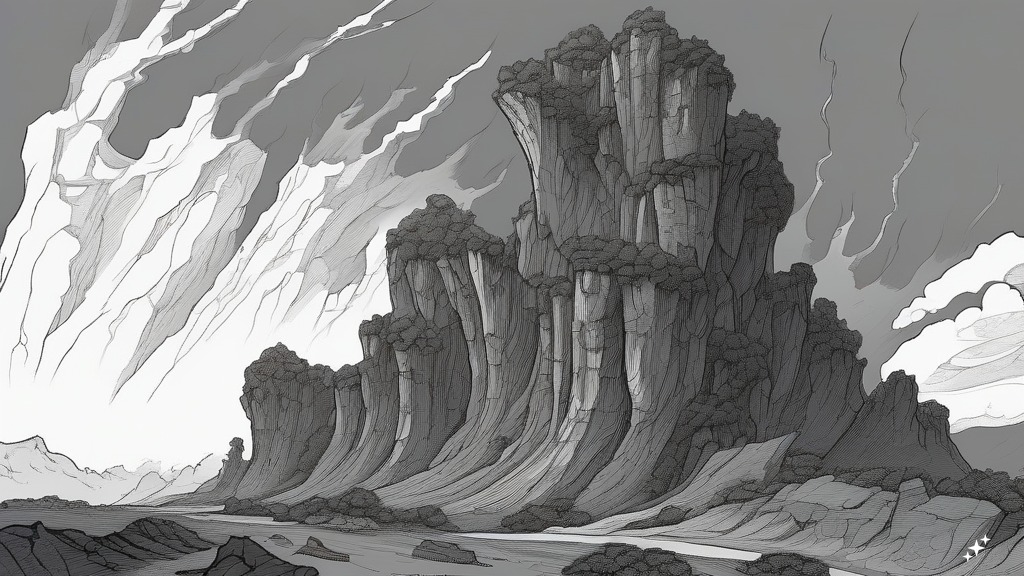
The Enigma of Amigara Fault
After an earthquake splits open a mountainside, hundreds of human-shaped holes are discovered in the exposed rock face. People from across Japan begin traveling to the fault, each drawn to the specific hole that matches their silhouette perfectly. They feel an irresistible compulsion to enter.
This is one of Junji Ito’s most famous works, period. If you’ve ever seen the internet meme “This is my hole! It was made for me!” — this is the story it comes from. It was originally published as a bonus chapter in Gyo Vol. 2 (Gyo is another Ito horror manga about fish with mechanical legs — yes, really) back in 2002, so its inclusion here gives it a proper home in a standalone collection.
Despite being arguably Ito’s most viral story online, The Enigma of Amigara Fault has never been adapted into anime (Japanese animation). For a lot of readers, this collection is worth picking up for this story alone.
The Sad Tale of the Principal Post
A family moves into a newly built house, and something is deeply wrong with its principal post — the central structural pillar of the home. The story draws on traditional Japanese architectural superstitions about the spiritual significance of a building’s main support column.
It’s a quieter story compared to some of Ito’s more intense work, but the slow creep of dread is effective. The cultural specificity gives it a unique flavor.
Billions Alone
Bodies begin turning up sewn together with fishing line — and the victims are always people who gathered in groups. As the strange killings spread, staying alone starts to look like the only safe move.
Themes of loneliness, alienation, and the danger of human connection run through the whole piece, and plenty of readers have noted how eerily resonant it feels in an age of isolation.
An Unearthly Love
One of the collection’s two Edogawa Ranpo adaptations. A woman in an arranged marriage begins to suspect that her kind, handsome husband is hiding something — and when she follows him to the storehouse at night, the truth is stranger and sadder than any affair. Without spoiling the ending, the story pushes obsession to a place where attraction and revulsion blur.
Edogawa Ranpo (the pen name of Tarō Hirai) was a pioneer of Japanese mystery and detective fiction — his pen name is a Japanese rendering of “Edgar Allan Poe,” a deliberate homage that tells you a lot about his sensibilities. His work blends mystery, horror, and the grotesque, making him a natural fit for Ito’s visual style.
It’s on the shorter side but packs a solid punch.
Venus in the Blind Spot (Title Story)
The collection’s title story centers on Mariko, the beautiful daughter of a UFO research society’s founder. The men of the club adore her — until, one by one, they realize they can no longer see her when she comes close. She’s right there, audible and present, but at close range she slips into a literal blind spot — like the small area in your eye where the optic nerve connects to the retina and vision simply fails.
Despite the literary flavor of its premise, the title story is an original Ito creation, not an adaptation — as the table below confirms.
Ito takes the scientific concept and turns it into a horror premise. It’s clever, creepy, and very Ito.
The Licking Woman
A deranged woman stalks the streets of a small town, licking people with a grotesque, oversized tongue — and her saliva carries a poison that causes rapid deterioration, even death if left untreated.
The concept sounds almost absurd on paper, but Ito’s detailed artwork makes the reality nightmarish. It’s one of the most viscerally horrifying pieces in the collection, and the ending lingers.
The Human Chair
A novelist receives a written confession from a chairmaker who claims to have hidden himself inside an armchair — living within the furniture, feeling the warmth and weight of anyone who sits down.
This is based on Edogawa Ranpo’s classic 1925 short story “Ningen Isu” (The Human Chair), one of the most famous stories in Japanese mystery and horror fiction. Ito’s visual interpretation brings a visceral, physical dimension to what was originally a purely psychological tale. You see the contorted figure inside the chair — that’s a dimension only manga can add.
How Love Came to Professor Kirida
A cold, intellectual professor who has deliberately cut himself off from emotional connections finds himself haunted by an invisible entity that shows him unwanted affection. The horror comes not from violence but from the suffocating, inescapable nature of the entity’s devotion.
This story is based on Robert Hichens’ 1900 ghost story of the same name, making it the collection’s one non-Japanese literary adaptation. Hichens was a British novelist and short story writer, and this piece is considered one of the great English-language ghost stories. It’s a fascinating choice — a slow, tension-building Victorian ghost story filtered through Ito’s distinctly Japanese horror sensibility.
Master Umezz and Me
This one is different from everything else in the collection. It’s not a horror story at all — it’s an autobiographical manga essay in which Ito recounts his personal relationship with Kazuo Umezu, a manga creator widely considered the founding figure of horror manga in Japan. Umezu’s works like The Drifting Classroom (a survival horror series set in a school transported to a wasteland) and Cat Eyed Boy (about a half-human, half-monster child) helped define the genre that Ito would later become famous for.
If you’re interested in the history of horror manga or want to understand Ito’s influences and how he developed as an artist, this is genuinely fascinating material. It’s warm, personal, and gives you a side of Ito you don’t see in his horror work. Even if you’ve never heard of Umezu before, the essay is short and charming — it reads more like a heartfelt letter to a mentor than a dry history lesson, so it doesn’t feel like a wasted chapter.
Just be aware going in that it’s an essay, not a scary story. Some readers are surprised by the tonal shift.
Keepsake
A samurai’s young wife dies — and nine months after her burial, a baby’s cry rises from inside her tomb. What unfolds entwines supernatural horror with body horror, built around a central image that lodges in your brain and refuses to leave.
It’s a solid closing story that circles back to one of Ito’s recurring themes — the way ordinary human impulses can become monstrous when pushed past their natural limits.
Which Stories Are Literary Adaptations?
3 of the 10 stories are adapted from existing literature rather than being original Ito creations:
| Story | Original Source | Original Author | Year |
|---|---|---|---|
| An Unearthly Love | “Hitodenashi no Koi” (A Brute’s Love) | Edogawa Ranpo | 1926 |
| The Human Chair | “Ningen Isu” (The Human Chair) | Edogawa Ranpo | 1925 |
| How Love Came to Professor Kirida | “How Love Came to Professor Kirida” | Robert Hichens | 1900 |
What makes these adaptations special is watching how Ito transforms prose into visual horror. A story like “The Human Chair” works brilliantly as written text — the creeping discomfort of imagining someone inside your furniture. But Ito’s drawings give it a physical, bodily reality that the original can only suggest. That’s what the comic format brings that prose can’t.
The remaining 7 pieces — one of which is the autobiographical essay — are original Ito works.
Which Stories Have Anime Adaptations?
None of them — as of July 2026. Neither of the two official anthology series (Junji Ito Collection, 2018, and Junji Ito Maniac: Japanese Tales of the Macabre, Netflix 2023) adapts any of the ten stories in this book.
The big surprise is that The Enigma of Amigara Fault has never been officially animated despite being Ito’s most viral and widely recognized story online. For all ten stories, the manga is the only way to experience them.
Is Venus in the Blind Spot Good for Beginners?
Yes — this is a great starting point for new Ito readers. Here’s why:
- Every story is standalone. You don’t need to have read anything else by Ito. No continuity, no prerequisites, no “you had to read X first” situations.
- The Enigma of Amigara Fault alone is worth the price of entry. If you’ve seen the meme and want to read the full story, this is your chance. And once you’re in, you’ve got nine more pieces waiting.
- The variety is a strength. You get original horror, literary adaptations, body horror, psychological horror, and an autobiographical essay. It’s a wide range of what Ito can do.
- 272 pages for $22.99 is solid value — that works out to about 30 pages per story on average, which is generous for short manga stories.
- The T+ (Older Teen) rating means it contains body horror and disturbing imagery, but it’s not the most extreme content out there. It’s intense but accessible.
The book is widely available — you can pick it up from Amazon, bookstores, or digitally.
Venus in the Blind Spot (Junji Ito)
How It Compares to Other Ito Collections
If you enjoy Venus in the Blind Spot and want more, here are the natural next steps:
- Shiver — Another short story collection with some of Ito’s most well-known standalone pieces. The stories lean more toward atmosphere and creeping dread.
- Smashed — Leans harder into the bizarre and the physically disturbing. Great if Venus made you want something weirder.
- Deserter — A more recent collection that continues the short story format with strong variety.
All of Ito’s short story collections work the same way — standalone stories, no reading order required, pick up whichever one interests you most.
For readers who want to go deeper into Ito beyond short stories, his longer works are the natural next step. Uzumaki is a three-volume series about a town consumed by an obsession with spirals, and Tomie follows a mysterious girl who cannot be killed and drives people to madness. These are serialized narratives rather than standalone short stories, so they’re very different experiences from the short-form collections.
Uzumaki (3-in-1 Deluxe Edition)
Honestly, just grab Venus in the Blind Spot and start reading. The Enigma of Amigara Fault will hook you within pages, and the rest of the collection gives you a fantastic tour of what makes Junji Ito one of the most recognized horror manga creators working today.
Venus in the Blind Spot (Junji Ito)