Black Paradox Manga Review — A Hidden Gem in Junji Ito’s Horror Catalog
Black Paradox is a single-volume standalone horror manga by Junji Ito, published in English by VIZ Media, and it’s absolutely worth your time. For anyone unfamiliar, manga refers to Japanese comics — typically read right-to-left — and Junji Ito is one of the most celebrated horror manga creators in the world, known for works like Uzumaki, Tomie, and Gyo. Black Paradox is one of his lesser-known titles, but it might be one of his most unhinged, and for a certain type of horror reader, that’s exactly the selling point.
The premise starts grounded and disturbing — four strangers meeting through an online suicide pact — and then careens into wild, genre-bending territory so fast you’ll get whiplash. In the best way.
A note before we go further: Black Paradox uses suicide as a central plot device. The entire story begins with a suicide pact, and while the narrative moves away from that premise quickly, it’s woven into the foundation. The manga also contains graphic body horror — meaning scenes depicting the human body being transformed, distorted, or violated in disturbing ways — throughout its second half. Readers who are sensitive to either of these topics should be aware before continuing or picking up the book.
This manga is best suited for readers who enjoy horror that escalates from the mundane into the impossible, who like their scares laced with science fiction, and who want a complete story they can read in a single sitting. Whether you’re already deep into Ito’s catalog or you’ve never read one of his books before, keep reading to find out if Black Paradox belongs on your shelf.
What Is Black Paradox About?
The story opens with four strangers — each using online usernames — who have connected through an internet suicide pact. They’ve agreed to die together, and they meet in person for the first time to follow through on the plan.
That’s a heavy starting point, and Ito doesn’t treat it lightly. The characters each have their own reasons for being there, and the early pages carry a genuine weight of despair. But this being a Junji Ito manga, things don’t go according to plan.
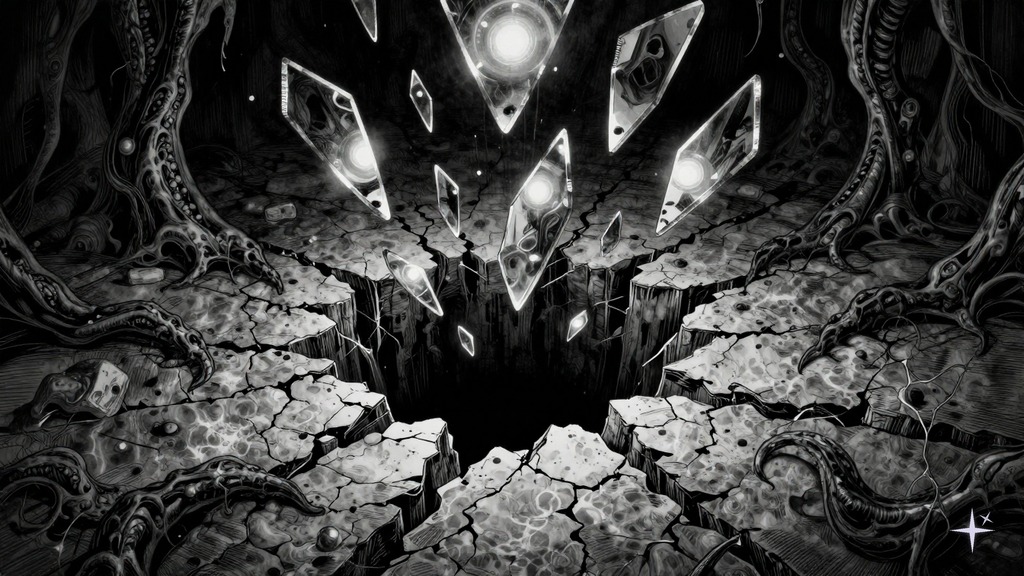
Before the group can act on their pact, something supernatural intervenes. One of the members experiences a phenomenon involving a doppelganger — an identical double of themselves that shouldn’t exist — and from that moment, the story’s trajectory shifts completely. What begins as a dark, psychologically grounded setup transforms into something much stranger. Mysterious luminous orbs, other dimensions bleeding into our reality, and the increasingly grotesque consequences of meddling with forces beyond understanding all come into play.
Without spoiling the specific twists (and there are several real surprises), the story escalates chapter by chapter. Ito takes the initial premise and stretches it into territory that’s part cosmic horror (horror rooted in the idea that the universe contains forces far beyond human comprehension), part body horror (horror focused on the violation and transformation of the human body), and part dark satire about human greed — where the absurdity of the characters’ choices is itself the commentary. The suicide pact becomes almost secondary as the characters — and the world around them — get pulled into something far bigger and far more bizarre than any of them bargained for.
The first act is bleak and atmospheric, the middle act introduces the supernatural mystery, and the final act goes completely off the rails in a way that will either thrill you or leave you bewildered. Probably both.
Themes and Horror Style
At its core, Black Paradox explores a fascinating tension: the gap between wanting to die and actually confronting what might exist beyond death. The four protagonists come together because they’ve decided life isn’t worth living — but when something from the other side reaches back toward them, their reactions are complicated, selfish, and very human.
Doppelgangers and the Unknown
The doppelganger concept is one of horror’s oldest tropes, and Ito uses it as a launching pad rather than a destination. The doubles in Black Paradox aren’t just spooky reflections — they’re tied to a larger set of rules about how Ito’s fictional universe works, something he builds out as the story progresses. There’s a sense of other dimensions bleeding into our reality, and the luminous orbs that emerge from the other side become objects of obsession for the characters.
The Commodification of the Supernatural
One of the story’s sharpest edges is how quickly the characters pivot from existential despair to opportunism. When they realize the supernatural phenomena they’ve stumbled into might have material value, the suicide pact dissolves and something uglier takes its place: greed. Ito doesn’t belabor this point with heavy-handed messaging — he lets the absurdity of the situation speak for itself. People who wanted to die yesterday are now scheming to profit from the boundary between life and death. It’s darkly funny in a way that sneaks up on you.
Body Horror Escalation
Readers should know going in that the second half of Black Paradox leans heavily into body horror — scenes where human bodies undergo disturbing transformations, mutations, and violations of their natural form. If you’re familiar with Ito’s work in Gyo or his short story “Tomie,” you know the territory — bodies doing things bodies should not do, rendered in meticulous, unflinching detail. Readers who are squeamish about this kind of imagery should be aware that it’s central to the story’s climax, not just a passing element.
The horror style overall is what you might call cosmic body horror — it’s less about jump scares or creeping dread and more about the slow realization that reality itself is wrong, combined with visceral physical grotesquerie. Ito’s trademark escalation is in full effect here: a grounded premise spirals outward into something vast and absurd, and he commits fully to wherever the logic takes him.
Junji Ito’s Art in Black Paradox
If you’re picking up a Junji Ito manga, the art is at least half the reason — and Black Paradox delivers.
Linework and Detail
Ito’s detailed linework — built from layers of fine, overlapping hatched lines that create depth and shadow — is present throughout. The supernatural elements in this story give him room to draw things that are genuinely unlike anything in his other works. The luminous orbs, the doppelgangers, and especially the body horror transformations in the later chapters feature some of his most imaginative visual design. There are pages here that feel like Ito was having fun pushing his own boundaries, and that energy comes through clearly.
Character Design
With four protagonists who are all introduced simultaneously, keeping them visually distinct is important — and Ito handles it well. Each of the four main characters has a clearly different look and body language, which matters in a fast-moving story where you need to track who’s doing what without getting confused. It’s a small thing, but in a single-volume manga with this many moving parts, clear character design is genuinely appreciated.
Panel Composition and Pacing
In manga, each page is divided into individual frames called panels, and how those panels are arranged affects pacing and impact. Because Black Paradox is contained in a single volume, Ito doesn’t have the luxury of slow, atmospheric buildup the way he does in a longer work like Uzumaki. The pacing is tighter, and the panel layouts reflect that — dread is established quickly, reveals happen with impact, and the escalation from chapter to chapter is visually communicated through increasingly chaotic and detailed page designs. The horror set pieces in the final act are dense with detail and worth lingering on.
How Black Paradox Compares to Other Junji Ito Works
If you’ve read other Junji Ito manga — or if you’re trying to figure out where to start — it helps to see where Black Paradox fits in his catalog. Here’s a quick comparison with some of his most well-known titles:
| Black Paradox | Uzumaki | Tomie | Gyo | Remina | |
|---|---|---|---|---|---|
| Length | 1 volume | 3 volumes | 1 volume (Complete Deluxe Edition) | 2 volumes | 1 volume |
| Horror type | Cosmic body horror | Cosmic dread / body horror | Psychological / body horror | Bio-horror / sci-fi | Cosmic horror / disaster |
| Pacing | Fast, compressed | Gradual buildup to climax | Episodic (standalone chapters) | Fast escalation | Fast escalation |
| Sci-fi elements | Heavy | Moderate | Minimal | Heavy | Heavy |
| Best for | A wild one-sitting read | Ito’s most acclaimed work | Recurring, varied horror | Gross-out sci-fi horror | Apocalyptic horror |
Note: “Cosmic horror” = horror rooted in vast, incomprehensible forces beyond human understanding. “Body horror” = horror focused on disturbing transformations of the human body. “Episodic” = each chapter works as its own self-contained story.
As an Entry Point
Before diving into comparisons, it’s worth addressing a common question: can you start with Black Paradox if you’ve never read Junji Ito before? Yes. It’s a complete, self-contained story in a single volume, and it requires zero knowledge of Ito’s other works. It’s not his most representative title (that would be Uzumaki, widely considered his masterwork), but it showcases his strengths — detailed art, escalating horror, and a willingness to go fully weird — in a compact package. If you read this and want more, you’ll know exactly what to expect from the rest of his catalog.
Scope and Length
Black Paradox is much shorter and more contained than Uzumaki or Tomie. It’s closer in scope to his other single-volume works like Remina. This means it doesn’t have the space for the kind of slow-building atmospheric dread that makes Uzumaki so effective — but it also means there’s no filler. Every chapter advances the plot or escalates the horror.
Closest Relatives in Ito’s Catalog
If you had to place Black Paradox in a family tree, its closest relatives are Remina and Gyo. All three share a willingness to take a premise and push it to its most extreme, horrifying conclusion without flinching. They’re the works where Ito fully commits to sci-fi horror and lets the story go wherever it wants. If you enjoyed either of those, Black Paradox is a natural next read.
The Hidden Gem Factor
One genuine advantage Black Paradox has over Ito’s biggest titles: it’s less widely discussed online. If you’ve had Uzumaki or Tomie partially spoiled by social media or YouTube thumbnails, you’ll appreciate going into this one relatively fresh. The twists hit harder when you don’t see them coming, and Black Paradox has several turns that land hard on a first read.
The VIZ Media Hardcover Edition
The English edition of Black Paradox was published by VIZ Media — one of the largest and most established manga publishers in North America — as a single hardcover volume, released on October 25, 2022. It’s a completed series in one book — no waiting for future volumes, no hunting down out-of-print editions.
Physical Quality
The VIZ hardcover follows the same format and presentation quality as their other Junji Ito deluxe hardcovers (the same line that includes their editions of Uzumaki, Tomie, Gyo, Remina, and others). If you own any of those, you know what to expect: a sturdy hardcover binding with a dust jacket (the removable paper cover that wraps around the book), quality paper stock, and clean print reproduction that does justice to Ito’s detailed linework. These are attractive books on a shelf, and they hold up well to rereading.
Translation
The English translation reads smoothly and captures both the dark tone of the early chapters and the increasingly bizarre sci-fi terminology that develops as the story progresses. Dialogue feels natural without losing the slightly formal quality that suits a Junji Ito story.
Value as a Purchase
As a single hardcover volume, Black Paradox is a straightforward purchase — one book, one complete story, no collecting required. That makes it a low-commitment way to add another Ito title to your shelf, or a solid gift for the horror manga fan in your life. It’s also the kind of book you can hand to a friend who’s never read manga before and say “just try this one.”
Black Paradox
Who Should Read Black Paradox?
You’ll Love This If…
- You’re working through Junji Ito’s catalog. If you’ve read the big titles and you want to keep going, Black Paradox is one of the more rewarding deep cuts. It’s not a minor work — it’s a full story with real ambition.
- You enjoy cosmic horror with body horror elements. If the intersection of “what lies beyond our reality” and “the human body doing terrible things” appeals to you, this manga delivers both.
- You want a one-volume horror manga you can finish in a sitting. No multi-volume commitment, no cliffhangers waiting for the next release. You pick it up, you read it, you’re done.
- You like horror that escalates fast. Black Paradox starts controlled and ends unhinged. If you find that kind of escalation thrilling rather than frustrating, you’re the target audience.
- You’re new to Junji Ito and want a low-commitment starting point. One book, one story, no prior knowledge needed. It’s not a bad place to begin at all.
This Might Not Be For You If…
- You prefer slow-burn psychological horror. Black Paradox moves fast, especially in its second half. If you want lingering dread and ambiguity, Uzumaki or Ito’s short story collections (such as Shiver or Fragments of Horror) might be better fits.
- You want a longer narrative with deep character development. A single volume with four protagonists means none of them get extensive depth. The characters here serve the story’s momentum more than they serve as fully realized people.
- You’re sensitive to suicide or body horror themes. As noted at the top of this review, Black Paradox uses suicide as a central plot device and contains graphic body horror throughout its second half. Readers should be aware of both before picking it up.
Final Verdict
Black Paradox is a strange, ambitious, and thoroughly entertaining horror manga that shows a side of Junji Ito you don’t see in his most famous works. It’s not perfect — the pacing in the final act is breakneck to the point where some readers will wish it had room to breathe, and the ending is abrupt in a way that feels like a feature or a flaw depending on your tolerance for ambiguity.
But as a single-volume experience? It’s a blast. The premise hooks you, the escalation keeps you turning pages, and Ito’s art gives you some truly unforgettable images along the way. If you’re looking for your next Junji Ito read and you haven’t picked this one up yet — grab it.