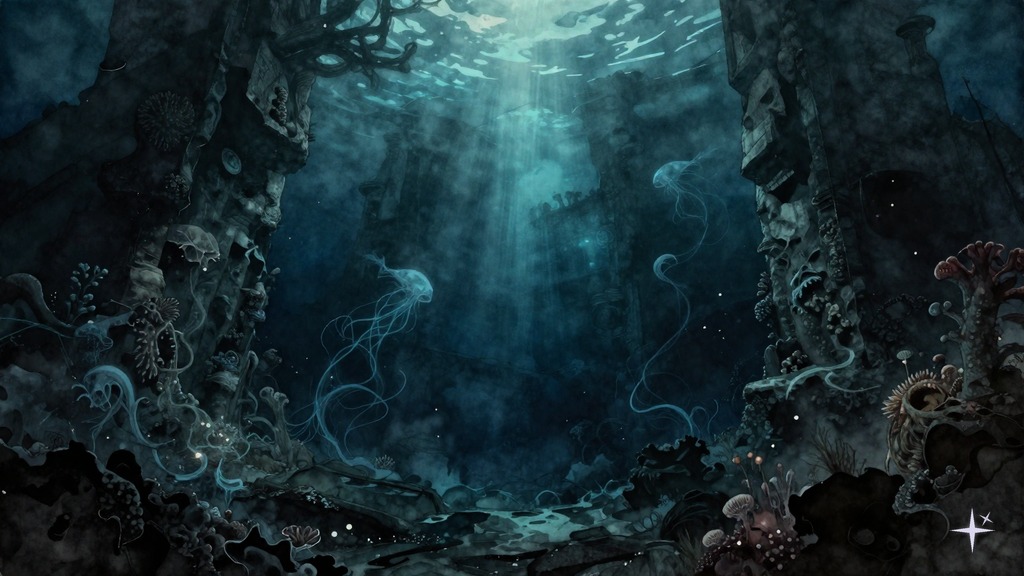
If you’ve been eyeing Children of the Sea (海獣の子供) and wondering whether this manga is a completed story or another series stuck in limbo, the answer is straightforward: it’s done. Fully finished. No cliffhanger, no indefinite wait for the next volume. The question “is Children of the Sea manga finished” has a clean, simple yes. This is a complete, self-contained manga you can read from start to finish right now.
One thing worth noting upfront, especially if you found this article through a horror manga site: Children of the Sea isn’t traditional horror. You won’t find slashers or gore here. But it shares deep roots with the kind of storytelling that draws horror fans in — an overwhelming sense of something ancient and incomprehensible lurking beneath the surface of the world. If that sounds like your thing, keep reading.
Let’s break down everything — how long the series is, how it ends (spoiler-free), whether there’s an anime adaptation, and where to grab the whole thing.
Yes — Children of the Sea Manga Is Finished at 5 Volumes
Children of the Sea was written and illustrated by Daisuke Igarashi (五十嵐大介). It was originally published chapter by chapter — a process called serialization — in Monthly IKKI, a manga magazine published by Shogakukan that has since ceased publication. The magazine targeted an older audience (a category called “seinen” in Japan, meaning manga aimed at adults rather than teens). The series ran from 2007 to 2012, spanning 43 chapters collected across 5 volumes.
If you’re new to manga, here’s how that works: manga stories are first released as individual chapters in magazines, then later gathered together and published as book-form volumes. So those 43 chapters became the 5 physical books you can buy and read today.
All five volumes have been released in English by VIZ Media, so there’s no gap between the Japanese and English editions — you can read the entire story without waiting for anything.
For readers who specifically look for finished manga before committing, this one checks every box. Five volumes is compact. The story has a clear beginning, middle, and end. There are no spin-offs or sequels you need to track down. It’s a single, self-contained work.
The story follows a girl named Ruka who encounters two mysterious boys, Umi and Sora, who were raised by dugongs (large marine mammals similar to manatees) in the ocean. What starts as a summer mystery about marine life gradually expands into something much stranger and more cosmic. Igarashi weaves together ocean science, mythology, and surreal imagery into a narrative that feels unlike almost anything else in manga.
If you like supernatural stories with a sense of genuine wonder — something that mixes the awe of a nature documentary with dreamlike, surreal imagery that gets under your skin — this series delivers that in a very manageable package.
How the Series Wraps Up (Spoiler-Free)
This is worth talking about because the ending of Children of the Sea is one of the most discussed aspects of the manga, and your enjoyment will depend a lot on what you expect going in. Since the series is finished, knowing what kind of ending you’re heading toward can help you decide whether to commit.
The story builds toward a singular, massive oceanic event — something cosmic in scale that connects the characters, the sea, and forces far beyond human understanding. Without spoiling specifics, the final volume takes the narrative in an increasingly abstract and surreal direction. Igarashi leans hard into telling the story through his artwork rather than through dialogue. Pages become dense with intricate, detailed drawings that carry the emotional and thematic weight — the images communicate what words alone can’t.
The ending is deliberately open to interpretation. It’s poetic rather than tidy. If you’re the kind of reader who wants every thread neatly resolved and every question answered, this finale may frustrate you. But if you’re open to a conclusion that feels more like an experience — something you absorb and sit with rather than decode — it’s genuinely powerful.
Here’s one concrete reassurance for anyone on the fence: the main characters’ arcs do reach resolution. Ruka’s journey has a meaningful endpoint. It’s the larger cosmic elements — the mysteries of the ocean and the forces at work beneath it — that stay open and mysterious. The story doesn’t abandon its characters; it just refuses to shrink the universe down to neat explanations.
Think of it this way: the ending is closer to the feeling of staring at the ocean at night and sensing something vast beneath the surface than it is to a standard manga climax. Igarashi trusts his artwork to communicate what words can’t, and the closing chapters are some of the most visually ambitious pages in the entire series.
Many readers find the ending deeply moving on a re-read, once they stop trying to “solve” it and just let the imagery wash over them. It’s the kind of conclusion that rewards patience and a willingness to meet the story on its own terms.
Is There an Anime Adaptation?
Yes — Children of the Sea received a theatrical anime film adaptation in 2019, produced by Studio 4°C and directed by Ayumu Watanabe. The movie condenses the full manga story into a single feature-length film, attempting to translate Igarashi’s incredibly detailed pen-and-ink artwork into animation.
The film is well-regarded for its visual ambition. Igarashi’s art style — intricate, organic, and packed with natural detail — presents a serious challenge for any adaptation, and the movie makes bold choices in how it interprets that visually. The oceanic sequences in particular are striking.
If you read and enjoy the manga, the film is worth seeking out as a companion piece. It offers a different way to experience the same story, and the animated interpretation of the manga’s more abstract moments gives you a fresh perspective on what Igarashi was doing on the page — seeing those surreal sequences in motion can deepen your understanding of the source material.
One thing to keep in mind: condensing 43 chapters and 5 volumes into a single movie inevitably means some material gets compressed or cut. The manga gives you more room to breathe with the story’s quieter moments and secondary characters. Readers who want the full experience should start with the manga — the film works best as a visual companion rather than a replacement.
Where to Buy the Complete Series
All 5 English volumes of Children of the Sea are published by VIZ Media and available through major online and physical retailers.
At only five volumes, this is one of the most affordable complete manga series you can collect. You’re not looking at a 30-volume commitment or a box set that takes up half a shelf. The entire story fits comfortably in one hand.
Each volume is a standard-sized paperback from VIZ — roughly the same dimensions as other VIZ manga you may have seen in a bookstore. There’s no omnibus or special deluxe edition to hold out for, so the five individual volumes are the way to go.
For readers new to the series, Volume 1 is the natural starting point. The story is sequential and builds carefully — jumping around would spoil the experience without giving you the context to appreciate it. Start here and read straight through.
Once you’ve read the full series, Volume 5 is the final volume and wraps up the story completely. If you’re buying all five at once, you’ll have the complete set from the start.
Children of the Sea
Since the series has been complete for years, availability is generally stable. You shouldn’t have trouble finding copies through standard retail channels. If a specific volume is temporarily out of stock at one retailer, check others — VIZ keeps its catalog titles in print.
FAQ
How many volumes is Children of the Sea?
5 volumes, containing 43 chapters total. The series was published chapter by chapter in Monthly IKKI from 2007 to 2012, then collected into five book-form volumes. All five are available in English from VIZ Media. It’s a quick, complete read.
Who created Children of the Sea?
Daisuke Igarashi (五十嵐大介) is both the writer and artist. Igarashi is known for his extraordinarily detailed, nature-focused artwork and stories that blend the natural world with supernatural and mythological elements. His other manga include Witches and Designs, both of which share his fascination with the natural world and its hidden strangeness. Children of the Sea is widely considered one of his most acclaimed works.
Is Children of the Sea manga horror?
Not in the traditional sense. You won’t find slashers, gore, or jump-scare-style scares here. But the series shares significant roots with cosmic horror — a subgenre built around the idea that the universe contains forces so vast and ancient that humans can barely comprehend them, let alone control them. Think Lovecraft’s ocean mythology, but filtered through something gentler and more awestruck.
The tone is closer to dark supernatural manga with elements of mystery and awe. If you enjoy stories where the unease comes from the sheer scale of what humans don’t understand — the deep ocean, the cosmos, the fundamental strangeness of life itself — Children of the Sea operates in that space. It’s unsettling and beautiful in equal measure, which is a combination that appeals to many horror manga fans even though the series doesn’t fit neatly into the genre.
Is the Children of the Sea manga worth reading if I’ve already seen the anime film?
Yes. The manga offers substantially more detail and breathing room than the film. Secondary characters get more development, and the story’s quieter, contemplative passages — which are central to the experience — have space to unfold at Igarashi’s intended pace. The artwork in the manga is also distinct from the animation; Igarashi’s pen-and-ink linework has a density and texture that translates differently on the page than on screen. If the film intrigued you, the manga will deepen that experience considerably.