The Liminal Zone Is a 2-Volume Horror Manga — 4 Stories Per Volume
The Liminal Zone is one of Junji Ito’s newer horror manga collections, published in English by Viz Media. If you’ve been searching for details on the Junji Ito Liminal Zone manga, here’s what you need to know: it’s a compact set — just two hardcover volumes, each containing four horror stories that don’t connect to each other. You can read them in any order.
Here’s the quick overview:
| Detail | Volume 1 | Volume 2 |
|---|---|---|
| Stories | 4 stories | 4 stories |
| Pages | 216 pages | 224 pages |
| Format | Hardcover | Hardcover |
| Publisher | Viz Media | Viz Media |
| English Release | July 26, 2022 | March 25, 2025 |
| Translator | Jocelyne Allen | Jocelyne Allen |
The English edition was translated by Jocelyne Allen, who has handled several of Ito’s other Viz releases. The hardcover format is consistent with Viz’s recent approach to Ito’s manga — they’ve been giving his collections the premium treatment, and The Liminal Zone follows that trend.
The title itself — “liminal zone” — refers to threshold spaces. That in-between feeling where the normal world starts to slip sideways. It’s a fitting name, because these stories tend to live in that uncomfortable space where everyday life warps into something deeply wrong.
Volume 1 Stories — What’s Inside This Junji Ito Manga
Volume 1 contains four stories. Here’s what you’re getting into with each one.
Weeping Woman Way
A couple encounters a mourner — a woman hired to weep at funerals. Paid mourners are a real tradition in parts of East Asia, and Ito takes that grounded starting point and pushes it into horror: the weeping doesn’t stop. The town the couple finds themselves in is full of women who cannot stop crying, and the reason spirals into body horror territory — meaning the horror comes from human bodies being twisted, deformed, or transformed in disturbing ways. It’s a strong opener — the kind of story where a single eerie image lodges in your brain and stays there.
Madonna
This one takes place at a Catholic school, and it leans hard into corruption and body horror. Without spoiling the specifics, there’s a religious figure at the center of the story whose appearance becomes increasingly wrong. Ito has always been good at taking things that are supposed to be sacred or beautiful and making them grotesque, and Madonna is a clear example. It’s one of the more visually striking stories in the volume — the kind of imagery that makes you pause on the page even when you’d rather look away.
The Spirit Flow of Aokigahara
Aokigahara — Japan’s infamous “suicide forest” at the base of Mount Fuji — is already a place loaded with real-world dread. Ito uses that setting and adds a supernatural element: a couple enters the forest and discovers a torrent of spirits flowing through the trees. The forest setting gives Ito room to build dread through environment — the dense trees, the oppressive quiet, the sense of being watched. It all builds before the supernatural element takes over. This is one of the strongest stories in the collection for setting and mood.
Slumber
The final story in Volume 1 follows a character plagued by nightmares — dreams of violence that feel too real and begin bleeding into waking life. It’s a quieter story than the other three, leaning more on psychological dread than visual shock, but it fits the collection’s interest in liminal spaces — those situations caught between normal and not-normal, between sleeping and waking. Together, the four stories give you a good cross-section of Ito’s range in this manga: body horror, dread built through environment, supernatural phenomena, and psychological unease.
The Liminal Zone Vol. 1 by Junji Ito
Volume 2 Stories — The Hikizuri Siblings and More
Volume 2 shifts things up. While it continues the four-stories-per-volume format, it includes something that long-time Ito readers will notice immediately: the return of the Hikizuri siblings.
The Hikizuri Siblings Return
The Hikizuri siblings are recurring characters across Ito’s manga — a deeply dysfunctional family whose members seem to attract supernatural misery like a magnet. They’ve appeared in earlier Ito collections, including stories compiled in Viz’s Lovesickness and other volumes. If you’ve read them before, their appearance in Volume 2 is a nice bit of continuity.
In this story, a girl weighed down by an invisible burden moves in with the Hikizuri family. As with most Hikizuri stories, the family dynamics are as horrifying as anything supernatural happening around them. The siblings bicker, scheme, and drag each other down while the situation around them gets worse.
If you haven’t encountered the Hikizuri siblings before, the story still works on its own — but knowing their history adds a layer of dread because you already know nothing good happens around this family.
The Perpetual Motion Machine Story
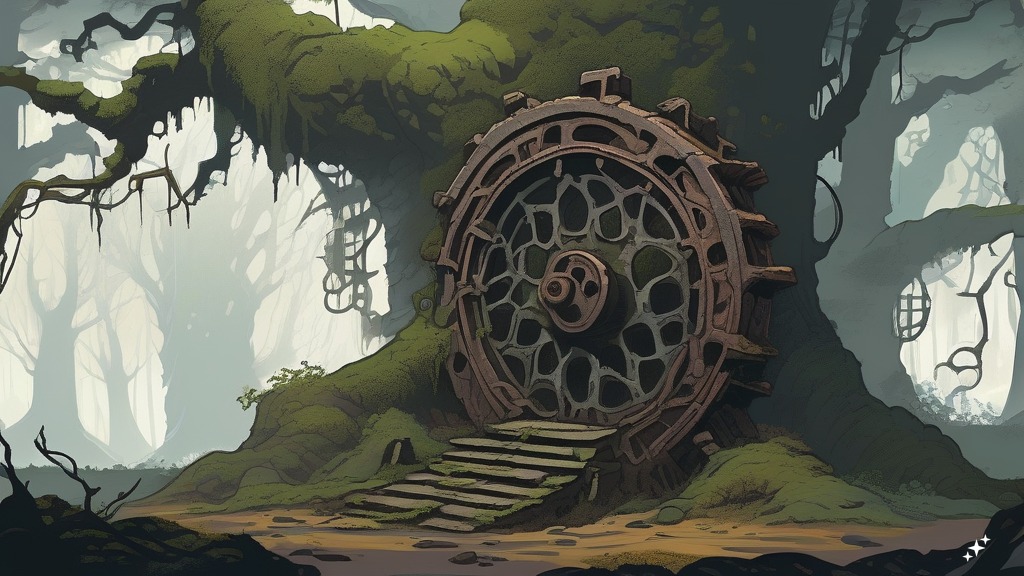
This is the standout premise of Volume 2 and arguably the strongest story in the entire Liminal Zone manga. A group of university students discover a decaying mountain village deep in the mountains. At its center sits an enormous perpetual motion machine — a rusted, impossible contraption that shouldn’t work but does. The village is falling apart around it, the residents are strange, and the students begin to disappear one by one.
It’s a classic horror setup — isolated location, dwindling group, a mystery at the center that pulls everyone in — but Ito’s visual treatment of the machine and the decaying village gives it his signature feel. The machine itself is the kind of detailed, mechanical monstrosity that Ito clearly enjoyed drawing. Every gear and pipe is rendered with obsessive precision, which makes the surrounding decay even more unsettling.
The Other Two Stories in Volume 2
The remaining two stories continue the collection’s focus on spaces and situations that feel fundamentally wrong. They work with group dynamics and isolation, and the settings lean toward decay and abandonment — crumbling structures, empty places that should be full of life. The tone across both is bleaker and more claustrophobic than anything in Volume 1. While they don’t hit as hard as the perpetual motion machine story, they round out a volume that feels consistently darker than its predecessor.
The Liminal Zone Vol. 2 by Junji Ito
What’s Different About the Art in This Junji Ito Manga
One thing readers have noticed — and this is worth mentioning because it affects whether you’ll enjoy the collection — is that Ito experiments with some new visual techniques here. You’ll see blurred faces, distorted framing, and pages where the individual frames (called panels in manga) are arranged more loosely than in his earlier work. The drawn lines themselves are sometimes softer or less precise than what you might expect from Ito.
If you’ve read his earlier manga like Uzumaki (a horror story about spirals consuming a town) or Tomie (a series about a girl who keeps coming back from the dead), The Liminal Zone might feel visually different. Those works are known for extremely precise, detailed ink work — every line sharp and deliberate. The Liminal Zone loosens that approach. Whether that works for you is a matter of taste — some readers appreciate the experimentation, others prefer his classic style.
The art in the perpetual motion machine story and the Aokigahara story is where these techniques land best. The blurring and distortion actually serve the mood in those settings — a decaying village and a haunted forest both benefit from art that feels slightly unstable. In other stories, the results are more uneven.
Is The Liminal Zone Manga Worth Buying?
Here’s the honest take: The Liminal Zone is not Ito’s strongest collection. Reader reception has been mixed, with most praise going to the art experimentation and most criticism directed at the storytelling, which many readers find less tightly constructed than his earlier short story collections. You’ll see this sentiment echoed across reader reviews on sites like MyAnimeList and Goodreads — the general consensus is that the ideas are strong but the execution is inconsistent.
That said, “not his strongest” still means it’s Junji Ito. The imagery is frequently striking, the premises are creative, and at its best — the perpetual motion machine story, the Aokigahara forest — it delivers genuine dread.
If You’re New to Junji Ito
This probably isn’t where to start. Not because it’s bad, but because Ito has collections that showcase his range much more effectively. Two better entry points, both also published as hardcover manga by Viz Media:
- Shiver — A greatest-hits-style manga collection with some of his most iconic short stories, including “Used Record” and “Fashion Model.” It’s consistently strong from start to finish and gives you the widest sample of what Ito can do. If you want variety and don’t know where to begin, start here.
- Venus in the Blind Spot — Another short story manga collection that hits harder and more consistently than The Liminal Zone. It leans more toward surreal horror and psychological dread — stories where the logic of the world itself feels wrong. If you want stories that get under your skin, this is the better pick.
Start with one of those, and if you like what you find, The Liminal Zone will be waiting.
If You’re Already a Fan
You’ll probably want both volumes. The Hikizuri siblings story in Volume 2 alone makes it worthwhile if you’ve been following those characters across Ito’s work. And the art experimentation is genuinely interesting even when the stories don’t fully land — it’s worth seeing an artist this established still trying new approaches decades into his career.
If You’re Collecting All of Ito’s Viz Hardcovers
If you’re buying every Junji Ito hardcover that Viz puts out, this is an easy pickup. The physical quality matches the rest of the line, and at only two volumes, it’s not a major investment.
Quick Buying Guide for The Liminal Zone Manga
Both volumes are available as hardcovers from Viz Media. Here’s what you’re looking at:
| Volume | Details |
|---|---|
| Vol. 1 | 216 pages, hardcover. Contains: Weeping Woman Way, Madonna, The Spirit Flow of Aokigahara, Slumber. |
| Vol. 2 | 224 pages, hardcover. Contains: Hikizuri siblings story, the perpetual motion machine story, + 2 more stories. |
The two-volume format makes this one of the easiest Ito manga collections to buy. No long series commitment, no hunting down out-of-print volumes. Grab Volume 1, see how you feel, and go from there.