What Is Remina About?
The story begins with an astronomer named Professor Oguro who discovers something unprecedented: a planet emerging from a wormhole in deep space. He names it Remina — after his teenage daughter.
Overnight, the discovery makes both the professor and his daughter famous. The public becomes obsessed with the planet, and by extension, with the girl who shares its name. Remina Oguro becomes a reluctant celebrity, adored by millions for something she had absolutely nothing to do with.
Then things go wrong.
The planet Remina isn’t just drifting through space. It’s moving with purpose, consuming stars and celestial bodies in its path — and it’s headed straight for Earth. As the reality of extinction sets in, the adoration that surrounded Remina the girl curdles into something violent. A cult that once worshipped her decides she’s the cause. The logic is irrational but absolute: destroy the girl, and maybe the planet will stop.
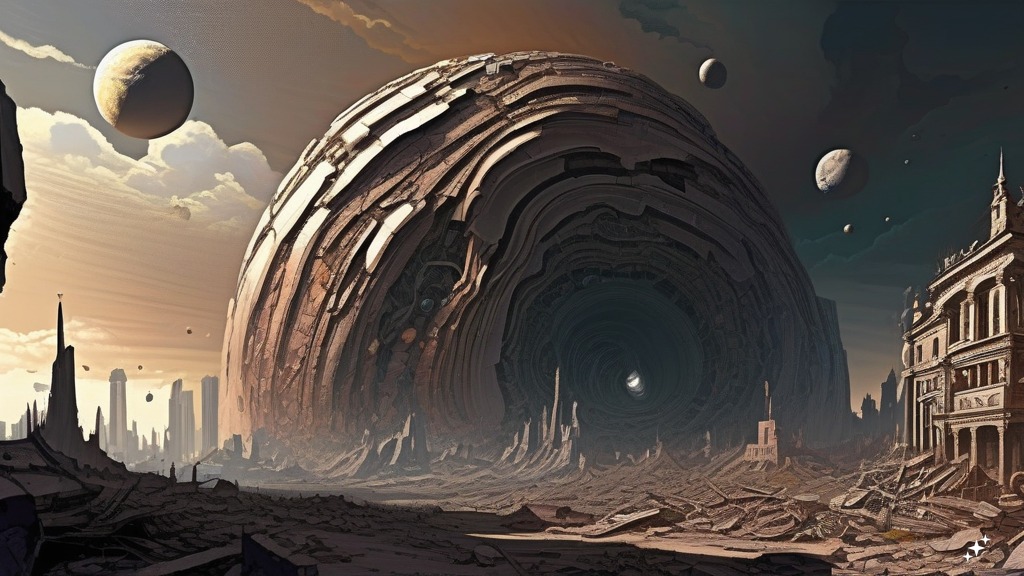
What follows is a relentless nightmare on two fronts. Remina is fleeing from an enraged mob that wants her dead while an incomprehensible cosmic entity bears down on all of humanity. The planet itself is no ordinary celestial body — it has features that defy physics and sanity, including what can only be described as a tongue that reaches out to lick the Earth’s surface.
The tone escalates from creeping unease to full apocalyptic chaos, layering Ito’s signature grotesque imagery over a deep sense of cosmic insignificance — the idea that humanity is tiny, fragile, and utterly irrelevant in the face of forces beyond comprehension. And critically, this is a complete, self-contained story — one volume, no sequels, no cliffhangers. You pick it up, you read it, you’re done.
Key Themes That Make Remina Stand Out
Cosmic Horror — Humanity’s Insignificance Filtered Through Manga
A quick note on terminology: cosmic horror is a horror subgenre built around the idea that the universe contains forces so vast and alien that humanity can’t understand them, let alone fight them. The genre traces back to the American writer H.P. Lovecraft, whose stories from the early 1900s established many of its conventions. You’ll sometimes see the word “Lovecraftian” used as shorthand for this kind of horror — it just means “cosmic horror in the tradition Lovecraft established.”
Most of Junji Ito’s famous works operate on a personal or town-wide scale. Uzumaki haunts a single town. Tomie — a series about a supernaturally beautiful girl who drives people to obsession and violence — fixates on one figure and the people around her. Remina goes bigger — much bigger.
The planet itself functions as something alien and unknowable. It doesn’t follow the rules of astronomy. It doesn’t care about physics. It consumes worlds, and it seems to do so with something resembling intent. The imagery Ito uses — that tongue, those surface details that shouldn’t exist on a planet — channels the idea that humanity is cosmically insignificant, that the universe contains things so far beyond our comprehension that understanding them isn’t even on the table.
This makes Remina feel genuinely different from Ito’s other work. If you’ve read a lot of his body horror (horror that focuses on disturbing transformations or violations of the human body) and psychological dread, the shift to apocalyptic-scale cosmic horror is refreshing. The threat here isn’t a spiral pattern or a shape-shifting girl — it’s the end of everything, and there’s nowhere to run.
Mob Mentality and Scapegoating
Here’s the thing about Remina that sticks with you long after you close the book: the planet isn’t the scariest part. The humans are.
The speed at which society pivots from worship to murderous persecution is genuinely unsettling. One day Remina is a beloved public figure. The next, people are hunting her through the streets with the absolute conviction that killing a teenage girl will somehow stop a planet. The logic doesn’t matter. Fear has eaten rationality alive.
Ito draws this with unflinching detail — the mobs, the violence, the self-appointed leaders channeling collective terror into targeted cruelty. It reads like a horror manga about witch hunts wrapped inside a cosmic apocalypse story. The commentary on how fear dismantles civilization and how quickly people will scapegoat the innocent is arguably the most effective element of the entire book.
The Duality of Fame
There’s a sharp little observation running through Remina about celebrity culture. Remina Oguro is adored for something she had no part in — her father named a planet after her, and the public projected meaning onto that accident. She didn’t ask for fame. She didn’t earn it in any traditional sense. It was given to her arbitrarily.
And then it’s taken away with equal arbitrariness, replaced by hatred and blame.
Ito explores how the public creates and destroys its celebrities on a whim, and how the object of that attention has almost no agency in either direction. Remina the girl is less a person to the mob and more a symbol — first of wonder, then of doom. The fact that she’s a real human being with her own terror and desire to survive barely registers with them.
Edition Guide — What You’re Actually Buying
If you’re shopping for Remina in English, here’s exactly what’s available:
The VIZ Media hardcover (2020) is the definitive English edition. VIZ Media is the largest manga publisher in North America, responsible for English releases of most major manga series. Their Remina hardcover collects the complete story in a single 256-page volume. This is part of VIZ’s premium Junji Ito hardcover line — the same format used for the Uzumaki Deluxe Edition (an oversized, premium-format hardcover collecting all three Uzumaki volumes in one book), Tomie, Sensor, and other Ito titles. Consistent sizing, quality binding, and presentation that looks great on a shelf.
Uzumaki (3-in-1 Deluxe Edition)
One thing that trips people up: the original Japanese title is Hellstar Remina (地獄星レミナ). VIZ shortened it to simply Remina for the English hardcover. Same manga, different name. If you see both titles referenced online, they’re talking about the same book.
The manga was originally serialized — meaning published chapter by chapter in a magazine before being collected into book form — in Big Comic Spirits Zōkan Casual, a Japanese manga anthology magazine, from 2004 to 2005. It was then collected into a single volume by Shogakukan (one of Japan’s largest manga publishers) in 2005. The English hardcover took fifteen years to arrive, but it’s the same complete story.
| Detail | Info |
|---|---|
| English Title | Remina |
| Original Title | Hellstar Remina (地獄星レミナ) |
| Author | Junji Ito |
| English Publisher | VIZ Media |
| Format | Hardcover |
| Pages | 256 |
| Release Date | December 15, 2020 |
| Volumes | 1 (complete story) |
| Anime Adaptation | None as of 2025 |
Is Remina Good? Honest Assessment for Beginners
This is where a lot of guides get cagey. Here’s a straightforward take.
What Remina Does Well
The artwork is spectacular. Ito’s cosmic and architectural destruction panels in Remina are some of the best he’s ever drawn. The scenes of the planet’s surface, the apocalyptic devastation on Earth, the sheer scale of what’s happening — these pages are why people collect Ito’s work in hardcover format. You want to linger on them.
The premise is unique in Ito’s catalog. He has dozens of works, and none of them quite do what Remina does. The combination of cosmic horror, mob violence, and celebrity commentary in a single manga-length story feels distinct.
It’s fast-paced and relentless. Once the horror starts escalating, it doesn’t let up. At 256 pages, there’s very little padding. The story grabs you and drags you through to the end.
It’s self-contained. No tracking down multiple volumes. No “you have to read this other thing first.” One book, one story, done.
Where Remina Falls Short
Character development is thin. Remina the character is more of a vehicle for the horror than a fully realized protagonist. Compared to the cast of Uzumaki — where you spend three volumes getting to know the residents of a cursed town — the characters here don’t get as much room to breathe. You’re watching things happen to Remina more than you’re understanding who Remina is.
The pacing in the final act feels rushed. After a steady escalation, the ending arrives quickly, and some readers find the resolution abrupt. Without spoiling anything, the conclusion has divided readers — some find it appropriately chaotic, others feel it doesn’t quite land.
It’s generally rated a tier below Ito’s best-known work. Among fans who’ve read widely across Ito’s catalog, Remina typically doesn’t rank alongside Uzumaki, Tomie, or even Gyo. That’s not a knock — those are some of the most celebrated horror manga ever made. But if you’re coming in expecting that level of impact, calibrate accordingly.
Who Will Love Remina
- Readers specifically looking for cosmic horror in manga form — this is one of the best options available
- Fans building a Junji Ito collection who want the complete hardcover line
- Anyone who liked the apocalyptic scale and gross-out spectacle of Gyo (Ito’s story about a fish-borne plague that fuses sea creatures with mechanical legs) and wants more of that energy
- Readers who want a single-sitting horror manga — you can finish this in an evening
Who Might Want to Start Elsewhere
- If you want Ito’s slow-burn psychological horror, Uzumaki is a better entry point
- If you want deeply developed characters and emotional complexity, Remina isn’t where Ito puts that energy
- If body horror — disturbing transformations and violations of the human body — is your main draw to Ito’s work, Remina leans more toward cosmic dread and mob violence. It has grotesque imagery, but the flavor is different
Where Remina Fits in Junji Ito’s Manga Catalog
Remina occupies an interesting middle ground in Ito’s body of work. It’s one of his mid-length standalone works — longer and more substantial than a single short story, but not the sprawling multi-volume narrative that Uzumaki is.
It sits alongside other single-volume Ito titles like Sensor (a dreamlike cosmic horror story involving a volcanic village and hair made of light), No Longer Human (Ito’s manga adaptation of the classic Japanese novel about alienation), and Deserter (a collection of Ito’s earliest short horror works, including the title story about a WWII deserter) in terms of format and commitment level. If you’re working through Ito’s catalog, these single-volume works are great breathers between his bigger pieces and short story collections.
Here’s how to think about it relative to his other major works:
| Title | Length | Primary Horror Type | Tone |
|---|---|---|---|
| Uzumaki | 3 volumes (or 1 Deluxe) | Supernatural / body horror | Slow-burn, escalating dread |
| Tomie | 1 volume (collected) | Psychological / supernatural — a girl who can’t die drives people to obsession | Obsession, repetition |
| Gyo | 1 volume (Deluxe) | Body horror / apocalyptic — sea creatures invade land on mechanical legs | Gross-out, fast-paced |
| Remina | 1 volume | Cosmic horror / mob violence | Relentless, apocalyptic |
| Sensor | 1 volume | Cosmic / religious — dreamlike mystery about a woman and a volcanic village | Atmospheric, dreamy |
If you’ve already read Uzumaki and want more Ito, Remina offers a completely different flavor. It’s cosmic instead of spiral-obsessed, mob horror instead of town horror, and operates on a planetary scale rather than a claustrophobic one. That contrast is part of what makes it worth reading — it shows Ito’s range.
Reading order doesn’t matter. Remina is entirely standalone. There are no shared characters, no shared universe, no prerequisites. Read it whenever you want.
For readers who love the cosmic horror angle specifically, pairing Remina with Ito’s short story collections gives you a well-rounded picture of how he handles different horror subgenres. Fragments of Horror (a collection of eight standalone short horror stories, each with a different theme and style) and Venus in the Blind Spot (another short story anthology mixing cosmic dread, body horror, and psychological unease) both contain stories that complement Remina’s themes without repeating them.
Frequently Asked Questions
Is Remina the Same as Hellstar Remina?
Yes — identical manga, cover to cover. Hellstar Remina (地獄星レミナ) is the original Japanese title. VIZ Media shortened it to simply Remina for the 2020 English hardcover release. If you see either title referenced in reviews, discussions, or online stores, they’re talking about the same book.
How Many Volumes Is Remina?
One volume, 256 pages. That’s the complete story. There are no additional volumes, no sequels, and no spin-offs.
Is There a Remina Anime?
No. As of 2025, no anime adaptation of Remina exists. While Junji Ito’s work has received anime adaptations — including the Junji Ito Collection (a 2018 anime anthology series adapting various Ito short stories) and an Uzumaki adaptation produced for Cartoon Network’s Adult Swim late-night programming block — Remina has not been adapted.
Is Remina Scary?
Yes, but the type of horror is different from what people sometimes expect from Junji Ito. The scares here lean toward cosmic dread and mob violence rather than the slow, creeping body horror of Uzumaki or the psychological discomfort of Tomie. The scale is what unsettles — an entire planet bearing down on Earth, paired with the horror of watching humanity tear itself apart. There are grotesque images, but the emphasis is on overwhelming, incomprehensible threat rather than individual disturbing panels.
Should I Read Remina Before or After Uzumaki?
Either order works perfectly. They are completely unrelated stories with no shared characters, settings, or continuity. If you’re brand new to Junji Ito, most people recommend starting with Uzumaki simply because it’s considered his masterpiece — but if the premise of Remina grabs you more, there’s absolutely no reason not to start here.
Is Remina Worth It if I’ve Only Read Uzumaki?
Definitely worth picking up, with one caveat: go in expecting something different. Uzumaki is a slow-burn descent into madness within a small town. Remina is a sprint through cosmic apocalypse and human cruelty. If you loved Uzumaki’s patient escalation and deeply woven atmosphere, Remina’s faster pace and thinner character work might feel jarring. But if you want to see what Ito does with a completely different kind of horror — and some of his most visually ambitious pages — it’s a great next read.
How Long Does It Take to Read Remina?
Most readers finish it in one to two hours. At 256 pages with Ito’s visual storytelling doing a lot of the heavy lifting, it moves quickly. It’s a perfect single-sitting read for an evening when you want something intense and self-contained.