Where to Read Junji Ito’s Venus in the Blind Spot
Here’s the most important thing upfront: Venus in the Blind Spot is a single standalone volume. You buy one book, you get the whole thing. No chasing down multiple volumes, no reading order to figure out.
It is not available to read free online through any legal channel. This is a compiled anthology — meaning a collection of separate, unrelated short stories gathered into one book — published by VIZ Media. It doesn’t appear on free manga reading platforms.
Here’s where you can get it:
Physical Copy (Hardcover)
- Amazon — the hardcover is widely available and frequently in stock
- Barnes & Noble — available in-store and online
- Books-A-Million — another reliable option
- Local independent bookstores — many stock VIZ Media titles, and they can special order if it’s not on the shelf
- Your public library — check this first if you’d rather borrow before buying. Many library systems carry VIZ hardcovers
Prices for the physical hardcover typically range from around $15–$20 USD depending on the retailer and any current discounts. The digital edition is usually a few dollars less.
Digital Copy
- Kindle (Amazon)
- Apple Books
- Kobo
- Google Play Books
The digital version is identical in content to the physical hardcover — all 272 pages, all 11 pieces.
The Library Option
If you use digital library lending apps like Libby/OverDrive or Hoopla (free apps that let you borrow ebooks and audiobooks with a library card), search for this title there before buying. A lot of public libraries have been expanding their manga collections, and VIZ titles are well-represented. This option is strongest in the US and Canada — availability varies by library system and region, so your results may differ.
What Is Venus in the Blind Spot?
Venus in the Blind Spot is a single-volume anthology collecting 10 stories by Junji Ito, published in English by VIZ Media on August 18, 2020. It’s a 272-page hardcover.
A few things that make this collection distinct:
- It’s not a serialized manga. “Serialized” means a story published in installments over months or years, requiring you to collect many volumes to get the whole narrative. This book is the opposite — each story is completely self-contained within a few pages. The stories were originally published across various Japanese magazines over different years and decades. VIZ compiled them into this English-language edition.
- Three of the stories are Junji Ito’s manga adaptations of works by Edogawa Ranpo, a legendary Japanese mystery and horror author who lived from 1894 to 1965. (More on him below — his connection to Edgar Allan Poe is genuinely fascinating.)
- It includes The Enigma of Amigara Fault, which is arguably the single most widely-shared Junji Ito story on the internet.
- It’s completely standalone. No sequel, no prequel, no series order to worry about. Pick it up, read it, done.
The collection covers a wide range of horror styles — body horror, psychological dread, supernatural creepiness, and even some dark comedy. It’s a sampler platter of what Ito does best.
Every Story in the Collection (Spoiler-Free)
Here’s what you’ll find inside, story by story. No endings spoiled — just enough to help you know what you’re getting into.
Venus in the Blind Spot (Title Story)
A man’s girlfriend keeps disappearing and reappearing in ways that shouldn’t be physically possible. The story plays with perception and obsession in a way that’s deeply unsettling — you start questioning what “seeing” someone really means.
The title story draws on motifs associated with Edogawa Ranpo, setting the tone for a collection that’s as much about psychological unease as it is about visual horror.
The Enigma of Amigara Fault
If you’ve spent any time in online horror communities, you’ve probably seen panels from this story even if you didn’t know the source. And if you haven’t — you’re in for something memorable.
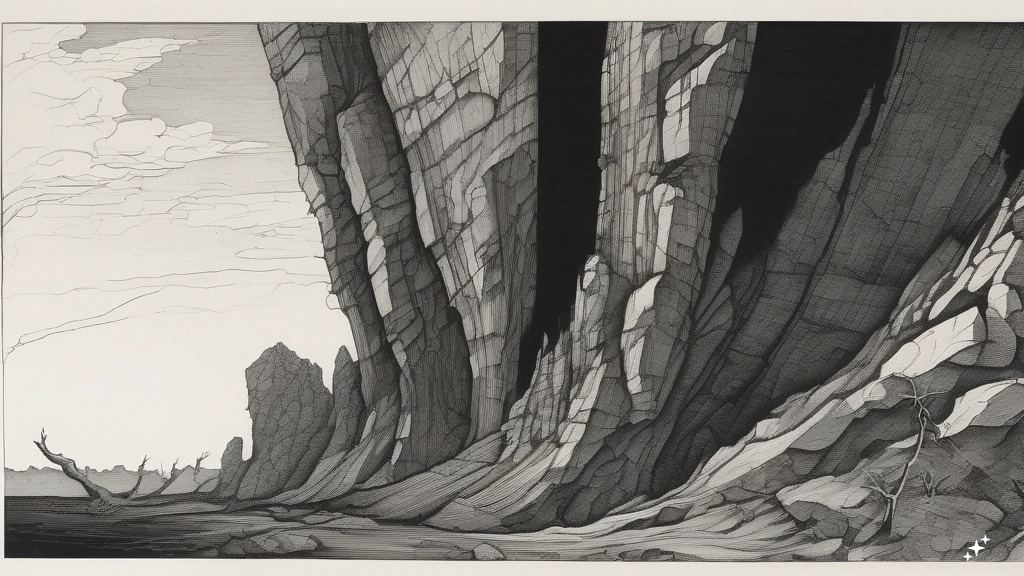
After an earthquake, a mountainside cracks open to reveal human-shaped holes — and people across Japan begin traveling to the fault line, convinced that one specific hole was made for them. They feel compelled to enter.
That’s all you need to know going in. The final pages are some of the most memorable in all of horror manga.
Helpful context: This story was originally published as a bonus inclusion at the end of Gyo, another Junji Ito series about a coastal town invaded by fish on mechanical legs. The Gyo 2-in-1 Deluxe Edition (a format that combines two volumes into one oversized book) includes Amigara Fault at the back. If you already own that edition, you may have read it there. Venus in the Blind Spot is the more convenient standalone way to access the story without buying a separate series.
This story was also adapted as episode 10 of Junji Ito Maniac: Japanese Tales of the Macabre, an anime anthology series on Netflix (2023) that adapts various Ito stories into animated episodes.
The Sad Tale of the Principal Post
A family moves into a new home. The house has a central pillar — a “principal post” — and something about it is deeply, fundamentally wrong.
This one is classic haunted-house Ito. The horror builds slowly through domestic unease rather than shock imagery.
The Edogawa Ranpo Adaptations (3 Stories)
Three stories in this collection are Junji Ito’s manga adaptations of works by Edogawa Ranpo. If you’re not familiar with Ranpo, here’s the quick version:
Edogawa Ranpo (1894–1965) was one of Japan’s most important mystery and horror writers. His pen name is a deliberate phonetic Japanese rendering of “Edgar Allan Poe” — say “Edogawa Ranpo” out loud and you’ll hear it. He’s considered the father of Japanese detective fiction, and his stories blend mystery with the grotesque in ways that pair perfectly with Ito’s visual style.
The three adaptations are:
An Unearthly Love — A disturbing story adapted from Edogawa Ranpo’s work. The horror here is more psychological than visual.
Human Chair — This is the standout of the three. Based on Ranpo’s classic short story “The Human Chair” (Ningen Isu), it follows a craftsman who hides himself inside a piece of furniture. The concept sounds almost absurd until Ito’s artwork makes it viscerally disturbing. This one was adapted as episode 5 of Junji Ito Maniac on Netflix.
How Love Came to Professor Kirida — Another Ranpo adaptation that blends obsessive love with creeping dread. It sits at the intersection of romance and horror in a way that’s uncomfortable in all the right ways.
These three stories are a unique selling point for this collection — you won’t find Ito’s Ranpo adaptations scattered across his other English-language anthologies.
Billions Alone
Content warning: This story involves dense clusters of tiny holes appearing on human skin. If that description already makes your skin crawl, you may be sensitive to trypophobia — a strong aversion to patterns of small holes or bumps. If so, this story is rough.
People begin developing those clusters across their bodies. The premise taps into this very specific, very common phobia, and Ito’s hyper-detailed artwork makes it almost unbearable to look at — which is, of course, exactly the point.
This is pure body horror — horror that comes from watching the human body warp, transform, or break down in ways that feel viscerally wrong. It’s effective and it’s relentless.
The Licking Woman
A woman with a grotesquely long tongue appears and begins terrorizing people. The imagery is bizarre and unsettling in that distinctly Ito way — the kind of horror that lodges in your brain not because it’s gory, but because it’s wrong.
Short, punchy, and weird. A good palate cleanser between the heavier stories.
Earthbound
People become physically rooted to specific spots on the ground. They can’t leave. They don’t want to leave. They just… stay.
This one works on a slow-burn existential level. The horror isn’t in what happens to the body but in the complete surrender of will. It’s quieter than some of the other stories here, but it lingers.
The Mystery of the Haunted House — Soichi’s Version
This story features Soichi Tsujii, a character who shows up across multiple Junji Ito collections. Soichi is a strange, mischievous kid who literally keeps iron nails clenched between his teeth (yes, actual nails — it’s his unsettling signature trait) and has a talent for causing supernatural trouble.
The tone here is noticeably lighter than the rest of the collection. Soichi stories lean more toward dark comedy than pure horror — think of him as the comic relief of the Junji Ito universe, though “comic relief” still involves cursed haunted houses.
If you enjoy Soichi here, more of his stories appear in Smashed and Soichi: Junji Ito Story Collection.
Master Umezz and Me (Bonus Essay)
This is not a horror story — it’s an autobiographical essay where Junji Ito writes about his admiration for Kazuo Umezu, a pioneer of horror manga who was active from the 1950s onward.
For readers interested in Ito as a person and artist rather than just a horror creator, this essay is genuinely valuable. It gives you a window into his influences, his artistic development, and the deep respect he has for the horror manga tradition that came before him.
It’s a warm, personal piece that feels like a bonus gift tucked into the back of the book.
Is Venus in the Blind Spot Good for Beginners?
Yes — this is one of the best entry points into Junji Ito’s work. Here’s why:
- No commitment required. Every story is self-contained. You can read one, put the book down, and come back whenever. There’s no ongoing plot to track.
- You get Ito’s greatest viral hit. The Enigma of Amigara Fault is often the very first Ito story people encounter online. Having it in a beautiful hardcover edition with full context is satisfying in a way that reading scattered panels on social media isn’t.
- Wide range of horror styles. Body horror (Billions Alone), psychological dread (Venus in the Blind Spot, Human Chair), supernatural creepiness (Earthbound, The Sad Tale of the Principal Post), dark comedy (Soichi) — you get to sample what Ito does across the horror spectrum and figure out what resonates with you.
- The Edogawa Ranpo adaptations add literary depth. If you appreciate horror with literary roots, the Ranpo connection gives these stories an extra dimension that’s unusual for manga anthologies.
- 272 pages for one purchase. That’s a lot of content in a single hardcover.
Who Might Want to Start Elsewhere
If you already know you prefer long, continuous narratives — a single story that builds across many chapters and volumes rather than a set of separate short stories — an anthology might feel scattered. In that case, consider:
- Uzumaki — Ito’s masterwork about a town consumed by spirals. It’s a complete story available as a 3-in-1 Deluxe Edition (all three original volumes collected into one oversized book). Deeply unsettling and tightly plotted.
- Tomie — A recurring character who appears across connected but self-contained stories. Each story works on its own, but they share the same central figure — giving it more cohesion than a random anthology.
Uzumaki (3-in-1 Deluxe Edition)
But honestly? Venus in the Blind Spot is a great sampler. If you read it and love the body horror, you know to chase that thread. If the Ranpo adaptations grab you, you can explore that literary horror angle. It helps you map your own taste.
Reading Order — How Venus in the Blind Spot Fits With Other Junji Ito Books
There is no required reading order. Venus in the Blind Spot is completely standalone. You can read it first, last, or in the middle of your Ito journey — it doesn’t matter.
That said, here’s how it connects to other books if you want to explore further:
If You Loved the Anthology Format
Grab Shiver: Junji Ito Selected Stories next — it’s another VIZ anthology with a different set of stories and a similar format. Between Venus in the Blind Spot and Shiver, you’ll have experienced a huge cross-section of Ito’s short work.
Other Junji Ito story collections worth exploring:
- Smashed — Another anthology, includes more Soichi stories
- Alley — A newer collection with stories not found in previous English compilations
- Stitches — More short horror from across Ito’s career
- Dissolving Classroom — A connected set of stories about a brother and sister with disturbing abilities
Alley: Junji Ito Story Collection
Stitches (Junji Ito)
Dissolving Classroom (Junji Ito)
If You Want a Longer Ito Story
- Uzumaki — The big one. A small town becomes obsessed with spirals, and things get progressively more nightmarish. Available as a 3-in-1 Deluxe Edition.
- Tomie — Ito’s first published work. A beautiful girl who cannot truly die — and the chaos that follows her everywhere.
- Gyo — A coastal town is invaded by fish on mechanical legs. Sounds ridiculous, reads as genuinely horrifying.
Uzumaki (3-in-1 Deluxe Edition)
If You Came Here Specifically for Amigara Fault
The Enigma of Amigara Fault also appears at the end of the Gyo 2-in-1 Deluxe Edition as a bonus story (that’s where it was originally published in Japan). If you already own that edition, you’ve read it. Venus in the Blind Spot is the easier standalone option if you don’t want to buy a separate series just for one story.
If You Want More Soichi
The Mystery of the Haunted House is just one Soichi story. If that weird kid with nails in his mouth charmed you, look for:
- Soichi: Junji Ito Story Collection — the definitive Soichi collection
- Smashed — contains additional Soichi appearances
If the Edogawa Ranpo Adaptations Hooked You
The Ranpo adaptations in this collection are unique to Venus in the Blind Spot within Ito’s English-language catalog. If you want to read Ranpo’s original prose stories in English, look for translated collections of his work — his writing is atmospheric and strange in ways that complement Ito’s visual interpretations beautifully.
Quick Reference
| Detail | Info |
|---|---|
| Title | Venus in the Blind Spot |
| Author | Junji Ito |
| Publisher (English) | VIZ Media |
| Release Date | August 18, 2020 |
| Format | Hardcover, 272 pages |
| Stories | 10 horror stories + 1 essay |
| Standalone? | Yes — single volume, no series |
| Digital? | Yes — Kindle, Apple Books, Kobo, Google Play |
Venus in the Blind Spot is a fantastic book to have on your shelf. It’s beautiful as a physical object, it’s packed with variety, and it contains at least two stories (Amigara Fault and Human Chair) that rank among the most memorable things Junji Ito has ever drawn. If anything in this guide caught your attention, grab a copy and see which stories stick with you — everyone has a different favorite, and that’s part of the fun.