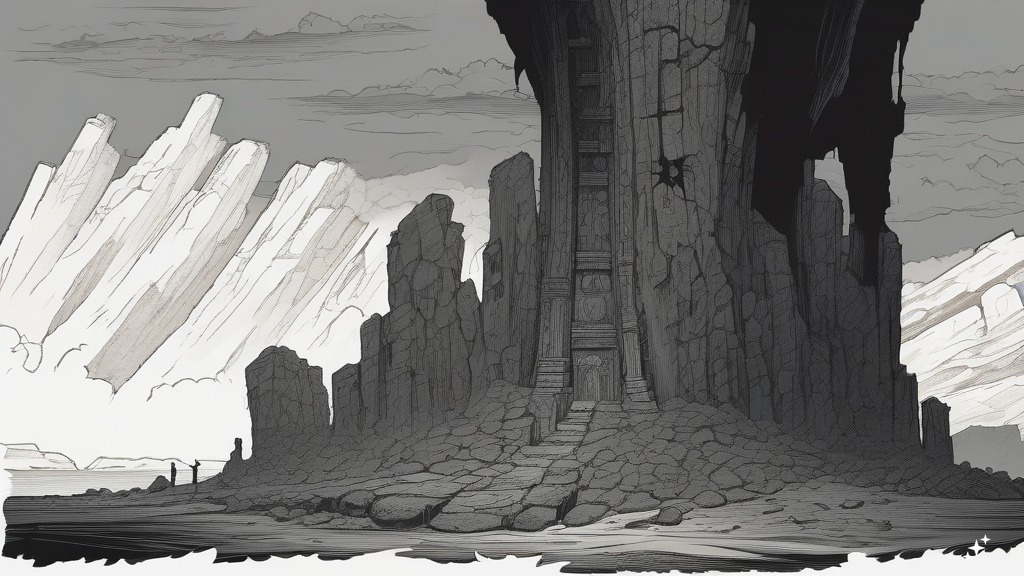
All 10 Stories in Venus in the Blind Spot
Here’s the full list in the order they appear in the collection:
- The Enigma of Amigara Fault — Original Ito story
- The Sad Tale of the Principal Post — Original Ito story
- Billions Alone — Original Ito story
- An Gravetown — Original Ito story (this is the official English title as printed in the Viz Media edition — the unusual phrasing is intentional)
- The Human Chair — Adapted from Edogawa Rampo
- Venus in the Blind Spot (title story) — Adapted from Yasutaka Tsutsui
- Kisses — Original Ito story
- Keepsake — Original Ito story
- Masterpiece — Original Ito story
- How Love Came to Professor Iwatani — Adapted from Yasutaka Tsutsui
Every story is self-contained — each one has its own beginning, middle, and ending, and you don’t need to read anything else first. There’s no ongoing plot connecting them, so you can read them in any order, though the book’s sequencing works well as-is.
Each Story Explained (Spoiler-Free)
1. The Enigma of Amigara Fault
Horror type: Cosmic and existential horror — stories where the source of fear is something vast, unknowable, or beyond human understanding, often leaving characters (and readers) with a sense of helplessness against forces that don’t care about humanity.
After a massive earthquake splits a mountainside open, survivors discover something deeply unsettling: the exposed rock face is covered in human-shaped holes. Each hole appears to be perfectly contoured to fit one specific person. And the people who find “their” hole feel an overwhelming compulsion to enter it.
This is one of Junji Ito’s most iconic and widely-shared stories. It originally appeared as a bonus chapter at the end of Gyo, another Ito horror manga about a coastal town invaded by fish on mechanical legs. The Amigara Fault story has since become legendary online — you’ve probably seen the “this is my hole” panels circulating as memes. The premise is beautifully simple and the payoff is the kind of image that sticks in your brain for days.
If you only read one story in this collection, make it this one.
Anime adaptation: Episode 11 of Junji Ito Maniac: Japanese Tales of the Macabre (Netflix, 2023).
2. The Sad Tale of the Principal Post
Horror type: Folklore-based atmospheric horror
A family moves into a traditional Japanese house and begins to notice something wrong with the main structural pillar — the hashira, or principal post. In Japanese architecture, the principal post holds real cultural significance, and there are longstanding superstitions about what happens when something goes wrong with it.
Ito takes those real architectural superstitions and pushes them into full-blown horror territory. This one’s a slow build that rewards patience. The atmosphere is thick, and the payoff lands hard.
Anime adaptation: Episode 11 of Junji Ito Maniac: Japanese Tales of the Macabre (Netflix, 2023).
3. Billions Alone
Horror type: Surreal and psychological horror
A woman starts seeing copies of herself — identical doubles, sometimes called doppelgängers. Not just glimpses — full, undeniable replicas, and they keep multiplying. The story plays with ideas about isolation and loneliness in modern life, wrapping social commentary inside a deeply unsettling premise.
What starts as eerie quickly becomes overwhelming. Ito has a gift for taking a single disturbing concept and escalating it to its most extreme logical conclusion, and this story is a strong example.
Anime adaptation: Episode 10 of Junji Ito Maniac: Japanese Tales of the Macabre (Netflix, 2023).
4. An Gravetown
Horror type: Quiet, slow-building horror — stories that create dread gradually through accumulation rather than sudden shocks.
A town is gradually overtaken by grave markers that seem to appear from nowhere. No dramatic catastrophe — just a steady, creeping accumulation of graves that the residents can’t explain or stop.
This one reads as a meditation on death’s constant, unavoidable presence. It’s quieter than many Ito stories, more melancholy than shocking, and the horror comes from the sheer relentlessness of it rather than any single big scare.
5. The Human Chair
Horror type: Psychological horror / literary adaptation
Adapted from: Edogawa Rampo’s 1925 short story of the same name.
A furniture maker constructs an elaborate, oversized chair — and then hides himself inside it. His goal: to feel the presence and warmth of whoever sits down. The story unfolds through his obsessive perspective as the chair is purchased and used by unsuspecting people.
Edogawa Rampo’s original is already a masterpiece of creepy psychological fiction, and Ito’s manga adaptation adds a visual dimension that amplifies the horror significantly. Seeing the contorted body crammed inside the upholstery, rendered in Ito’s incredibly detailed ink drawing, takes the concept from unsettling to viscerally disturbing.
Content note: This story deals with voyeurism and obsessive fixation on another person’s body. The horror comes from the psychological violation rather than graphic violence, but the premise may be uncomfortable for some readers.
This is a strong pick for readers who enjoy horror rooted in psychological suspense rather than monsters or gore. If you like this, tracking down more of Rampo’s original stories is well worth it.
Anime adaptation: Episode 10 of Junji Ito Maniac: Japanese Tales of the Macabre (Netflix, 2023).
6. Venus in the Blind Spot (Title Story)
Horror type: Sci-fi horror — horror that uses scientific or pseudo-scientific concepts (ideas that sound scientific but aren’t proven) as the basis for its scares.
Adapted from: Yasutaka Tsutsui’s science fiction work.
A university student becomes obsessed with investigating a woman who seems to exist only in people’s peripheral vision. She’s visible at the edges of sight but impossible to look at directly — as if she occupies a literal blind spot in human perception.
The title story blends scientific concepts with psychological horror in a way that feels distinctly different from Ito’s usual fare. The Tsutsui source material brings a more cerebral, science-fiction-flavored approach, and Ito’s adaptation leans into the visual paradox of illustrating something that can’t be seen head-on.
7. Kisses
Horror type: Body horror — a horror subgenre focused on the violation, transformation, or destruction of the human body in disturbing ways. Think less “jump scare” and more “what happened to that person’s face.”
A young woman’s face becomes the center of a bizarre and disturbing curse. This is one of the shorter pieces in the collection, and it hits fast.
Classic Ito body horror — the kind of story where the human form is twisted and violated in ways that feel both impossible and horribly plausible. Brief but memorable.
Content note: Contains graphic depictions of facial disfigurement.
8. Keepsake
Horror type: Grief horror / supernatural
Items left behind by a deceased relative begin to take on a sinister quality. What should be comforting mementos become something deeply wrong.
This story transforms the universal experience of mourning into something monstrous. There’s genuine emotional weight here alongside the horror, which gives it a different kind of impact than the more purely visceral stories in the collection.
9. Masterpiece
Horror type: Psychological horror / obsession
An artist’s relentless pursuit of creating the perfect artwork drives them to increasingly disturbing extremes. The line between creative dedication and destructive madness dissolves completely.
Stories about artistic obsession are a well-worn horror tradition, but Ito’s version benefits enormously from being a visual medium — you’re watching an artist go mad in pursuit of art, illustrated by an artist whose own obsessive detail is legendary. There’s a satisfying layered quality to it.
10. How Love Came to Professor Iwatani
Horror type: Philosophical / surreal horror
Adapted from: Yasutaka Tsutsui’s work (the second Tsutsui adaptation in this collection).
A professor receives a visit from a supernatural entity that claims to be the literal embodiment of love. What follows is not romantic or heartwarming.
This is the most philosophical story in the collection — more concerned with ideas than with scares, though it has plenty of Ito’s signature visual unease. It’s a strange, thought-provoking way to close the book.
Which Stories Are Adapted from Other Authors?
Out of the 10 stories, 7 are original Junji Ito works and 3 are adaptations of stories by other Japanese authors:
| Story | Original Author | Source |
|---|---|---|
| The Human Chair | Edogawa Rampo | 1925 short story of the same name |
| Venus in the Blind Spot | Yasutaka Tsutsui | Science fiction short story |
| How Love Came to Professor Iwatani | Yasutaka Tsutsui | Short story |
Edogawa Rampo (1894–1965) is one of the foundational figures of Japanese mystery and horror fiction. His pen name is itself a Japanese rendering of “Edgar Allan Poe” — the famous 19th-century American horror and mystery writer — and his work occupies a similar position in Japanese literature: dark, psychologically complex, and hugely influential. “The Human Chair” is one of his most famous stories.
Yasutaka Tsutsui (born 1934) is a major Japanese science fiction author known for blending surreal, often darkly comic concepts with literary sophistication. Western audiences may recognize his work through the anime film The Girl Who Leapt Through Time (2006) and Paprika (2006), both adapted from his novels.
Ito’s adaptations aren’t just straight retellings — they’re visual reinterpretations. He takes stories that were originally pure text and finds the horror imagery hiding inside them. The result feels like a collaboration across time, with Ito’s detailed art giving form to ideas that the original authors could only describe in words.
Which Stories Were Adapted in the Anime?
Four of the 10 stories in this collection appeared in Junji Ito Maniac: Japanese Tales of the Macabre, a 2023 Netflix anime series:
| Episode | Stories Adapted |
|---|---|
| Episode 10 | Billions Alone + The Human Chair |
| Episode 11 | The Enigma of Amigara Fault + The Sad Tale of the Principal Post |
The remaining 6 stories — An Gravetown, Venus in the Blind Spot, Kisses, Keepsake, Masterpiece, and How Love Came to Professor Iwatani — have not been adapted into anime as of this writing.
A few things worth knowing if you’re coming to this book from the anime:
- The manga versions have significantly more detail than the anime adaptations. Ito’s artwork is extraordinarily dense and intricate, and even a well-produced anime can’t fully replicate that level of detail on screen. If you liked these stories in the anime, the manga versions are a clear upgrade.
- The Enigma of Amigara Fault in particular benefits from being read on paper. The pacing of a manga — where you control how fast you turn pages — makes the horror land differently than watching it unfold in real-time animation. Remember that manga reads right to left, so start from the right side of each two-page spread.
- Each anime episode pairs two stories together, so the individual stories are shorter in animated form than they are on the page.
Best Stories to Start With
All 10 stories are standalone, so there’s no wrong starting point. That said, if you want recommendations:
- The Enigma of Amigara Fault — The most accessible story in the collection and one of Ito’s most iconic works. The premise is immediately gripping and the horror is universal — you don’t need any background in manga or Japanese horror to connect with it.
- The Human Chair — A strong pick if you enjoy horror rooted in psychological suspense. Rampo’s classic premise is already deeply unsettling, and Ito’s art turns it into something unforgettable. The fact that it’s an adaptation actually makes it a nice entry point — there’s a clear narrative structure that carries you through.
- Venus in the Blind Spot (the title story) — For readers who like their horror blended with sci-fi concepts. The scientific angle gives it a different flavor from the rest of the collection, and it’s a fun demonstration of how Ito handles source material from another author.
Reading straight through in the book’s order works perfectly well too. The sequencing provides good variety between horror types, and the collection builds nicely.
Where to Buy Venus in the Blind Spot
Venus in the Blind Spot is published by Viz Media as a single hardcover volume. Here are the key details:
Venus in the Blind Spot (Junji Ito)
- Format: Hardcover, 272 pages
- Publisher: Viz Media
- Publication date: August 18, 2020
- ISBN: 978-1974715473 (this is the book’s unique identification number — useful for looking it up at bookstores or libraries)
This is the only physical English edition available — there’s no softcover version from Viz. A digital edition is available through Amazon Kindle and other digital manga platforms if you prefer reading on a screen. The hardcover typically retails in the $20–$25 range, though prices vary by retailer. The physical edition is well-made and looks great on a shelf alongside other Ito collections.
Content note for the collection overall: Venus in the Blind Spot contains graphic body horror (disturbing transformations and disfigurement of the human body), voyeuristic and obsessive themes, and imagery that some readers may find deeply unsettling. This is standard for Junji Ito’s work, but worth knowing if you’re new to his manga or considering this as a gift.
Other Junji Ito Collections Worth Checking Out
If you enjoy Venus in the Blind Spot and want more, Ito has a deep catalog of story collections. Here are a few that pair well, matched to what you might have liked most in this book:
- If you loved the atmospheric, creepy stories (like An Gravetown and The Sad Tale of the Principal Post): Try the Junji Ito Story Collection 3 books set: Lovesickness, Deserter, Fragments of Horror — Lovesickness leans into romantic horror with heavy atmosphere, Deserter collects some of his lesser-known pieces, and Fragments of Horror is one of his most refined collections. They’re available individually or as a set.
- If the body horror grabbed you (Kisses, Billions Alone): Stitches is another Ito story collection featuring a mix of body horror and psychological horror. It’s a natural follow-up if the more visceral stories in Venus were your favorites.
- If you want something newer: Alley is a more recent collection that shows Ito continuing to evolve his style while maintaining everything that makes his horror work.
- If you want something short and fast: Dissolving Classroom is a shorter Ito work that’s perfect for readers who want something they can finish in a single sitting. Dark comedy meets body horror in a way that’s distinctly different from the more atmospheric pieces in Venus.
- If you’re ready for a longer Ito work: Uzumaki (3-in-1 Deluxe Edition) — Ito’s most celebrated long-form work, about a town slowly consumed by spirals. Where Venus in the Blind Spot shows Ito’s range across 10 standalone stories, Uzumaki shows what happens when he commits a single horrifying concept across an entire series. It’s available in a single hardcover collecting all three volumes.
Note: this is a multi-book set put together by a third-party seller, not an official publisher box set.
Junji Ito Story Collection 3 books set: Lovesickness, Deserter, Fragments of Horror
Stitches (Junji Ito)
Alley: Junji Ito Story Collection
Dissolving Classroom (Junji Ito)
Uzumaki (3-in-1 Deluxe Edition)
Venus in the Blind Spot is a strong introduction to Junji Ito’s range — you get his original horror alongside his literary adaptations, his body horror alongside his atmospheric pieces, his iconic work alongside his lesser-known stories. It’s 10 stories, 272 pages, and zero filler.