What Is Junji Ito’s Osamu Dazai No Longer Human Manga?
No Longer Human is Junji Ito’s manga adaptation of Osamu Dazai’s 1948 literary classic of the same name. It’s a 12-chapter work aimed at adult readers, originally published chapter by chapter in Big Comic Original (a Japanese manga anthology magazine) from May 2017 to April 2018. Those chapters were then collected into 3 Japanese book volumes before being combined into a single English hardcover.
No Longer Human (Junji Ito)
If you’re new to manga, that chapter-by-chapter magazine publishing process is how most manga works — artists release individual chapters in magazines, and those chapters later get collected into book form for purchase.
In English, Viz Media published it as a single hardcover edition — all 616 pages in one book, released on December 17, 2019.
This wasn’t just another project for Ito. Dazai’s novel was his favorite book, and adapting it was his dream project. That personal investment shows on every page. The result is widely considered one of Ito’s most celebrated works — and also his most unusual.
Here’s the thing to know upfront: this is not a typical horror manga. There are no spirals consuming a town (that’s Uzumaki, Ito’s most famous horror series ), no immortal girl stalking her victims (that’s Tomie, another signature Ito work). Instead, it’s a literary adaptation where Ito uses his signature grotesque, surreal imagery to externalize the protagonist’s psychological torment — making visible what Dazai conveyed through prose.
Uzumaki (3-in-1 Deluxe Edition)
The manga is complete — no ongoing publication to wait on.
The Source Material — Osamu Dazai’s Novel in 60 Seconds
Before diving into the manga, it helps to understand what Ito was working with.
Osamu Dazai’s No Longer Human (人間失格) was published in 1948 and has since sold over 12 million copies, making it one of the best-selling and most widely read novels in Japanese literary history. It sits alongside other foundational Japanese novels like Natsume Sōseki’s Kokoro and Mishima’s The Temple of the Golden Pavilion as a pillar of modern Japanese literature.
The story follows Ōba Yōzō — a man who feels fundamentally disqualified from being human. From childhood, he senses a gulf between himself and everyone around him. To survive, he develops a “clowning” persona — performing cheerfulness and humor to mask his alienation. But that mask cracks, and the story traces his slow, devastating descent through failed relationships, addiction, exploitation, and institutionalization.
The novel’s structure is distinctive:
- Prologue — A narrator discovers three notebooks and photographs
- First Notebook — Yōzō’s childhood and the origin of his alienation
- Second Notebook — Adolescence and college years, deepening disconnection, a failed double suicide
- Third Notebook — Adult life: alcoholism, drug abuse, madness, and final collapse
- Epilogue — The narrator reflects on what he’s read
One piece of context that haunts the entire work: Dazai died by suicide in June 1948, before the final installment was even published. The novel draws heavily from Dazai’s own real life, and knowing this colors every page with an almost unbearable weight. This isn’t a writer imagining despair — it’s a writer documenting it.
For readers who want to experience the novel in English, two translations are widely available:
- Donald Keene’s translation (1958, New Directions) — the classic edition, still in print
- Mark Gibeau’s translation (2018, Stone Bridge Press, titled A Shameful Life) — a more recent rendering with updated language
Both are worth reading, and we’ll discuss below whether you want to read the novel before or after the manga.
How the Manga Adapts the Novel
This is where things get interesting — and where Ito’s adaptation stands apart from most manga based on novels.
Ito follows the three-notebook structure faithfully. The manga’s 12 chapters break down to 4 chapters per notebook, mapping directly onto Dazai’s original organization. There are no new characters. No invented subplots. No additional scenes that weren’t in the source text. Ito’s contribution is entirely visual.
So what does he actually do?
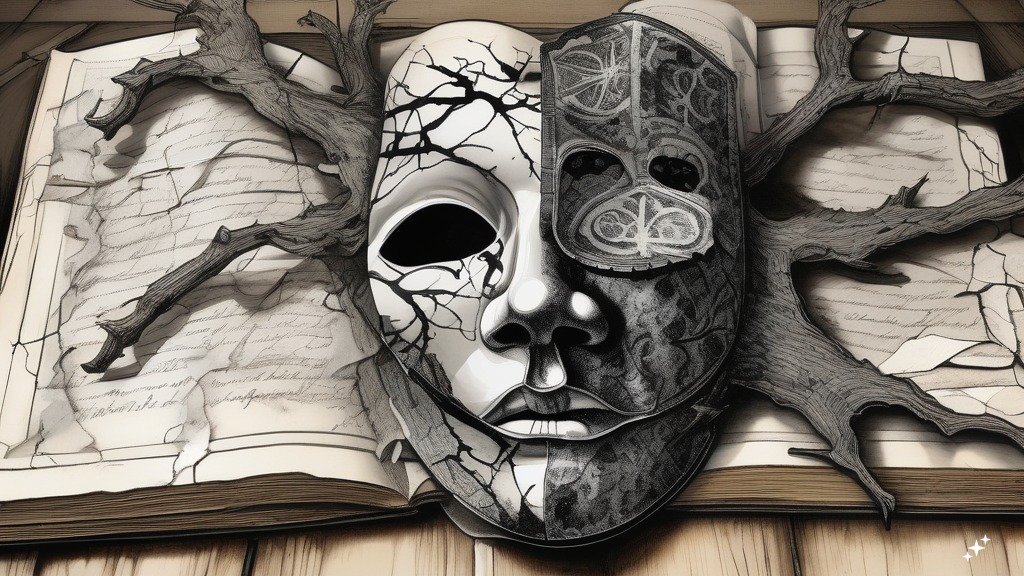
The key adaptation technique is this: Ito renders Yōzō’s internal psychological states as grotesque, surreal imagery. When Yōzō feels the world closing in, the panels warp. When he senses the monstrous gap between his performed self and his actual self, that gap becomes literal — twisted faces, bodies distorting, nightmarish visions bleeding into otherwise realistic scenes.
A “monster within” visual motif runs throughout the entire manga. Yōzō’s self-perception as something fundamentally inhuman — the core anxiety of Dazai’s prose — gets translated into images that feel pulled from Ito’s horror work. But here, the horror isn’t supernatural. It’s psychological, and the grotesque imagery is metaphorical rather than literal.
This means the manga is more restrained than Uzumaki or Tomie. If you come in expecting graphic physical horror (the kind where bodies twist and warp as part of a supernatural threat) or escalating supernatural dread, you’ll find something quieter and more literary. The horror here lives in the character’s mind, and Ito makes it visible without ever breaking the story’s realism.
The result is genuinely powerful: the psychological horror — horror that comes from the mind and emotions rather than monsters or violence — that was always inherent in Dazai’s prose becomes something you can see on the page. For readers who struggle with dense literary fiction, Ito’s visual interpretation can make Yōzō’s experience more immediately accessible and visceral than prose alone.
Volume-by-Volume Breakdown
While the English edition collects everything in a single hardcover, the story still follows the three-part structure of the original novel and the Japanese book releases.
A note before reading further: The section below describes key plot events from each part of the story, including some that involve suicide and self-harm. If you’d prefer to go in completely fresh, skip ahead to the “English Edition” section.
Volume 1 — First Notebook (Chapters 1–4)
The story opens with Yōzō’s childhood — specifically, the development of his “clowning” persona. Even as a young boy, Yōzō senses that he’s different from the people around him. He doesn’t understand what drives them, what they want, what makes them happy or angry. The world of human beings is genuinely alien to him.
His survival strategy: become the class clown. Perform. Make people laugh. If they’re laughing, they won’t notice that you’re faking everything. If they think you’re funny, they won’t look too closely.
Ito’s visuals in this section establish the tone for everything that follows. The everyday scenes of childhood are rendered with careful realism, but Yōzō’s internal experience pushes through in moments of visual distortion — glimpses of the disconnect between the smiling face he shows the world and the void he experiences inside.
Volume 2 — Second Notebook (Chapters 5–8)
Yōzō moves to Tokyo for high school and college, and his carefully maintained mask begins to crack under the weight of more complex social demands. He falls in with a group that introduces him to political radicalism and heavy drinking. He enters his first romantic relationships — but connection remains impossible for someone who doesn’t believe he’s truly human.
The section builds toward one of the novel’s most devastating sequences: a failed double suicide. Yōzō and a woman attempt to drown themselves together. She dies. He survives. The guilt and the questions that follow — why did he live, was he ever sincere, was even his desire to die a performance — become the hinge point of the entire story.
Ito’s art in this section is some of the most striking in the entire manga. The failed suicide and its aftermath give him material that bridges his horror sensibility and the novel’s literary weight in a way that feels completely earned.
Volume 3 — Third Notebook (Chapters 9–12)
The final section is the descent. Yōzō spirals into alcoholism, drug addiction, and exploitation by the people around him. His relationships collapse. His health deteriorates. He’s eventually institutionalized — and in one of the most quietly devastating moments in the story, he realizes that being placed in an asylum means society has officially confirmed what he always suspected: he is no longer human.
This is where the “monster within” motif reaches its full expression. Ito doesn’t need to invent horror for these chapters — Dazai’s narrative provides more than enough. But the visual language Ito has built across the previous eight chapters pays off here, as the surreal and grotesque elements that were subtle early on become more prominent and more heartbreaking.
The manga ends where the novel ends — with the epilogue’s narrator reflecting on Yōzō’s notebooks. There’s no last-minute salvation or uplifting resolution. It’s an honest, unflinching conclusion.
English Edition — What You Get (and What’s Missing)
The English edition is a Viz Media hardcover that collects all 3 Japanese volumes into a single 680-page book.
No Longer Human (Junji Ito)
- Release date: December 17, 2019
- ISBN: 978-1974707096
- Format: Hardcover, right-to-left reading
A quick note if you’ve never read manga in print: manga reads from right to left, which means you open the book from what would be the “back” cover of a Western book, and you read panels from right to left across each page. It feels natural within a few pages.
- Content: All 12 chapters of the No Longer Human adaptation
The book is a hefty, attractive volume that looks great on a shelf and holds up well to rereading. The hardcover format suits the material — this feels like a literary object, not a disposable paperback.
However, there’s an important note about missing content.
In 2019, Japan received a Complete Edition — an expanded version that included not only the 12-chapter No Longer Human adaptation but also 5 additional short stories adapted from other Osamu Dazai works:
- Schoolgirl
- Cherries
- Blue Bamboo
- Ōtogizōshi: Urashima-san
- Run Melos!
This kind of expanded re-release is common in Japanese manga publishing — a publisher will revisit a popular title years later and bundle bonus material into a new edition.
These bonus stories are NOT included in the English Viz release. The English edition contains only the 12-chapter main adaptation. As of this writing, the Dazai short story adaptations have not been published in English.
This is worth knowing before you buy, especially if you see the Japanese Complete Edition online and wonder if you’re getting the same content. You’re not — but the core adaptation is complete and self-contained.
Quick Reference
| Detail | Info |
|---|---|
| Original novel | Osamu Dazai, 1948 |
| Manga artist | Junji Ito |
| Serialization | Big Comic Original, Feb 2009 – May 2011 |
| Chapters | 12 (4 per notebook) |
| English publisher | Viz Media |
| English format | Single hardcover, 616 pages |
| English release | December 17, 2019 |
| ISBN | 978-1974707096 |
| Anime | No anime adaptation currently announced |
| Missing from English ed. | 5 bonus Dazai short story adaptations (Japan-only Complete Edition, 2019) |
Do You Need to Read the Novel First?
Short answer: no.
The manga is a complete, self-contained adaptation. Ito follows the novel closely enough that you won’t miss any plot points or character beats by coming in fresh. The story makes full sense on its own.
That said, reading the novel first does deepen your appreciation for what Ito accomplishes. When you know exactly what Dazai wrote in a particular passage, and then you see how Ito chose to visualize it — what he emphasized, what he made monstrous, where he let silence and empty space do the work — the adaptation becomes a conversation between two artists across decades. That’s a genuinely rewarding experience.
But the reverse order works just as well. Plenty of readers discover the manga first and then pick up Dazai’s novel, motivated by the manga to engage with the source text. The manga can serve as an entry point into Japanese literary fiction in a way that few other works can.
Here’s why either order works: the story is character-driven, not plot-twist-driven. There are no shocking reveals that get “spoiled.” The power of No Longer Human — in both its novel and manga forms — comes from the accumulation of detail, the weight of watching a person unravel in slow motion. Knowing what happens doesn’t diminish the impact. If anything, it intensifies it.
Who Should Read This Manga
This manga is great for:
- Junji Ito fans looking for his most literary, emotionally complex work — this is Ito at his most personal and his most restrained, and it’s fascinating to see what he does when the horror is entirely internal
- Readers interested in Japanese literature who prefer manga format or want a visual companion to one of Japan’s most important novels
- Horror manga readers who want psychological depth over sudden shocks — if you’ve been reading horror manga and want something that lingers in your mind for different reasons, this is it
- Anyone who loved the novel and wants to see it through a new visual lens
A word of caution, though:
This is NOT the best starting point if you want typical Junji Ito horror. If you’ve never read Ito and you’re looking for the experience that made him famous — the spiraling dread, the graphic physical horror, the cosmic wrongness — start with Uzumaki (his most famous work, about a town consumed by spirals) or Tomie (about an immortal girl who drives people to obsession and violence) instead. No Longer Human is a literary adaptation first and a horror manga second. Readers who come in expecting wall-to-wall Ito-style horror may feel like they got something different from what they wanted.
Uzumaki (3-in-1 Deluxe Edition)
It’s different — and it’s wonderful — but go in with the right expectations.
Wrapping Up
Junji Ito’s No Longer Human is one of the most unusual and rewarding manga in his catalog. It’s not his scariest work — but it might be his most emotionally devastating. By bringing his visual horror language to Dazai’s literary masterpiece, Ito created something that belongs fully to both the world of manga and the world of Japanese literature.
No Longer Human (Junji Ito)
If you’re even slightly curious, the 680-page Viz hardcover is a beautiful object and a complete experience in one volume. Set aside an afternoon, let Yōzō’s story unfold at its own pace, and see what happens when one of manga’s greatest horror artists turns his eye inward.