All 12 School-Live! Manga Volumes — The Complete Series
Great news if you hate waiting for new releases: School-Live! is a finished series. The numbered main series runs exactly 12 volumes in both the original Japanese edition and the English translation published by Yen Press. There’s no need to worry about catching up to an ongoing story or waiting months between cliffhangers — you can read the entire thing from start to finish right now.
The series was written by Norimitsu Kaihou (credited under Nitroplus) and illustrated by Sadoru Chiba. It was originally published chapter by chapter in Manga Time Kirara Forward, a magazine better known for lighthearted, cute everyday-life series — which makes School-Live!’s presence there even more unsettling when you know what the story actually is.
Chiba’s art deserves special mention — the ability to shift seamlessly between adorable, innocent-looking character designs and genuinely disturbing horror imagery is what makes the series’ central gimmick work so well on the page.
With all 12 volumes available in English, this is one of the easiest complete horror manga series to collect. No out-of-print volumes to hunt down, no translation gaps to worry about.
What School-Live! Is About (Spoiler-Free)
The setup sounds simple: four girls are members of the School Living Club at Megurigaoka Private High School. The club’s activity? Living at school full-time. They sleep in the classrooms, grow vegetables on the rooftop garden, and go about their daily school routines with infectious cheerfulness.
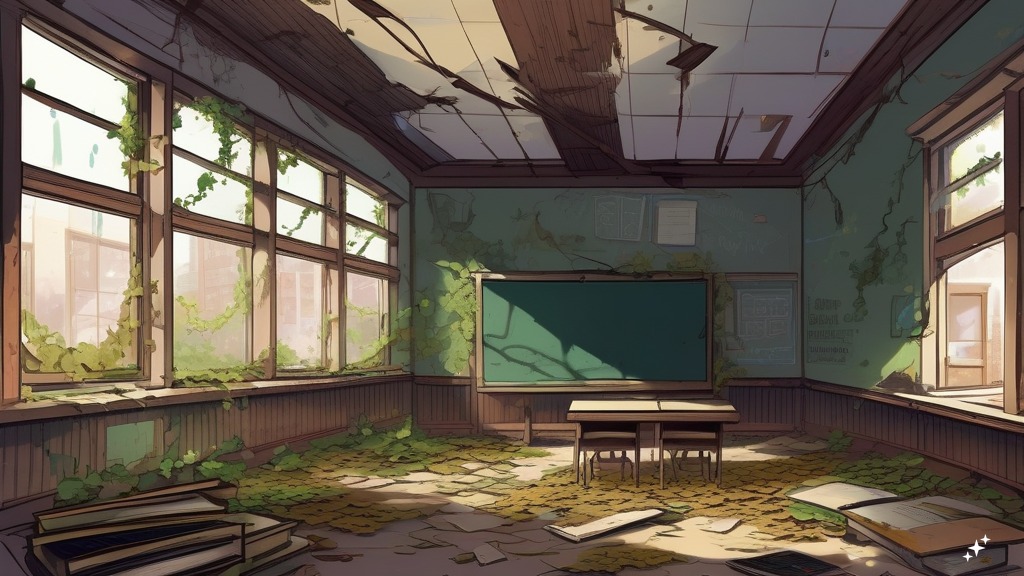
The catch — and this is the hook that made the series famous — is that the world outside has been overrun by zombies. The school is their shelter. The barricades on the doors aren’t decorations. And the club’s cheerful leader, Yuki Takeya, isn’t just being optimistic — she’s experiencing a psychological break that lets her see the ruined school as a normal, functioning campus.
What makes School-Live! remarkable isn’t the zombie apocalypse itself. Plenty of manga have done that. It’s the gap between surface and reality — the way the art style, the character interactions, and Yuki’s perception create a constant tension between what you’re shown and what’s actually happening. Early chapters will have panels of Yuki chatting happily with classmates, and then the next page reveals the empty, blood-stained hallway she’s actually standing in.
This isn’t a series that relies on jump scares or graphic violence (though it has its moments). The horror is psychological — the dread of knowing the truth while watching characters desperately maintain a fiction. It’s heartbreaking and unsettling in equal measure, and it works because you genuinely care about these characters and their fragile coping mechanisms.
The core cast includes Yuki (the delusional optimist), Kurumi (the athletic one who carries a shovel as her weapon), Yuuri (the calm, motherly club president), and Miki (a newcomer who joins later and struggles with the group’s deliberate denial of reality). Their dynamics and how each character processes trauma differently gives the series an emotional depth that elevates it far beyond its premise.
Volume-by-Volume Breakdown Across All 12 Books
Here’s a volume-by-volume breakdown of School-Live!’s four major storylines. Each section covers the general tone and stakes of those volumes without giving away specific plot twists — but if you want to go in completely blind, skip ahead to the buying guide below.
Volumes 1–3 — School Life and the First Cracks
Volume 1 is where the magic trick happens. The opening chapters present what looks like a perfectly normal school manga — Yuki and her friends goofing around, attending class, having fun at their club. If you go in blind, you might genuinely wonder why this is shelved in the horror section. Then the perspective shifts, the facade cracks, and suddenly everything you’ve been reading clicks into place with a sickening lurch. It’s one of the most effective reveals in manga, and it works even better on the page than it did in the anime because you control the pacing of that realization. The first volume establishes the School Living Club, introduces the core cast, and sets the rules of this world — the zombies outside, the barricades, the rooftop garden that keeps them fed, and most importantly, the unspoken agreement among the girls to play along with Yuki’s delusion because shattering it might break her completely.
School-Live!, Vol. 1
Volume 2 deepens the survival mechanics and the characters’ backstories. We learn more about how the outbreak started at the school, what the early days were like, and how the girls organized themselves into the School Living Club in the first place. Kurumi’s role as the group’s protector comes into sharp focus — she’s the one who does the dirty work of dealing with zombies when they breach the perimeter, and the emotional toll of that responsibility starts to show. The volume also begins developing the relationship between the girls and Megu-nee (Megumi Sakura), their faculty advisor, whose presence in the story carries a weight that becomes clearer as you read further. Volume 2 is where School-Live! proves it isn’t a one-trick pony — the initial reveal was the hook, but the character work is what keeps you turning pages.
School-Live!, Vol. 2
Volume 3 brings the first major survival crisis. The school — which has been their sanctuary — faces a direct threat that forces the girls to confront just how fragile their safe zone really is. Without spoiling specifics, this volume is where the series stops pulling punches. Characters are pushed to their limits, and the consequences are real. If volumes 1 and 2 drew you in with clever storytelling and likeable characters, volume 3 is where the story grabs you by the throat and doesn’t let go. By the end of this volume, the status quo has fundamentally changed, and there’s no going back to the comfortable routine of the early chapters.
School-Live!, Vol. 3 (Volume 3)
Volumes 4–6 — The School’s Last Days
Volume 4 is the aftermath of that crisis — and a revelation. The girls learn that their school was built as an emergency evacuation facility, which explains its solar panels, water supply, and stocked storerooms — and raises unsettling questions about how much someone knew before the outbreak ever happened. Meanwhile, one of the group is fighting for her life after the breach, and the volume wrings real dread out of whether she can be saved. It’s the darkest stretch of the story so far, and it permanently changes how you read the school’s cheerful facade.
School-Live!, Vol. 4 (Volume 4)
Volume 5 stays at the school, but starts looking outward. The girls throw a school festival — one of the series’ signature set pieces, cheerful on the surface with grief running underneath — and a message from other survivors reaches them: proof that they aren’t the only ones left. By the volume’s end, new trouble is closing in, and it’s clear the school can’t shelter them forever. The mix of warmth and dread here is School-Live! at its most characteristic.
School-Live!, Vol. 5 (Volume 5)
Volume 6 is the goodbye. A “graduation trip” finally gives the girls a reason to leave Megurigaoka behind, and a mysterious voice on the radio gives them a destination. It’s a transitional volume — equal parts farewell to the school era and setup for the larger, stranger story that the second half of the series becomes. The quiet moments here land hard precisely because everyone (reader included) knows there’s no coming back.
School-Live!, Vol. 6 (Volume 6)
Volumes 7–9 — University Storyline and Deeper Conspiracies
Volume 7 opens the story’s longest and most ambitious storyline. The girls arrive at a university campus that has become a refuge for another group of survivors — one that’s larger, more organized, and operating under very different rules than the School Living Club. This is where School-Live! evolves from a survival horror story into something closer to a conspiracy thriller. The university group has resources and structure, but also internal politics and secrets. The contrast between the School Living Club’s tight-knit, emotionally supportive dynamic and the university’s more pragmatic, sometimes ruthless approach to survival creates compelling tension. Yuki’s presence is particularly interesting here — her detachment from reality, which was a coping mechanism in the school setting, reads very differently to people who’ve been making hard survival choices for months.
School-Live!, Vol. 7 (Volume 7)
Volume 8 digs into the conspiracy at the heart of the outbreak. Questions about who caused the zombie pandemic and why begin getting answers — but the manga doesn’t hand them to you in a single dump. It parcels out information through documents, flashbacks, and unreliable accounts from characters with their own agendas. The horror in this volume is less about zombies at the door and more about the growing realization that the apocalypse may not have been an accident. Tensions between the two survivor groups also escalate, with disagreements about what to do with the information they’re uncovering and how far they’re willing to go to find a way forward.
School-Live!, Vol. 8 (Volume 8)
Volume 9 brings the university storyline to a head. Relationships between the survivor groups reach a breaking point, and the consequences of what they’ve uncovered force characters into impossible choices. This volume is intense — it has some of the series’ most dramatic moments and highest stakes. The characters you’ve been following for eight volumes are tested in ways that fundamentally change them. Kaihou’s writing is at its strongest here, balancing multiple storylines, plot threads, and emotional beats without losing the thread. Volume 9 also sets the stage for the final stretch by establishing what the group’s ultimate goal will be and what they’ll have to sacrifice to achieve it. If you’ve been reading this far, this is the volume that makes the ending feel truly urgent.
School-Live!, Vol. 9 (Volume 9)
Volumes 10–12 — The Final Stretch
Volume 10 begins the endgame. Armed with the knowledge they’ve gathered about the true nature of the outbreak, the surviving members of the School Living Club set out on what amounts to a final mission. The stakes are as high as they’ve ever been, and the tone reflects it — there’s a weight to every decision, every conversation, every quiet moment between action sequences. The series has come a long way from the cheerful school club facade of volume 1, and seeing how much these characters have grown and what they’ve lost along the way gives the final chapters real emotional gravity. Yuki’s character development across the entire series pays off in these later volumes in ways that are genuinely moving.
School-Live!, Vol. 10 (Volume 10)
Volume 11 ratchets up the tension as the group pushes deeper into dangerous territory and the full scope of what happened becomes clear. This is the second-to-last volume, and it reads like one — the pacing is tight, the reveals are significant, and the series begins closing loops that were opened way back in the early chapters. Characters who seemed minor or whose roles seemed finished earlier in the story get moments of resolution that feel earned rather than forced. The horror in these final volumes is grounded less in shock and more in emotional dread — you care about these characters so much by now that the possibility of losing any of them carries tremendous weight.
School-Live!, Vol. 11 (Volume 11)
Volume 12 brings School-Live! to its conclusion. Without revealing how the story ends, this volume delivers resolution for the central mystery, the character journeys, and the thematic question that has driven the series from the very beginning: can you survive horror by choosing to see the good in the world? The epilogue gives each surviving character a sendoff that feels appropriate to their journey. Kaihou and Chiba stick the landing — the ending is satisfying, emotionally resonant, and true to what the series has always been about. Whether the story ends on a hopeful note or a bittersweet one is something worth discovering for yourself. Volume 12 is the reward for investing in the complete series, and it earns every page.
School-Live!, Vol. 12 (Volume 12)
School-Live! Manga vs. Anime — Key Differences
The School-Live! anime aired in 2015 and ran for 12 episodes. It covers roughly the material from volumes 1 through 5, ending before the university storyline begins. If you watched the anime and are wondering whether the manga is worth reading, the short answer is: absolutely yes.
Here’s what you should know about the differences:
The anime’s biggest change is structural. The anime reveals the zombie apocalypse twist at the end of episode 1, using it as a cliffhanger hook. The manga plays it differently — the reveal is more gradual and arguably more unsettling because you piece it together through visual cues before it’s ever explicitly stated. Both approaches work, but they create very different reading/viewing experiences.
Several characters and subplots are manga-only. The anime streamlined the cast and cut certain story threads to fit into 12 episodes. Some characters who play important roles in the manga’s later volumes either don’t appear in the anime or are significantly reduced. If you only watched the anime, you’re missing substantial character development and world-building.
The anime ends where the manga is just getting started. The university storyline, the conspiracy revelations, and the entire final stretch — which is arguably the best part of the series — exist only in the manga. The anime covers maybe 40% of the full story. If you liked the anime, the manga gives you the other 60%, and it’s darker, more complex, and more rewarding.
The manga’s tone shifts more dramatically over time. The anime maintains a relatively consistent balance between cute and creepy throughout its run. The manga starts in that same space but gradually tilts harder toward psychological horror and thriller territory in the later volumes. By the university chapters, it barely resembles the cute, innocent-looking series it pretended to be in chapter one.
One thing worth noting: the anime has a slightly different ending for its covered material. If you start reading the manga from volume 1 (which is recommended), don’t assume you know what’s coming just because you saw the anime — there are enough differences in plot details and character beats that the manga version will still surprise you.
How to Buy All 12 School-Live! Manga Volumes
All 12 volumes of School-Live! are available in English from Yen Press. The series is available in both physical paperback and digital formats. Here’s what you need to know about collecting the full set.
There is no box set or omnibus edition. (One note for completionists: Yen Press also publishes School-Live! Letters, a standalone epilogue volume set after the main story — optional reading, but it exists.) Unlike some completed manga series that get repackaged into collected editions, School-Live! is only available as individual volumes. That means you’ll need to buy all 12 separately. The upside is that individual volumes are widely available and typically priced in the standard manga range — usually between $10 and $15 per volume for physical copies, with digital editions sometimes slightly cheaper.
Buying the full set at once is the most satisfying way to experience this series. Because it’s complete and relatively short at 12 volumes, it’s a manageable investment compared to longer-running series. The total cost for all 12 physical volumes typically runs between $120 and $180 depending on where you buy and whether any volumes are on sale. Searching for “School-Live complete manga set” on Amazon or your preferred retailer is the fastest way to find all 12 in one place.
Digital vs. physical comes down to personal preference. The physical volumes have solid print quality and look great on a shelf. The digital versions are convenient if you want to start reading immediately or save space. Either way, the reading experience is excellent — Chiba’s art translates well to both formats.
If you’re not sure whether the series is for you, start with volume 1. It’s a complete enough experience on its own — you’ll know by the end of it whether you want to continue. And if that first volume hooks you (it almost certainly will), the remaining 11 are right there waiting.
For readers coming from the anime who want to pick up where the show left off, you could start around volume 5 or 6 — but honestly, starting from volume 1 is the better call. The manga version of the early story has enough differences and additional depth that it’s worth experiencing from the beginning. Plus, at only 12 volumes total, it’s not a huge time commitment to read the whole thing.
The series has stayed consistently in print since its English release, so availability shouldn’t be an issue. All 12 volumes are readily available through major book retailers and online stores.