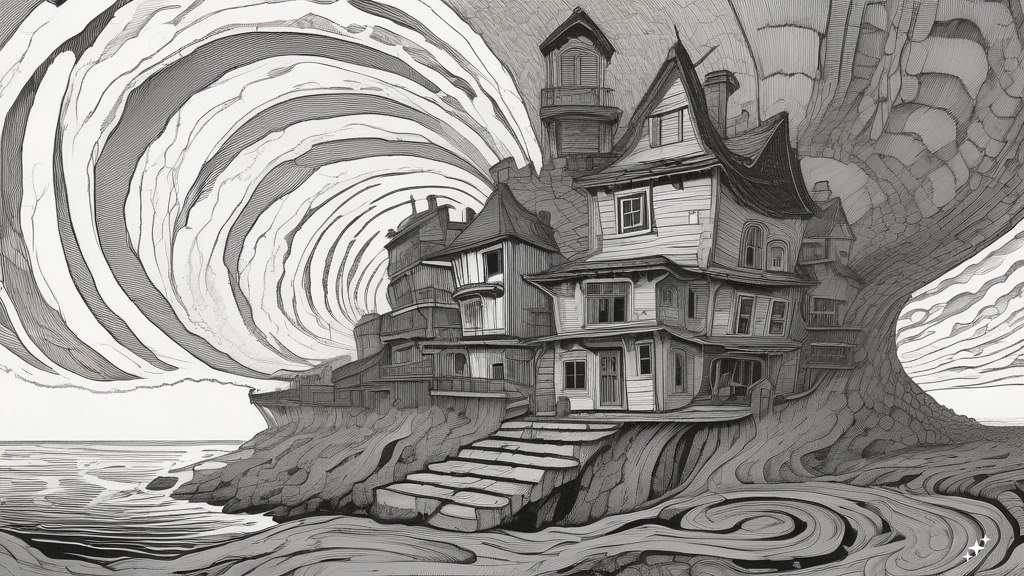
What Is Uzumaki — the Spiral into Horror Manga?
Uzumaki: Spiral into Horror is a horror manga (Japanese comic) by Junji Ito, published in English by VIZ Media, the largest English-language manga publisher in North America. The complete series runs 20 chapters plus 2 bonus chapters, originally collected across 3 volumes. It’s a finished, self-contained story — no cliffhangers, no “read 47 volumes to get the full picture.” One book, one story, done.
Here are the quick stats:
- Author/Artist: Junji Ito
- Publisher: VIZ Media (English)
- Length: 20 chapters + 2 bonus chapters (3 volumes)
- Status: Complete
- Rating: T+ (Older Teen) per VIZ; 16+ per Common Sense Media
- MyAnimeList score: 8.66 (out of 10, from the largest anime/manga community database online)
- Goodreads rating: 4.33
A quick note if this is your first manga: manga volumes are physical books, and each volume contains multiple chapters — similar to how a novel has chapters inside a single book. When you buy one of the collected editions described below, you get the entire story in a single physical book.
Also worth knowing: manga is read right-to-left, the opposite of Western books. When you open the book, you start from what would be the “back” of a Western book and read panels from right to left. Every English-language manga edition includes a guide page explaining this, so don’t worry — you’ll get the hang of it within a page or two.
It’s one of the most widely recommended horror manga in the English-speaking world, and for good reason. But let’s talk about what actually happens in it.
The Story (Spoiler-Free)
Uzumaki is set in Kurouzu-cho, a small coastal town in Japan where something is very, very wrong. The spiral — as a shape, a pattern, a force — has infected the town. It starts small. A man becomes obsessed with spiral patterns. A girl’s hair begins to curl on its own. Snail shells appear where they shouldn’t.
The story follows Kirie Goshima, a high school girl, and her boyfriend Shuichi Saito as they watch their town slowly come apart. Shuichi senses the danger early — he wants to leave — but the town has a way of keeping people in.
What makes Uzumaki so effective is how it escalates. Each chapter introduces a new way the spiral manifests, and each one is worse than the last. Early chapters feel like creepy standalone horror stories. By the end, you’re reading something that feels genuinely apocalyptic.
It’s weird. It’s grotesque. It’s beautiful in a way that makes you uncomfortable about finding it beautiful. That’s Junji Ito for you.
Volume-by-Volume Breakdown
If you’re picking up Uzumaki for the first time, here’s what to expect from each section of the story. No major spoilers — just enough so you know what you’re getting into.
Volume 1 — Chapters 1–7
This is where it all starts. Kirie introduces us to her ordinary life in Kurouzu-cho, and things go sideways almost immediately. Shuichi’s father develops a disturbing fixation on spiral shapes — collecting them, staring at them, becoming consumed by them.
From there, each chapter works as a semi-standalone horror story connected by the recurring spiral motif:
- The Scar — a girl’s forehead scar takes on a life of its own
- Twisted Souls — two lovers become literally intertwined
- Medusa — Kirie’s hair begins to spiral and draw attention she doesn’t want
- Jack-in-the-Box — one of Ito’s most unsettling visual concepts (you’ll know it when you see it)
Volume 1 establishes the pattern that makes Uzumaki work: personal obsession escalates into body horror, and every chapter raises the question of how much worse can this get?
The answer, consistently, is “much worse.”
Each chapter is self-contained enough that you can take breaks between them if the horror gets intense. This is actually one of the things that makes Uzumaki so beginner-friendly — you can read at your own pace without losing the thread of the story.
Volume 2 — Chapters 8–13
This is where Uzumaki shifts gears. The horror stops being about individuals and starts consuming the community.
- The Snail — students at Kirie’s school begin transforming in ways that are equal parts disgusting and sad
- The Black Lighthouse — the town’s lighthouse takes on a sinister role
- Mosquitoes — exactly as horrifying as it sounds, and then some
- The Umbilical Cord — pregnancy and birth get the Junji Ito treatment (deeply unsettling)
- The Storm — even the weather itself starts spiraling
- The House — claustrophobic horror as row houses begin curling inward, trapping residents inside
Volume 2 is the turning point. You go from “this town has a weird problem” to “this town is falling apart and nobody can stop it.” The body horror is still present, but now there’s a growing sense of societal breakdown that adds a layer of dread on top of the visceral scares.
If Volume 1 is a horror anthology, Volume 2 is where it becomes clear you’re reading something much bigger.
Volume 3 — Chapters 14–20
Full apocalypse.
Kurouzu-cho is completely cut off from the outside world. Civilization collapses. The chapters here — Chaos, The Labyrinth, The Rising — read like a disaster story filtered through a fever dream.
The final chapters, The Completion and Escape, take Kirie and Shuichi underground, where they discover the true nature of the spiral and what it’s been building toward this entire time.
The ending is cryptic and haunting. It doesn’t explain everything, and it’s not trying to. It’s the kind of ending that sits with you for days and rewards a second read. Some people find it frustrating; most find it perfect for what Uzumaki is.
The volume also includes bonus chapters (sometimes listed as “Galaxies” or “The Galaxy”), a related short story that adds flavor without being required reading.
Volume 3 is the payoff. Everything that felt like a collection of creepy stories snaps into focus as a single, escalating narrative. It’s Junji Ito at his most ambitious, and it lands.
Which Edition Should You Buy?
Good news: you don’t need to hunt down individual volumes. Uzumaki is available in collected editions that contain the entire story in one book. Here’s how they compare:
| Feature | 3-in-1 Deluxe Hardcover (all 3 original volumes in one book) | 2-in-1 Deluxe Softcover (volumes 1 and 2 collected in one book, plus volume 3 separately) |
|---|---|---|
| Year released | 2013 | 2023 |
| Pages | 648 | 672 |
| Format | Hardcover | Standard softcover (5.75″ × 8.25″) |
| Bonus content | Interviews, sketches, creator’s notes | Same story content |
| ISBN | 978-1-4215-6132-5 | 978-1-9747-1742-2 |
| Typical price | ~$20–$28 | ~$15–$20 |
| Best for | Display, reading experience, gift | Portability, budget |
Both editions use the same updated English translation.
The 3-in-1 hardcover is the one most people recommend, and it’s the version you’ll see photographed on every manga shelf tour. The oversized pages give Ito’s artwork the space it deserves — and his artwork really deserves space. The detail in his linework is extraordinary, and seeing it at a larger size makes a genuine difference. It also includes bonus material like interviews and sketches that the softcover doesn’t have.
Uzumaki (3-in-1 Deluxe Edition)
The 2-in-1 softcover (released in 2023) contains the complete story in a smaller, standard-sized format. It’s lighter and more affordable. If you’re on a budget or prefer something easier to hold while reading in bed, this is a solid pick. You’re not missing any story content.
The original 3 paperback singles (published 2001–2002) use an older translation and are largely out of print. They occasionally pop up in used bookstores, but there’s no real reason to seek them out when the collected editions are readily available and contain the improved translation.
Bottom line: If you’re buying Uzumaki as a gift or want the best possible reading experience, go with the 3-in-1 hardcover. If you want the most affordable way to read the complete story, the 2-in-1 softcover is the way to go. Either way, you’re getting the full manga — no need to buy multiple books.
Content Warnings
Uzumaki is horror manga, and it doesn’t pull punches. Here’s what to be aware of:
- Graphic body horror — Human bodies twist, stretch, coil, and mutate in extremely detailed artwork. This is Junji Ito’s specialty, and he goes all in. If you’re sensitive to images of repeating patterns in organic matter — spirals, holes, unnatural textures on skin or flesh — be aware that Uzumaki leans into this heavily. Some people find these patterns deeply unsettling (this response is sometimes called trypophobia), and this manga will trigger it.
- Blood and gore — Present throughout, escalating in later chapters.
- Brief nudity — Occasional and non-sexualized, but present.
- Suicide depiction — Occurs in the story and is depicted on-page.
- Psychological horror — Themes of obsession, madness, loss of autonomy, and inescapable fate.
VIZ rates Uzumaki T+ (Older Teen). Common Sense Media recommends it for ages 16 and up. That feels about right.
Good for: Readers who enjoy atmospheric horror, surreal imagery, and stories that build dread slowly rather than relying on jump scares. Also great for people who love detailed black-and-white artwork.
Maybe skip if: You’re very sensitive to body horror, or images of human bodies being distorted in unnatural ways would cause you real distress rather than fun-scary discomfort.
The Anime Adaptation — What It Covers and What It Misses
In September–October 2024, an Uzumaki anime miniseries finally aired on Adult Swim’s Toonami block (a late-night anime programming block on Cartoon Network in the US) after years of delays and anticipation. It ran for 4 episodes.
Here’s the honest breakdown:
Episode 1 was widely praised. It used a striking black-and-white animation style that felt faithful to Ito’s artwork, and fans were thrilled. It adapted Chapters 1–2 of the manga with care and precision.
Episodes 2–4 experienced a significant and noticeable quality drop. The animation shifted in style and consistency, and the response from fans ranged from disappointed to genuinely upset.
More importantly for manga readers: the anime adapted roughly 8 of the manga’s 20 chapters. That means over half the story was skipped entirely.
Here’s the episode-to-chapter mapping:
| Episode | Manga Chapters Adapted |
|---|---|
| Episode 1 | Chapters 1–2 |
| Episode 2 | Chapters 3, 5, 6 |
| Episode 3 | Chapters 10, 11, 12 |
| Episode 4 | Chapter 17 (with elements of Chapters 16, 19, 20) |
Major chapters the anime skipped that fans particularly love:
- Jack-in-the-Box (Chapter 7) — one of the most iconic and disturbing visuals in the entire series
- The Snail (Chapter 8) — a fan-favorite chapter that’s become synonymous with Uzumaki
- The Black Lighthouse (Chapter 9) — eerie and atmospheric
- The House (Chapter 13) — claustrophobic brilliance
- Butterfly (Chapter 14) — a gorgeous and terrifying chapter
The bottom line: Watching the anime is not a substitute for reading the manga. If you’ve only seen the anime, you’ve experienced less than half the story, and you’ve missed some of its best moments. The manga is the definitive version of Uzumaki by a wide margin.
If you watched Episode 1 and loved it, the manga will deliver that quality of experience consistently across all 20 chapters.
Why Uzumaki Is the Best Entry Point for Horror Manga
If you’ve never read horror manga before — or even never read manga at all — Uzumaki is one of the best places to start. Here’s why:
- It’s self-contained. One complete story in one book. No need to commit to a 30-volume series or figure out reading orders. You buy one book, you get the whole experience.
- The chapter-by-chapter structure is beginner-friendly. Each chapter tells its own small horror story with a beginning and an end, like episodes of a TV show, while still contributing to the larger narrative. If a particular chapter really gets under your skin, you can put the book down and come back later without losing your place in the story.
- It showcases everything Ito does well in one package. Ito is famous for his short horror stories, and he’s brilliant at them. But Uzumaki is where he proves he can sustain a single narrative across 20 chapters with escalating stakes and a real conclusion. For a first-time reader, it’s the ideal introduction to his range.
- It’s easy to find. Uzumaki is in print, widely stocked, and available at bookstores, libraries, and online retailers. You won’t need to track down rare volumes or navigate confusing edition histories.
- It’s a shared reference point. Uzumaki comes up in virtually every “what horror manga should I read first?” conversation. Reading it connects you with the broader horror manga community and shows you what the genre is capable of at its best.
What to Read After Uzumaki
Finished Uzumaki and hungry for more spiral-into-horror-style manga? Here are some directions to go, depending on what hooked you.
More Junji Ito
- Tomie — Ito’s longest-running series. It follows Tomie, a girl who can’t be killed and drives everyone around her to madness and violence. Like Uzumaki’s early chapters, each installment works as a standalone horror story, but the recurring character ties everything together. Some of Ito’s most memorable imagery lives here.
- Gyo — Body horror meets disaster horror. Fish with mechanical legs invade the coast. It’s wilder and more action-oriented than Uzumaki, and just as grotesque. Available as a complete 2-in-1 edition (both original volumes in a single book).
- Shiver — A collection of 10 short horror stories, including “The Long Hair in the Attic” and “Greased.” Great if you loved the creepy standalone feel of individual Uzumaki chapters and want more self-contained hits. The tone leans toward quiet dread and body horror.
- Fragments of Horror — Another short story collection, but with a more literary and experimental edge. The stories here are stranger and more abstract than Shiver. If Uzumaki’s weirder moments were your favorite parts, start here.
Note: this is a multi-book set put together by a third-party seller, not an official publisher box set.
Junji Ito Story Collection 3 books set: Lovesickness, Deserter, Fragments of Horror
- Remina — Cosmic horror in a single volume. A newly discovered planet is heading straight for Earth, and society collapses. If you liked Uzumaki’s apocalyptic third act, Remina goes there faster and harder.
Beyond Junji Ito
- The Drifting Classroom by Kazuo Umezz — A school full of children is transported to a barren wasteland. It’s older (1972–1974) and the art style is rougher and more expressionistic than Ito’s precise linework, but the escalating horror and survival themes have a lot in common with Uzumaki’s later chapters. One of the foundational works of horror manga.
- Parasyte by Hitoshi Iwaaki — Alien parasites take over human bodies. More action-oriented than Uzumaki, but the body horror and themes of identity will feel familiar. Also has an excellent anime adaptation if you want to continue in that format.
- Mermaid Saga by Rumiko Takahashi — Takahashi is best known for comedies and adventure series, but Mermaid Saga is pure horror. It’s about the dark consequences of eating mermaid flesh for immortality. Quieter and more melancholy than Uzumaki, but beautifully crafted.
—
Uzumaki is one of those rare manga that lives up to its reputation. It’s creepy, it’s creative, it’s visually stunning, and it tells a complete story that sticks with you long after you close the book. If you’ve been curious about horror manga and haven’t taken the plunge yet, the 3-in-1 hardcover is the way most readers start — and you’ll understand the hype by the end of Chapter 1.
Uzumaki (3-in-1 Deluxe Edition)