What Is the Doubt Horror Manga About? — Premise and the Rabbit Doubt Game
The short version: Doubt is a completed 4-volume horror-mystery manga by Yoshiki Tonogai about six friends who play a mobile phone game called Rabbit Doubt, then wake up trapped in an abandoned hospital where the game has become lethally real. One of them is the “wolf.” And the wolf is killing them off one by one.
The manga was originally published chapter by chapter in Monthly Shōnen Gangan, a manga magazine run by Square Enix (the same company behind Dragon Quest and Final Fantasy). That chapter-by-chapter run lasted from July 2007 to February 2009. The collected volumes have been translated and published in English by Yen Press, the company that brings many popular manga series to English-speaking readers.
Let’s break down the setup a bit more, because it’s genuinely clever.
The Rabbit Doubt Game
In the mobile game Rabbit Doubt, the rules are simple:
- All players are rabbits — except one
- One player is secretly the wolf
- Each round, the wolf “kills” a rabbit
- The surviving rabbits vote on who they think the wolf is
- If they guess right, the rabbits win — if not, the wolf picks them off until no one is left
Sound familiar? It’s essentially Werewolf (or Mafia, or Among Us) in mobile game form. The characters in Doubt are all fans of this game. They meet up through it. They become friends.
And then they wake up locked inside an abandoned hospital, with one of their group dead, and a message telling them the game is now real.
The Real-Life Stakes
Someone among the six survivors is actually killing people. The doors in the hospital are locked with a barcode system — each person has a barcode on their body that acts as a key, but only to certain doors. This means the group has to work together to move through the building, even though trusting anyone could get you killed.
It’s a locked-room mystery — a story where the characters are sealed inside a confined space with a killer, and they have to figure out who did it before it’s too late. That mystery structure is layered on top of a social-deduction horror setup. The paranoia isn’t just atmosphere — it’s baked into the mechanics of the story itself.
The tone is psychological horror first, graphic violence second. There’s definitely blood and body horror, but the real terror comes from watching characters turn on each other, form alliances, break them, and desperately try to figure out who’s lying before it’s too late.
Main Characters — Who’s Trapped in the Hospital
The cast is small and deliberate. With only six survivors in a sealed building, every single character is a suspect. Here’s who you’ll meet (keeping things spoiler-free):
Yū Aikawa
The protagonist and the reader’s way into the story. Yū is a high school student and Rabbit Doubt player who wakes up in the hospital with no memory of how he got there. He’s likable and determined, which makes him a solid anchor — but the manga does a good job of making you question even him at times.
Mitsuki Hōyama
Yū’s close friend and the emotional core of the group. Her relationship with Yū gives the story its human stakes. When things get desperate, how far will friendship stretch when survival is on the line?
Eiji Hoshi
An older member of the Rabbit Doubt group. There’s something slightly off about him from the start — is it just his personality, or something more? Tonogai uses him well to keep you second-guessing.
Rei Hazama
Quiet and hard to read. In a story built on paranoia, the character who gives the least away is often the most suspicious. Rei fills that role perfectly.
Haruka Akechi
Outwardly friendly and cooperative. But in Doubt, being helpful can look an awful lot like manipulation. The manga keeps you guessing about Haruka’s true motives.
Hajime Komaba
Rounds out the group. Each character adds a different flavor of suspicion to the dynamic, and Hajime’s presence helps fill out the web of distrust.
Why the Small Cast Works
Six characters. One killer. An abandoned hospital with locked doors. That’s all Tonogai needs. The small cast means there’s no dead weight — every interaction carries tension because every character is a viable suspect. You’ll find yourself mentally building a case against each one, flipping your theory every few chapters. It’s incredibly engaging.
Why Doubt Works as Horror — What Makes This Manga Scary
Doubt isn’t trying to be the goriest manga on the shelf. It’s not competing with series that pile on shock value. Instead, it zeroes in on something much more unsettling: the horror of not being able to trust anyone.
Paranoia as the Engine
The scariest thing in Doubt isn’t the wolf — it’s the idea of the wolf. Every conversation between characters is laced with doubt. Is that person telling the truth? Why do they want to go through that door? Why are they suddenly being so helpful?
This paranoia isn’t just thematic window dressing. It drives the plot. Characters make alliances, break them, accuse each other, defend each other — and the reader is right there with them, trying to puzzle it out.
The Among Us Connection (Before Among Us Existed)
Doubt started its magazine run in 2007 — over a decade before Among Us became a cultural phenomenon in 2020. If you’ve ever experienced the tension of an Among Us game where you genuinely don’t know who the impostor is, imagine that feeling sustained across 20 chapters with real consequences. Characters don’t get voted out and float away as ghosts. They die brutally.
The social-deduction game genre has exploded in recent years, and Doubt feels remarkably ahead of its time.
Tonogai’s Visual Approach
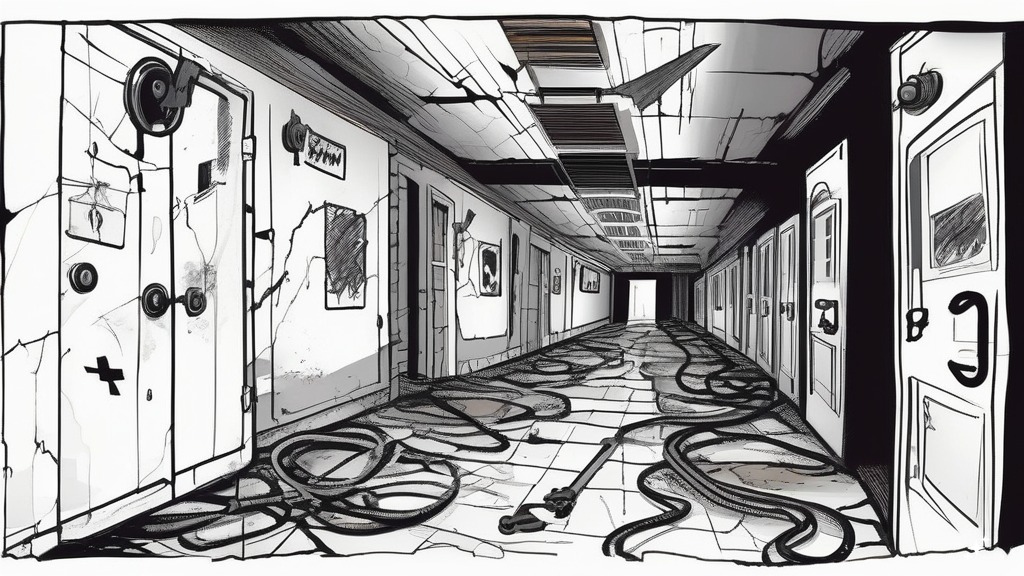
Yoshiki Tonogai’s art leans into claustrophobia. The hospital corridors are narrow and dark. Panel layouts — the individual frames that make up each page — feel cramped and oppressive. When violence happens, Tonogai doesn’t shy away — there are moments of genuine body horror that hit hard precisely because the manga earns them through slow-building tension.
The character designs are clean and distinct (important when you need to keep track of a small cast under pressure), and the abandoned hospital setting is rendered with enough detail to feel genuinely threatening.
Pacing: 20 Rounds, Zero Padding
Doubt’s 20 chapters are called “Rounds” — fitting for a game-based story. And the pacing is relentless. There are no detours into backstory that don’t serve the central mystery. Every Round either raises the stakes, shifts suspicion, or drops a revelation.
This is a story that respects your time. It sets up its premise, executes it with precision, and lands its ending. You can legitimately read the whole thing in a single sitting.
The Barcode Puzzle-Box
The barcode/key mechanic isn’t just a plot device — it adds a puzzle-box structure to the horror. Characters can only open certain doors, which means the group’s movement through the hospital becomes a logic problem layered on top of the mystery of who the killer is. It gives readers something concrete to track alongside the character dynamics.
How to Read Doubt — Volumes, Availability, and Reading Order
Good news: getting into Doubt is about as simple as it gets.
Volume Breakdown
| Volume | Chapters (Rounds) | Notes |
|---|---|---|
| Vol. 1 | Rounds 1–5 | Setup, the game begins |
| Vol. 2 | Rounds 6–10 | Suspicion escalates |
| Vol. 3 | Rounds 11–15 | Major revelations |
| Vol. 4 | Rounds 16–20 | Climax and resolution |
Total: 4 volumes in Japanese, 20 chapters, complete series. No waiting for new volumes. No cancelled-before-the-ending cliffhangers. The whole story is here.
Note: The English Yen Press edition releases as 2 omnibus volumes (Vol. 1 EN = JP Vols. 1–2; Vol. 2 EN = JP Vols. 3–4).
English Availability
Doubt is published in English by Yen Press. The English Yen Press release is 2 omnibus volumes, each collecting 2 of the original Japanese volumes. You can find them in both print and digital formats through major book retailers and online shops, including Amazon and digital manga platforms.
No Anime Adaptation
As of now, Doubt has no anime adaptation. This is a manga-only experience. Given the tight pacing and visual horror, it honestly works really well on the page — the way manga lets you control the pace of each page turn, lingering on a creepy image or flipping fast during a chase scene, is a big part of what makes it effective.
Tonogai’s Connected Works — Reading Order
Yoshiki Tonogai wrote two more manga after Doubt that share its DNA:
- Doubt (4 volumes) — Start here
- Judge (6 volumes) — A thematic follow-up with a new cast and setting
- Secret (3 volumes) — Another thematic follow-up, also standalone
These are thematic follow-ups, not direct sequels. Think of them like anthology entries from the same creator — they share themes (death games, paranoia, trust) and Tonogai’s style, but they feature different characters and different settings. You can read any of them independently without missing plot details from the others.
That said, starting with Doubt makes the most sense. It’s the shortest, the tightest, and it establishes the core ideas that Judge and Secret expand on.
Doubt vs. Judge vs. Secret — Tonogai’s Death-Game Trilogy
If you finish Doubt and want more, here’s how the three series compare. Remember: these are standalone stories that share a creator and themes, not a connected trilogy. You don’t need to read one to understand the others.
| Doubt | Judge | Secret | |
|---|---|---|---|
| Volumes | 4 | 6 | 3 |
| Chapters | 20 | 32 | 12 |
| Setting | Abandoned hospital | Courthouse-like building | School-related setting |
| Game Mechanic | Werewolf/Rabbit Doubt | Courtroom voting with animal masks | Guilt-based confessions |
| Theme | Trust and deception | Judgment and punishment — players vote on who “deserves” to die | Guilt and buried secrets |
| Horror Intensity | High | Higher — darker and more elaborate | Moderate |
| Tone | Paranoid thriller | Darker, characters who aren’t clearly good or evil | More psychological, less violent |
| English Publisher | Yen Press | Yen Press | Yen Press |
| Status | Complete | Complete | Complete |
Judge — The Bigger, Darker Follow-Up
Judge takes the death-game concept and cranks it up. Seven people wake up wearing animal masks in a building that resembles a courthouse. They’re forced into a voting game — each round, the group votes on who “deserves” to die. The moral stakes are heavier, the characters occupy more ambiguous ground between good and evil, and the twists are more elaborate.
At 6 volumes, it’s longer than Doubt but still very manageable. If you liked Doubt’s paranoia but want something with more layers, Judge delivers.
Secret — The Shortest and Most Psychological
Secret is only 3 volumes and focuses on a group of people who share a traumatic event. The horror comes less from a game mechanic and more from the guilt each character carries. It’s quieter than Doubt and Judge — less outright violence, more slow-burn psychological tension.
Where to Start
Start with Doubt. It’s the tightest entry point, the easiest to pick up, and it’ll tell you immediately whether Tonogai’s style of horror works for you. If it does, Judge and Secret are waiting.
Who Should Read the Doubt Horror Manga — And Who Should Skip It
Doubt Is a Great Fit If You:
- Love social-deduction games — Among Us, Werewolf, or Mafia. If the tension of “someone in this group is lying” excites you, Doubt is built on exactly that feeling.
- Want a short, completed horror manga — At 4 volumes, it’s a one-weekend read. No 30-volume commitment. No ongoing series to track. Just a clean, contained story.
- Are new to horror manga — This is honestly a fantastic entry point. It’s short enough to not feel overwhelming, the premise is instantly understandable, and the horror is effective without being gratuitous. If you’re testing the waters with horror manga, Doubt is a great place to start.
- Enjoy mysteries with a puzzle element — The puzzle-box structure of the hospital, the barcode keys, and the process of elimination make this satisfying for mystery fans too.
Content Warnings
Doubt earns its horror label. Be aware of:
- Graphic violence — Characters die, and it’s shown explicitly
- Body horror — Some deaths and imagery are viscerally unsettling
- Psychological manipulation — Characters lie, betray, and manipulate each other into doubting their own perceptions under extreme pressure
It’s not the most extreme horror manga out there, but it’s not pulling punches either.
You Might Want to Skip Doubt If:
- You want supernatural horror — Doubt is grounded, human-evil horror. There are no ghosts, demons, or curses. The monster here is a person.
- You prefer long-running series — If you like slow-burn world-building across dozens of volumes, Doubt’s tight 4-volume structure might feel too compressed.
- You want deep character development — The cast serves the mystery well, but this isn’t a character study. People are here to be suspects first and characters second. That’s a feature, not a bug — but it’s worth knowing going in.
Similar Manga Worth Checking Out
If the Doubt horror manga is your kind of thing, here are some other series that scratch a similar itch:
- Tomodachi Game — A friendship-testing death game with heavy psychological manipulation. This one is longer and still ongoing, so keep that in mind if you loved Doubt’s short, complete format. Same “who can you trust?” energy, though.
- Real Account — Social media meets death game. Players die if their follower count drops to zero. Wilder premise, similar tension. Complete at 24 volumes.
- Liar Game — More cerebral and less violent, focused on elaborate psychological games. If you like the strategy side of Doubt, this is worth knowing about. Complete at 19 volumes. Note: No official English-language manga edition exists; only fan translations are currently available.
- Deadman Wonderland — A prison-set death game where characters have supernatural powers. More action-oriented than Doubt, but shares the trapped-with-killers setup. Complete at 13 volumes.
Final Thoughts
Doubt is one of those manga that does exactly what it sets out to do. It puts you in a room with a killer, gives you a small group of suspects, and dares you to figure it out before the last page. The fact that it accomplishes this in just 4 volumes — with genuine twists, real tension, and a satisfying conclusion — makes it impressive.
Yoshiki Tonogai understood something fundamental about horror: the scariest thing isn’t what’s lurking in the dark. It’s the person standing right next to you, smiling, while you wonder if they’re the one holding the knife.
Grab Volume 1, settle in for a tense read, and try not to trust anyone.
DOUBT, Vol. 1
DOUBT, Vol. 2