Full Plot Summary
Spoiler warning: This section covers the entire story, including the ending. If you haven’t read it yet, the story is short enough to finish in one sitting, and it hits harder going in blind. Consider reading it first, then coming back. You’ll find where to get it in the “Where to Read” section below.
The Setup
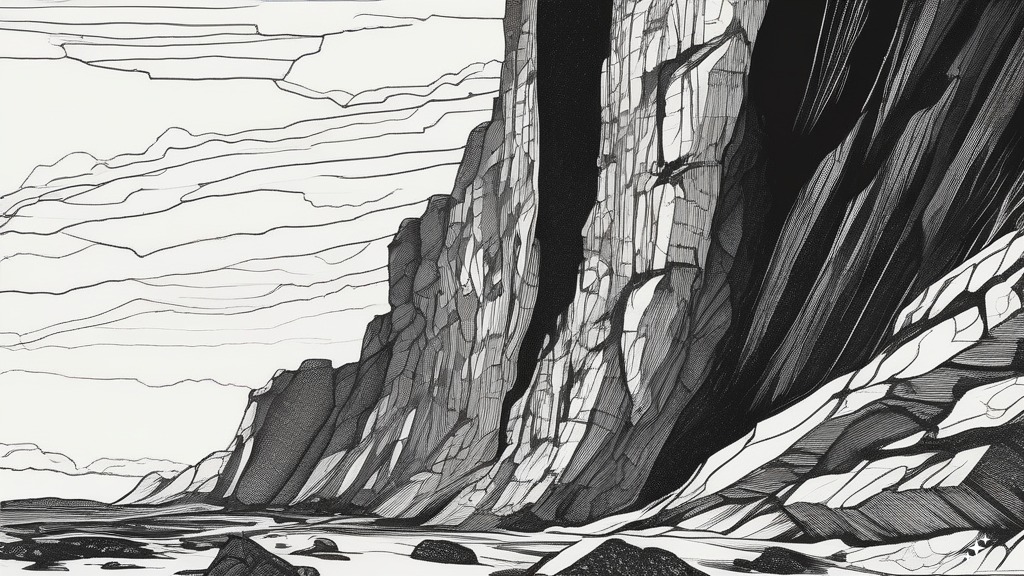
An earthquake strikes Japan, and the resulting geological shift reveals something on the exposed face of the Amigara Fault — a mountainside now covered in thousands of human-shaped holes. Not rough, vaguely person-like impressions. Precise silhouettes. Each one is a different shape, a different size, as if cut to match a specific individual.
News crews arrive. Scientists investigate. Nobody can explain the holes. They’re ancient — far older than recorded history. There’s no logical reason for them to exist.
Two strangers, Owaki and Yoshida, meet at the mountain. Both were drawn there after seeing the news coverage. Neither can fully explain why they came. They just… had to.
The Compulsion
As more people arrive at the site, something deeply unsettling starts happening. Individuals begin finding holes that match their exact silhouette. Not approximately — perfectly. And once they find their hole, they feel an overwhelming, irresistible urge to enter it.
One by one, people walk up to the mountainside and slide into their holes. They fit so precisely that once inside, they can only move forward. There is no turning around. There is no backing out.
Nakagaki, a man who previously murdered someone, is among those who enter. His case hints at guilt as a possible trigger — the holes seem to pull hardest at people who already carry something heavy inside them. But guilt alone doesn’t explain it, because people with no apparent burden feel the same pull.
Yoshida’s Struggle
Yoshida confides in Owaki that she’s been having a recurring nightmare — she’s trapped in a tight, dark, confined space, unable to move. She’s terrified that the dream is connected to the holes, that she’ll find hers and won’t be able to resist.
She’s right to be afraid. She does find her hole.
Owaki, desperate to protect her, fills her hole with rocks to block the entrance. For a moment, it seems like it might work.
It doesn’t. Yoshida returns in a trance-like state, removes the rocks, and enters. Owaki can only watch.
The Ending
The final pages shift to the other side of the mountain.
Scientists have found exit points — the openings where the tunnels emerge. But the tunnels on this side are nothing like the clean, human-shaped silhouettes on the entrance side. These exit holes are stretched, warped, impossibly distorted.
And then the shapes begin to emerge.
What comes out is barely recognizable as human. The bodies have been compressed, elongated, and twisted into grotesque, spaghetti-like forms. Limbs stretched to absurd lengths. Torsos flattened and curved. Faces pulled into silent, frozen expressions.
They move at an impossibly slow pace, scraping against stone. The sound they make:
DRR… DRR… DRR…
The story ends there. No explanation. No rescue. No reversal. Just the image of what the holes do to you — and the knowledge that everyone who entered is becoming this.
The Ending Explained
So what actually happens inside the tunnels?
The holes are not uniform passageways. They start as a perfect match for a person’s silhouette, but as they go deeper into the mountain, the tunnels twist and deform. The walls gradually change shape, bending and compressing the body as it’s pushed — or pulled — forward.
Because the fit is so tight, there’s no room to turn around. You can only go forward. And as you go forward, the tunnel reshapes you.
By the time a person emerges on the other side, they’ve been physically warped beyond recognition. The process is slow — agonizingly slow. The distorted figures at the exit are still alive (or at least still moving), which makes it worse.
Here’s what Ito deliberately withholds:
- Who or what made the holes — never explained
- Why the holes match specific people — never explained
- What the purpose is — never explained
- Whether the process can be stopped or reversed — it can’t, as far as we see
The horror isn’t in the answer. The horror is that there is no answer. The holes exist. They call to you. You go in. You come out wrong. That’s it.
What Does It Mean? Themes and Symbolism
For a 30-page story, Amigara Fault carries a staggering amount of thematic weight. Here’s what makes it resonate so deeply.
The Compulsion You Cannot Resist
The most immediate reading is about self-destructive impulses.
Every person who finds their hole knows, on some level, that entering is dangerous. The scientists warn people. Owaki tries to physically block Yoshida’s entrance. The characters themselves express fear and hesitation.
And they go in anyway.
This maps directly onto experiences many people recognize:
- Addiction — knowing something is destroying you but being unable to stop
- Intrusive thoughts — the unwanted mental image of doing something harmful, accompanied by a strange pull toward it
- The call of the void — that unsettling urge you feel standing at the edge of a cliff, not because you want to jump, but because some part of your brain whispers what if. (There’s a French phrase for this — “l’appel du vide” — that you might see referenced in discussions of this story.)
The phrase “This is my hole — it was made for me!” captures something deeply uncomfortable: the seductive certainty of a path that feels destined. It’s not that these people are forced. It’s that they feel, with their whole being, that the hole belongs to them. That it was always waiting. That they were always going to enter.
That’s scarier than a monster chasing you. A monster, you can run from. How do you run from something that feels like it was always part of you?
Conformity and Identity
Each hole is uniquely shaped for one person. No two are alike. On the surface, that sounds almost affirming — you’re special, you’re unique, there’s a space in the world that’s yours alone.
But in Ito’s hands, that uniqueness becomes a trap.
Your individual shape — the thing that makes you you — is exactly what pulls you into a passage that will destroy you. Your identity is your vulnerability. The more perfectly something fits you, the more power it has over you.
There’s a sharp societal reading here too. Think about the pressure to find your “place” in the world — your career, your role, your identity. Society has a hole shaped like you. It tells you this is where you belong. You slide in because it fits so perfectly. And slowly, over time, it reshapes you into something you didn’t choose.
The people who emerge from the other side of the mountain aren’t themselves anymore. They’ve been deformed by the very thing that was supposedly made for them.
Fear of Bodily Transformation
Body horror — horror that focuses on disturbing changes to the human body, whether through mutation, deformation, or violation — is a throughline across Ito’s entire body of work. In Uzumaki (a three-volume series about a town consumed by an obsession with spiral patterns), people spiral into snail-shell shapes. In Tomie (Ito’s longest-running series, about a girl who cannot die and drives everyone around her to obsession and violence), flesh regenerates and multiplies in grotesque ways. Ito is fascinated by the body as something that can be warped beyond recognition — slowly, inevitably, irreversibly.
What makes the body horror in Amigara Fault especially effective is the pacing. There’s no sudden explosion of gore. The transformation happens over what must be hours, days, maybe longer — a gradual compression and stretching as the tunnel reshapes human flesh.
The slow crawl is worse than any sudden shock. You have time to understand what’s happening. And you can’t stop it.
The Unknowable
This is the cosmic horror element — a type of horror built around the idea that some things in the universe are so vast, ancient, or alien that humans can never understand them. Writers like H.P. Lovecraft popularized this approach (stories about ancient gods and incomprehensible forces), though Ito’s version is distinctly his own, rooted in quiet, personal dread rather than tentacled monsters.
The holes are never explained. Not who made them, not why, not how. They’re ancient beyond reckoning, and they simply exist. Scientists study them and come up empty.
Ito has spoken about leaving his horror unexplained, and it’s one of his most effective tools. The moment you give a monster a backstory, you give the reader a framework to process it. You make it comprehensible. Manageable.
The holes in Amigara Fault are none of those things. They’re not a punishment. They’re not a test. They’re not a message. They just are.
And here’s the meta-level twist: demanding an answer to “why do the holes exist?” is itself a form of the compulsion the story depicts. You’re drawn to the mystery. You want to find the explanation that fits you perfectly. You keep going deeper.
Sound familiar?
Why “DRR DRR DRR” Became a Meme
The final page of Amigara Fault features one of the most iconic panels in manga history: the distorted, elongated human shapes emerging from the mountain, accompanied by the sound effect “DRR… DRR… DRR…” — representing warped bodies scraping against stone.
This image, along with the quote “This is my hole! It was made for me!”, became massive on the English-speaking internet starting in the early-to-mid 2000s. The story spread through forums and platforms like 4chan (an anonymous imageboard popular in internet subcultures), Reddit, and Tumblr, shared among horror fans who couldn’t stop talking about it.
A few reasons it caught fire:
- The story is short. You can read the whole thing in 10-15 minutes. That makes it incredibly easy to share — “just read this, trust me” — and people do.
- The final image is unforgettable. Once you see those distorted shapes, you can’t unsee them. It’s the kind of image that burns into your brain and demands to be shown to someone else.
- “This is my hole” is endlessly remixable. The quote works as a punchline, a reaction image, a philosophical statement, and a genuine expression of dread. It’s been applied to everything from job hunting to relationship memes to existential crisis posts.
- DRR DRR DRR is weirdly fun to type. There’s something about that specific sound effect — those three syllables, repeated — that sticks in your head like a song you can’t shake.
For a huge number of Western readers, Amigara Fault is the gateway to Junji Ito’s work. They see the meme, read the story, get horrified, and then want more. It’s arguably done more to popularize horror manga in English-speaking countries than any marketing campaign could.
Where to Read The Enigma of Amigara Fault
Here’s an important detail that trips people up: The Enigma of Amigara Fault is not sold as a standalone book. However, it’s available in TWO VIZ Media English editions: the Gyo (2-in-1 Deluxe Edition) and Venus in the Blind Spot.
Gyo (2-in-1 Deluxe Edition)
Venus in the Blind Spot (Junji Ito)
It’s included as a bonus story in the Gyo (2-in-1 Deluxe Edition), published by VIZ Media (one of the largest publishers of manga in English). Gyo is the main feature of that book — a horror manga about fish with mechanical legs invading coastal Japan — and Amigara Fault is appended at the end.
Funny enough, many readers buy the Gyo Deluxe Edition specifically for Amigara Fault, and Gyo ends up being the bonus story in their experience. Gyo is a great read in its own right, though — very different tone, much more chaotic.
A few things to keep in mind:
- Format and price: The Gyo 2-in-1 Deluxe Edition is a hardcover collecting both volumes of Gyo plus The Enigma of Amigara Fault as a bonus. It typically retails for around $20-25 USD. It’s also available digitally if you prefer reading on a tablet or phone.
- Reading direction: Like all manga from Japanese publishers, this reads right-to-left. Start at what would normally be the “back” of the book, and read each page from the right side to the left. Panels flow right to left, top to bottom. It becomes natural after a few pages.
- No anime adaptation exists. There is no animated version of The Enigma of Amigara Fault. The manga is the only official way to experience the story.
- Length: Amigara Fault itself is roughly 30 pages. You’ll finish it in one sitting. But the Gyo volume gives you a full-length horror manga plus this bonus, so you’re getting a lot of content for the price.
How Amigara Fault Fits into Junji Ito’s Wider Work
The Enigma of Amigara Fault started as a bonus tucked into the back of Gyo. But it outgrew the main story in cultural impact. For many readers, it’s the single most famous thing Junji Ito has ever created, which is saying something for an author with a catalog as deep as his.
It shares DNA with several of Ito’s major works:
- Uzumaki — Both stories deal with an obsessive pattern (spirals in Uzumaki, human-shaped holes here) that exerts an irresistible pull on people. Both feature body horror driven by slow, inevitable transformation. Both leave the cosmic “why” unanswered. If Amigara Fault is the short-story version of that idea, Uzumaki is the full epic — a three-volume descent into a town where spiral shapes consume everything and everyone. If you want to go deeper into Ito’s world, the Uzumaki (3-in-1 Deluxe Edition) is the place to start. It collects the entire story in one hardcover volume.
Uzumaki (3-in-1 Deluxe Edition)
- Gyo — Since Amigara Fault literally comes packaged with Gyo, you’ll read this one by default. Gyo is wilder, grosser, and more action-driven. It doesn’t have the quiet, existential dread of Amigara Fault, but it shares Ito’s obsession with the body as something that can be hijacked and transformed.
- Tomie — The theme of compulsion — being drawn to something destructive despite knowing better — connects directly to Amigara Fault. Tomie is a longer series you can follow across multiple volumes if that hook interests you.
If Amigara Fault hooked you and you want more of Ito’s short horror, his story collections are a great next step. A story collection is a single book that contains multiple standalone short stories — you don’t need to read them in any particular order, and each tale is self-contained. Collections like Deserter, Lovesickness, and Fragments of Horror are packed with stories that hit just as hard in their own way. You can grab the Junji Ito Story Collection 3-book set (which bundles Lovesickness, Deserter, and Fragments of Horror together) for a deep dive into his short-form work.
Note: this is a multi-book set put together by a third-party seller, not an official publisher box set.
Junji Ito Story Collection 3 books set: Lovesickness, Deserter, Fragments of Horror
Stitches and Alleyare two more recent Ito story collections worth checking out. Stitches gathers tales that lean into psychological unease, while Alley collects stories with Ito’s signature blend of the grotesque and the eerily mundane.
Stitches (Junji Ito)
Alley: Junji Ito Story Collection
Where Amigara Fault Sits as a Starting Point
For newcomers to Junji Ito, Amigara Fault is close to a perfect first read:
- It’s short — no need to buy multiple volumes
- It’s standalone — no ongoing storyline to track
- It demonstrates everything Ito does well: creeping dread, unforgettable imagery, body horror, cosmic mystery, and an ending that doesn’t let you off the hook
- It comes bundled with Gyo, so you get a full-length work as a bonus
The only downside is that because it’s so short, it might leave you wanting more. That’s not really a downside, though. That’s the hook working exactly as intended.
Final Thoughts
The Enigma of Amigara Fault works because it’s built on a fear that’s impossible to fully rationalize away: the fear that something out there was made specifically for you, and that finding it will be your undoing.
It’s not about jump scares. It’s not about a villain you can defeat. It’s about a hole in a mountain that has your exact shape, and the quiet, horrible certainty that you will walk into it.
Junji Ito wrote it as a bonus story. The internet turned it into one of the most iconic pieces of horror manga ever made. And decades later, people are still staring at that final panel — those twisted shapes, that impossible sound — and feeling something crawl up their spine.
If you’re ready to experience it yourself, pick up the Gyo 2-in-1 Deluxe Edition — Amigara Fault is waiting at the back of the book. And if it hooks you the way it hooks most people, the Uzumaki (3-in-1 Deluxe Edition) is your next stop.
Uzumaki (3-in-1 Deluxe Edition)
DRR… DRR… DRR…