BLAME! at a Glance — What You Need to Know Before Reading
Before we dig in, here’s the quick-reference version. (If you’re new to manga — manga are Japanese comics, typically released as a series of collected books called “volumes,” each containing several installments known as “chapters.”)
| Detail | Info |
|---|---|
| Author/Artist | Tsutomu Nihei |
| Volumes | 10 (Japanese) / 6 (English Master Edition) |
| Chapters | 67 |
| Serialization | 1997–2003 (Monthly Afternoon — a Japanese manga magazine published by Kodansha, one of Japan’s largest publishers) |
| Status | Completed |
| English Publisher | Vertical/Kodansha USA (the North American publishing branch of Kodansha) |
| Genre | Sci-fi, horror, cyberpunk |
| MyAnimeList Score | 8.67 out of 10 (MyAnimeList is a popular community database where readers rate manga and anime — Japanese animation — on a 10-point scale) |
| Content Note | Contains graphic violence, body horror, and disturbing imagery. No sexual content. |
That one-sentence verdict bears repeating: BLAME! is not for everyone, and that’s completely fine. Knowing what you’re walking into makes it a much better experience.
Story — What Is BLAME! Actually About?
Here’s the setup, kept spoiler-free.
In the impossibly distant future, a colossal structure called The City has grown beyond all control. It expands endlessly in every direction — floors stacked upon floors upon floors, stretching so far that entire civilizations live and die without ever seeing the sky. Humanity is nearly extinct, scattered in tiny pockets throughout this infinite megastructure.
A lone figure named Killy walks through The City. His mission: find a human who carries the Net Terminal Gene, a biological trait that would allow humanity to reconnect with the Netsphere — the governing network that once kept The City in check. Think of it like an internet that controlled all of The City’s systems. Without that connection, The City just keeps building, and the automated defense system called the Safeguard treats all humans as unauthorized intruders. Which means it tries to kill them on sight.
Along the way, Killy encounters Cibo, a scientist who becomes his closest companion and gives the story much of its emotional weight. Together, they navigate threats from the Safeguard (which ranges from humanoid exterminators to building-sized nightmares) and the Silicon Life, a faction of post-human beings with their own agenda for The City.
Killy’s weapon is the Gravitational Beam Emitter — a handgun-sized device that can punch holes through kilometers of structure in a single shot. It’s as terrifying as anything he fights.
The important thing to know upfront: BLAME! tells this story primarily through visuals, not words. Some chapters contain fewer than ten lines of dialogue. Pages upon pages of Killy walking through corridors, encountering strange structures, moving on. You won’t get narration boxes spelling out what’s happening. You piece the story together the same way Killy pieces together his journey — one step at a time, often in the dark.
This is intentional. It’s the entire point. And once it clicks, it’s incredible.
Nihei’s Art — Why BLAME! Looks Like Nothing Else in Manga
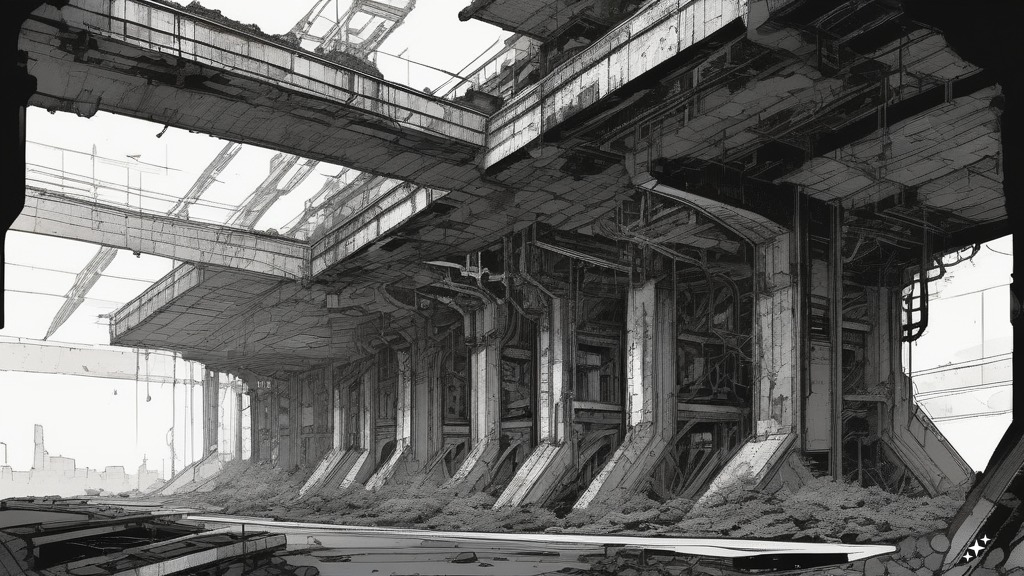
Tsutomu Nihei studied architecture before becoming a manga artist, and that background is visible on every single page of BLAME!. This isn’t a manga that happens to have nice backgrounds. The architecture is the manga.
Scale That Breaks Your Brain
BLAME!’s most jaw-dropping quality is its sense of scale. Nihei draws two-page spreads (where an image stretches across both facing pages) showing corridors that stretch to vanishing points, ceilings so distant they disappear into darkness, and structures so massive that Killy — the protagonist — is barely a speck on the page. There are panels (the individual framed images on a page) where you have to hunt for the human figure among the geometry.
This isn’t showing off. It’s storytelling. The City is so vast that it has its own weather systems, its own gravity anomalies, its own ecosystems. By making the architecture overwhelm the characters visually, Nihei communicates something that dialogue never could: you are unimaginably small, and this place does not care about you.
That feeling — of being tiny and irrelevant inside something incomprehensibly huge — is where BLAME!’s horror lives.
Line Work That Evolves
If you read BLAME! from volume 1 to the end, you’ll notice a clear shift in Nihei’s art style. The early chapters are rougher, sketchier, with heavy black inks and a raw, almost chaotic energy. As the series progresses, the line work becomes cleaner, more precise, and more architecturally detailed. Both styles serve the story — the early roughness matches the disorientation of Killy’s initial wandering, while the later clarity reflects the expanding scope of the world.
Horror Through Environment
BLAME! doesn’t do jump scares or shock gore (though there’s plenty of violence). Its horror comes from the environment itself. The City is wrong. It shouldn’t exist at this scale. The corridors are empty. The silence is deafening. When a threat does appear, it feels like the structure itself is rejecting you.
If you’re a fan of HR Giger — the Swiss artist famous for designing the creature in the original Alien film, known for his dark, mechanical-organic imagery — then BLAME! is going to feel like coming home to a very unsettling home. Nihei’s work shares that same fusion of living things and cold machinery.
A Note on Influences
Nihei’s visual style sits in an interesting space between European sci-fi comics and the manga tradition. His compositions owe as much to architectural illustration and concept art as they do to standard comics storytelling. This makes BLAME! feel genuinely unique. You won’t read another manga that looks or feels quite like this.
Is BLAME! Hard to Read? Addressing the Biggest Concern
Let’s be real about this, because it’s the number one thing that comes up in every discussion about BLAME!: yes, it can be hard to read, especially at first.
Here’s why:
- Minimal dialogue. Some chapters have almost no words at all. Pages upon pages of Killy walking through corridors, encountering strange structures, moving on. If you’re used to manga where characters explain the plot through conversation, this will feel alien.
- Time jumps without warning. Time skips happen without announcement. Location changes happen without transition panels. You’ll sometimes turn a page and find yourself in what seems like a completely different part of The City with no explanation of how Killy got there — because Killy has been walking for decades between panels.
- Intentional ambiguity. Plot points are implied rather than stated. Character motivations are shown through action, not explained through thought bubbles. The lore of the Netsphere, the Safeguard, and the Silicon Life is parceled out in fragments.
Reading Tips That Actually Help
Here are some practical suggestions for getting the most out of BLAME!:
- Slow down and sit with each page. BLAME! rewards patience. Each page — sometimes each panel — is meant to be studied. Look at the architecture. Notice the scale. Let the atmosphere sink in. This isn’t a series you can flip through quickly, but that’s part of what makes it special.
- Treat it like an art book that tells a story. If you approach BLAME! expecting a traditional narrative, you’ll get frustrated. If you approach it as a visual experience that contains a narrative, the experience transforms.
- Don’t panic if you’re confused. You’re supposed to be confused. Killy doesn’t know where he is or what he’ll find next. Neither do you. That’s the point.
- Re-read sections. BLAME! rewards re-reading more than almost any manga out there. Things that seemed like meaningless background details on your first read suddenly click into place on your second.
- It’s totally fine to look up a plot summary after your first read. There’s no shame in it. Plenty of people read BLAME! for the visual experience first, then go back with a better understanding of the plot to catch details they missed.
Honest Assessment
BLAME! is not for everyone, and that’s completely fine. If you try volume 1 and it’s not working for you, you haven’t failed some kind of test. It just means this particular style of storytelling isn’t your thing — and there are plenty of other great horror manga out there to explore. No wrong way to feel about it.
That said — if it does click? You’ll love it. There’s nothing else like it.
Which Edition Should You Buy? Master Edition vs. Tokyopop
This is a straightforward decision, but it’s worth explaining why.
Master Edition (Vertical/Kodansha USA) — The One to Get
The Master Edition collects BLAME! into 6 oversized softcover volumes. The format is roughly 7.3 × 10.3 inches — significantly larger than a standard manga volume (which is typically around 5 × 7.5 inches), closer to the size of a large magazine.
Why this matters for BLAME! specifically:
- Nihei’s art demands space. Those massive architectural spreads were drawn to be big. Seeing them at the Master Edition’s oversized format is a completely different experience from reading them on a standard-size page. Details that were muddy or invisible at smaller sizes become clear and stunning.
- Revised artwork. Nihei went back and touched up some of the art for the Master Edition. The revisions are subtle but noticeable, particularly in the early chapters where the original art was roughest.
- Bonus content. Each volume includes supplementary material such as author notes and additional artwork.
- Print quality. The paper stock, binding, and overall production quality are excellent. These are handsome books that look great on a shelf.
- Price range. Each Master Edition volume typically runs around $20–$25 USD, so the full six-volume set will cost roughly $120–$150 depending on where you buy. Not cheap, but reasonable for oversized softcovers of this quality.
For new readers, this is a great starting point — grab volume 1 and see if the art and atmosphere pull you in:
BLAME! 1 (Master Edition) — ASIN: 1942993773
BLAME! 1 (Master Edition)
And if you want the whole set in one shot:
BLAME! Manga Complete Master Edition Vol. 1-6 — ASIN: B0FMJC9RLH
Note: this is a multi-book set put together by a third-party seller, not an official publisher box set.
BLAME! Manga Complete Master Edition Vol. 1-6
Tokyopop Edition — Skip It
The original English release from Tokyopop came in 10 standard-size volumes. These are out of print — meaning the publisher no longer produces them, so you can’t buy them new from a bookstore. Copies that do turn up are sold through used book resellers (eBay, used listings on Amazon, etc.) and are increasingly expensive. More importantly, the smaller page size genuinely hurts the reading experience — BLAME!’s art was designed for impact at scale, and shrinking it down flattens the atmosphere.
Unless you’re a collector specifically hunting for the Tokyopop run, there’s no reason to seek these out. The Master Edition is better in every way.
Digital Availability
BLAME! is available digitally through various platforms. Digital works fine and is a perfectly valid way to read it, especially on a tablet where you can zoom in on details. That said, the physical Master Edition is the best way to experience the art if you have the option. There’s something about holding those oversized pages that a screen doesn’t quite replicate.
BLAME! and the 2017 Netflix Movie — How They Connect
In 2017, a CGI animated film adaptation of BLAME! was released on Netflix. It was produced by Polygon Pictures, the studio known for several anime (Japanese animation) adaptations.
What the Movie Covers
The film doesn’t attempt to adapt the entire manga. Instead, it takes a relatively self-contained storyline — roughly corresponding to material from around an original story set in the BLAME! universe of the original Japanese release — and builds a standalone story around it. A small community of humans surviving inside The City encounters Killy and Cibo, and the story follows their fight for survival against the Safeguard.
Is It Good?
As a standalone sci-fi action film, it’s decent. The CGI animation captures some of The City’s scale, and the action sequences are solid. It gives you a taste of the world.
But it barely scratches the surface of the manga’s scope. The movie tells one small story in one small corner of an infinite structure. The manga is the entire journey across that structure. The loneliness, the oppressive silence, the slow accumulation of lore — none of that can fit into a 106-minute film.
Verdict on the Movie
If you’re curious about BLAME! but not sure you want to commit to the manga, the Netflix movie is a fine entry point. It’ll give you a sense of the setting and the visual tone. Just know that the manga is an entirely different (and much larger) experience.
And if you’ve already read the manga, the movie is a fun supplement — nice to see The City animated, even if it can’t match what Nihei achieves on the page.
Where BLAME! Fits in Tsutomu Nihei’s Other Works
If BLAME! clicks with you and you want more from the same creator, Nihei has several other manga worth knowing about. Here’s how they connect and where to go next.
NOiSE — The Prequel
NOiSE is a single-volume manga (one collected book) set in the same universe as BLAME!, but at an earlier point in time — before The City had expanded to its incomprehensible scale. It provides some backstory on how things got so bad.
Read it after BLAME!, not before. NOiSE works best as supplementary context once you already know what The City becomes. Reading it first would spoil the disorienting discovery that makes BLAME! so effective.
Nihei’s Other Major Works
- Biomega — Shares BLAME!’s visual style and some thematic elements but tells a more conventional (relatively speaking) action story involving a zombie-like infection and motorcycle chases through a dark, technology-saturated landscape.
- Knights of Sidonia — Nihei’s most accessible and narrative-driven work. A sci-fi story about the last remnants of humanity living on a massive ship and fighting alien creatures. This one has clear character arcs (storylines with a beginning, middle, and end), dialogue, and a more traditional plot structure. If you find BLAME! too opaque but love Nihei’s visual imagination, Knights of Sidonia is a great alternative. (This is also the series whose anime adaptation was produced by the same studio that made the BLAME! movie.)
- APOSIMZ — Nihei’s most recent completed manga, set on a frozen artificial planet. It falls somewhere between BLAME!’s atmospheric minimalism and Knights of Sidonia’s structured storytelling.
Suggested Reading Order If You Want More Nihei
- BLAME! — Start here if you haven’t already.
- NOiSE — Read it as a companion piece to BLAME!.
- Biomega — See Nihei push into more action-driven territory while keeping his visual identity.
- Knights of Sidonia — Experience Nihei at his most story-focused and accessible.
You don’t have to follow this order. Each work stands on its own. But this progression gives you a nice sense of how Nihei’s storytelling evolved over time.
BLAME! Manga Review: Final Verdict — Should You Read It?
Let’s make this as clear as possible.
You’ll Probably Love BLAME! If You Enjoy:
- Atmospheric horror — dread that comes from environment and silence, not gore or shock
- Architectural and environmental art — if you’ve ever stared at a concept art book for longer than you’d admit, this is your manga
- Worldbuilding through visuals — discovering a world by seeing it rather than having it explained to you
- Dark, mechanical-organic aesthetics — if the original Alien film’s design sense appeals to you, BLAME! lives in that neighborhood
- Piecing together a story — if you enjoy putting fragments together and debating interpretations, BLAME! will give you plenty to work with
- Manga that doesn’t hold your hand — you walk through The City alongside Killy, and nobody’s going to tell you where you are
You Might Want to Skip BLAME! If You Prefer:
- Dialogue-heavy storytelling — there are chapters with almost no words
- Clear, linear plots — BLAME! deliberately withholds narrative clarity
- Character-driven drama — Killy is intentionally enigmatic, and character development is minimal by design
- Fast reading — if you tend to flip through pages quickly, BLAME!’s art won’t have a chance to work on you
And if that’s you, there’s nothing wrong with that. Horror manga is a huge genre with something for every taste.
The Numbers
With a MyAnimeList score of 8.67 out of 10, BLAME! is widely regarded as one of the greatest sci-fi manga ever created. That score reflects a passionate readership that considers it a landmark work. But scores only tell you what other people think — what matters is whether it connects with you.
The Recommendation
Honestly? Just grab volume 1 of the Master Edition and give it a shot. You’ll know within the first 50 pages whether BLAME!’s wavelength matches yours. If the vast, silent corridors and Killy’s solitary journey pull you in, you’re in for one of the most unique reading experiences manga has to offer.
BLAME! 1 (Master Edition) — ASIN: 1942993773
BLAME! 1 (Master Edition)
And if you already know this is your kind of thing and want to commit to the full journey:
BLAME! Manga Complete Master Edition Vol. 1-6 — ASIN: B0FMJC9RLH
BLAME! Manga Complete Master Edition Vol. 1-6
There’s nothing else in manga that looks like BLAME!, feels like BLAME!, or does what BLAME! does. It carved out its own space in 1997, and nothing has filled it since. That alone makes it worth trying.