Every Fire Force Manga Volume — Complete Series at 34 Books
Good news if you’re looking at the Fire Force manga volumes and wondering how big the commitment is: it’s done. The series is complete at 34 volumes, all available in English from Kodansha Comics, a major manga publisher. No waiting for the next release, no cliffhanger purgatory — you can read the whole thing start to finish right now.
Written and illustrated by Atsushi Ohkubo, the creator behind Soul Eater (a gothic action-horror manga with a strong cult following), Fire Force ran in Weekly Shonen Magazine — a Japanese publication aimed at younger male readers — and wrapped up with 304 chapters across those 34 volumes. If you’re new to manga, think of chapters as individual episodes and volumes as the collected books that bundle them together, typically around 8–10 chapters per volume. The Japanese edition published from February 2016 through May 2022, and the English release followed closely behind.
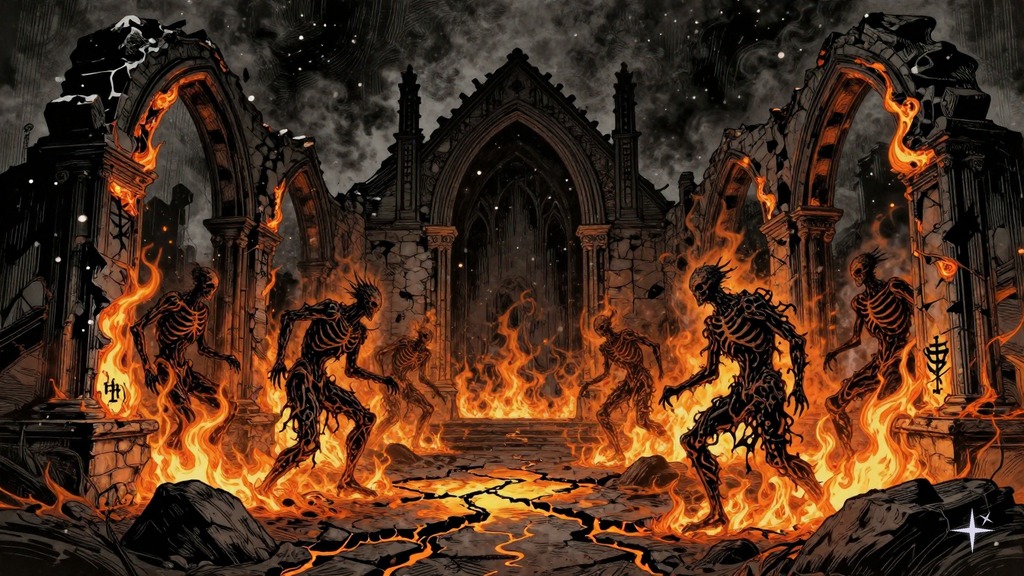
So why is this on a horror manga site? Because Fire Force earns its place here. The premise — people spontaneously combust and transform into flaming creatures called Infernals — is horror at its core. The early volumes frame this as an action-firefighter story, but as the series progresses, it layers on cult horror (shadowy religious organizations pulling strings behind the scenes), body horror (grotesque physical transformations that are hard to look at), and real existential dread. Ohkubo has a gift for making creepy imagery land hard, and Fire Force gets dark. If you’ve read Soul Eater and loved its eerie, Halloween-tinted atmosphere, you’ll recognize similar DNA here — except Fire Force pushes further into outright disturbing territory.
The 34-volume length makes this a mid-size commitment. Not a quick weekend read, but nowhere near the marathon of something like One Piece. It’s a sweet spot for collecting: manageable enough to display on a single shelf, long enough to tell a properly sprawling story.
The Cheapest Way to Get the Full Set
Here’s what you need to know about formats: Fire Force is available in several English editions. Beyond the standard individual volumes, Kodansha Comics has released a 12-volume omnibus series (Omnibus Volumes 1–10 are 3-in-1 editions that bundle three volumes into one book; Omnibus Volumes 11 and 12 are 2-in-1 editions, published from 2022 through 2024) and box sets that collect multiple volumes together. There are no deluxe hardcovers (premium oversized reprints) for this series.
That gives you real options for how to build your collection — and the bundled formats can bring the per-volume cost down compared to buying all 34 singles individually. Here are the main approaches:
The Omnibus Editions (3-in-1)
Kodansha Comics published a complete omnibus run of Fire Force — 12 omnibus volumes covering all 34 volumes of the series — Omnibus Volumes 1–10 each collect three single volumes, while the final two (Omnibus Volumes 11 and 12) each collect two volumes (Vols. 31–32 and 33–34 respectively). These were released between 2022 and 2024 and are widely available at major retailers. If you want to read the full story with fewer books on your shelf and a lower per-volume cost, the omnibus editions are the most efficient way to do it.
The Box Sets
Kodansha has also released box sets collecting runs of individual volumes together: Box Set 1 covers Volumes 1–6, and Box Set 2 covers Volumes 7–11. These bundle the standard single volumes with extras like exclusive posters. Box sets tend to price out cheaper per book than buying the same volumes individually, and they make a clean starting point if you want to test the series before committing to the full run. Note that as of this writing, box sets do not cover the complete 34-volume series — you’ll need to pick up the remaining volumes separately or through the omnibus editions.
Buying Individual Volumes New
All 34 volumes are published by Kodansha Comics and widely available at major retailers. Individual volumes carry a list price typically in the range of $10–$13, though manga pricing has shifted over the years and earlier volumes may carry a slightly different cover price than later ones. Check the current price printed on the back cover before buying.
At full retail, 34 volumes adds up — you’re looking at roughly $350–$450 for the complete set at list price. But between the omnibus editions, box sets, and spacing out purchases over time, you have ways to soften the cost.
Buying Secondhand
Since Fire Force is a completed series with a large print run (the total number of copies printed in a given batch), secondhand copies are widely available. Used bookstores, online marketplaces, and manga trading groups on social media or forums often have individual volumes or partial sets at well below list price. The condition varies, but manga paperbacks tend to hold up well if the previous owner took reasonable care of them.
One tip: look for people selling their full set at once. Collectors who’ve finished the series sometimes offload all 34 volumes together, and bulk lots tend to price out much cheaper per book than buying singles.
Going Digital
If shelf space or budget is the primary concern, digital editions are the most cost-effective way to read the full series. Digital manga volumes are typically priced below their physical counterparts, and they go on sale periodically at storefronts like Amazon’s Kindle store, Apple Books, and Kobo. You lose the collectibility factor, but you gain instant access and zero storage issues.
A hybrid approach works well too — read digitally, then buy physical copies of your favorite volumes for the shelf.
What About That Volume 34?
The final volume of Fire Force wraps up the entire 304-chapter story. If you’re collecting the series, this is obviously the one that completes your set. Volume 34 is available from Kodansha Comics and easy to find at retail.
Fire Force
Key Volumes Worth Knowing About
Fire Force tells one continuous story, so skipping volumes isn’t really an option — plot threads, character developments, and the escalating horror all build on what came before. An “arc” in manga means a self-contained storyline within the larger series, and Fire Force has several major ones. Certain stretches stand out as turning points or high points, especially from a horror perspective.
Volume 1 — Where It All Starts
The first volume introduces Shinra Kusakabe, a young man with the ability to ignite his feet (earning him the unsettling nickname “Devil’s Footprints”), and Special Fire Force Company 8, the squad tasked with putting Infernals to rest. The horror tone is established immediately: ordinary people burst into flames and become mindless fire monsters, and the only mercy is a prayer and destruction. It’s tragic, eerie, and sets the stakes in a way that feels distinctly different from typical action openings.
If you read Volume 1 and feel like it’s “just” an action manga, give it time. The horror elements are planted here but bloom later.
Volumes 4–5 — The Asakusa Arc
This is where the world starts to open up and the horror deepens. The Asakusa arc takes the cast outside their usual territory and digs into how Infernals are created — not just the what, but the who and why behind the phenomenon. The realization that someone is deliberately turning people into Infernals shifts the story from supernatural firefighting into conspiracy horror. The imagery gets more intense here, and Ohkubo’s art style — angular, kinetic, with a knack for making fire look both beautiful and terrifying — really starts to flex.
Volumes 11–12 — The Netherworld Arc
If there’s a stretch of Fire Force that earns the “horror manga” label without any caveats, it’s this one. The Netherworld arc takes the characters into an underground realm where the horror imagery hits its most intense peak. The creatures, the atmosphere, the sense of being trapped in a place that shouldn’t exist — it’s genuinely unsettling. Ohkubo draws from body horror and claustrophobic dread in ways that feel closer to the work of Junji Ito (the legendary horror manga artist behind Uzumaki and Tomie) than anything you’d expect from a magazine aimed at younger readers.
These two volumes are often the point where readers who were on the fence about the series become fully committed.
Volume 20 — Where the Tone Shifts
Around Volume 20, Fire Force shifts gears. The story expands its scope and moves into much larger, more philosophical territory. The horror becomes less about individual monsters and more about a creeping sense that something is fundamentally wrong with the world itself — what you might call existential dread, the unsettling feeling that the ground beneath the story can’t be trusted.
This is where some readers fall even more in love with the series, and where others decide they preferred the earlier, more action-focused arcs. Both reactions are valid.
Volumes 30–34 — The Final Arc
The last five volumes bring everything together in an ambitious finale. The scale of what’s happening is enormous, and the horror elements — which have been building for dozens of volumes — pay off in ways that feel fully earned. Without spoiling the ending, the final arc swings big and takes creative risks that most series in this genre wouldn’t attempt.
Not every reader loves how it wraps up, but almost everyone agrees it goes for something bold.
Are Any Volumes Hard to Find?
The short answer: not really. Fire Force is a completed series from Kodansha Comics, one of the major English manga publishers, and it sold well enough to stay consistently in print.
That said, a few practical notes:
- Earlier volumes (roughly Volumes 1–10) occasionally show as temporarily out of stock at specific retailers. This is normal for completed series — retailers adjust stock levels based on demand, and a popular series can sell through its current batch of copies before new ones arrive. These gaps are usually temporary, not permanent.
- No volumes are believed to be out of print. Kodansha has kept the full series available, which isn’t always the case with completed manga. This is a good sign for collectors — there’s no urgency to grab a rare volume before it disappears.
- Digital availability means no volume is truly inaccessible. Even if a specific physical volume is temporarily sold out, the digital edition is always there. This is a nice safety net if you’re mid-read and don’t want to wait for a restock.
If you’re building a physical collection, the main annoyance you might encounter is waiting a week or two for a restock on a specific volume. That’s it. No hunting through specialty shops, no paying collector premiums — Fire Force manga volumes are widely available and straightforward to collect.
Who Fire Force Is For — A Horror Fan’s Perspective
Fire Force occupies an interesting space. It’s published in a magazine aimed at younger male readers, it has flashy action sequences and comedic moments, and its protagonist is a grinning hero who wants to be a firefighter. On paper, that doesn’t scream “horror manga.” In practice, the series delivers horror elements that would feel at home in much darker publications.
You’ll love Fire Force if you want:
- Action-horror that starts accessible and gets progressively more disturbing
- Body horror and creature design that’s inventive and reliably creepy
- Cult conspiracy horror — shadowy organizations, religious fanaticism, and the slow reveal that everything is worse than you thought
- A mounting sense of existential dread that builds across 34 volumes into something that questions the fabric of the story’s reality
- Atsushi Ohkubo’s art, which is dynamic, stylish, and uniquely good at making horror imagery pop within an action framework
You might want to skip Fire Force if:
- You want pure horror with no action elements — the early volumes lean heavily into battle sequences and team dynamics, and while the horror deepens dramatically over time, the action-adventure foundation is always there
- You dislike fan service — Fire Force has a recurring gag where one female character is placed in sexualized situations played for comedy. It happens often enough to be noticeable and many readers find it tonally jarring, especially when it interrupts otherwise tense scenes. It’s not graphic, but it’s persistent.
- You want a slow-burn, atmospheric horror experience from page one — Fire Force builds to its horror gradually, and the first several volumes feel more like an action series with horror flavoring
For readers coming from Soul Eater, the transition is natural. Ohkubo’s visual style, his love of gothic and macabre imagery, and his tendency to build toward increasingly cosmic stakes are all present in Fire Force, pushed further than Soul Eater took them.
For readers coming from horror manga like Uzumaki (Junji Ito’s spiral-obsessed nightmare) or Chainsaw Man (Tatsuki Fujimoto’s chaotic, blood-soaked action-horror) — Fire Force will feel lighter in tone, especially early on. But if you stick with it, the later arcs deliver horror that hits hard enough to stand alongside those titles, even if the packaging is different.
34 volumes. 304 chapters. One complete story from start to finish. If you want a horror-tinged action series you can collect in full without waiting for a single new release, Fire Force is a rock-solid pick. Grab Volume 1 and see if the Infernals get under your skin — for most readers, they do.