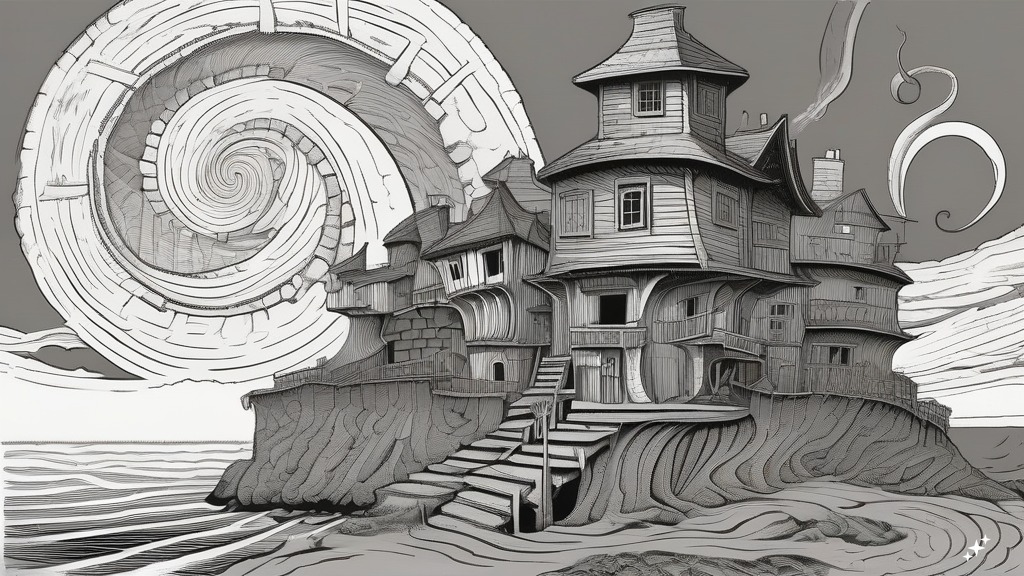
What Is Uzumaki About?
Uzumaki (the word means “spiral” in Japanese) is set in Kurôzu-cho, a small fictional coastal town in Japan. The story is narrated by Kirie Goshima, a high school student who watches as her town slowly falls under a supernatural curse — one centered entirely on the shape of the spiral.
It starts small. Kirie’s boyfriend Shuichi Saito notices that his father has become obsessed with spiral shapes — collecting spiral-patterned objects, staring at snail shells for hours, behaving in increasingly disturbing ways. Shuichi insists something is deeply wrong with the town, but nobody listens.
From there, the obsession spreads. Other townspeople develop their own fixations on spirals. Bodies begin to twist and deform. The natural world warps. And the curse keeps escalating, chapter after chapter, until the entire town is unrecognizable.
What makes the premise so effective is its simplicity. The antagonist isn’t a monster or a ghost or a serial killer. It’s a shape. The spiral itself is the horror — an abstract geometric form that somehow becomes the most terrifying thing you’ve ever seen on a page. Ito takes something you encounter a hundred times a day (in seashells, in hair, in water drains, in fingerprints) and makes you dread it.
The series was originally published chapter by chapter in a Japanese manga magazine called Big Comic Spirits from 1998 to 1999, then collected into book form. It’s a completed story — 20 chapters across 3 volumes — with a clear beginning, middle, and end. No cliffhangers, no ongoing series to keep up with. You pick it up, you read it, and you’re done.
Why Uzumaki Is Considered the Best Horror Manga for Beginners
There are a lot of reasons Uzumaki gets recommended as a starting point for people new to horror manga — or new to manga in general. Here’s what makes it work so well as a first read:
- It’s self-contained. The entire story fits in one book. You don’t need to commit to 30+ volumes or worry about where to stop. There’s no sequel, no spinoff, no required reading order. Start at chapter 1, finish at chapter 20, done.
- It’s available as a single hardcover. The Uzumaki 3-in-1 Deluxe Edition collects all 20 chapters in one 648-page hardcover volume. One purchase, complete story. It looks gorgeous on a shelf, too.
- Each chapter works on its own. While there’s an overarching narrative building across all three volumes, most individual chapters function as standalone horror stories — each one introduces a new situation, builds tension, and delivers a payoff. This means you get a satisfying dose of horror every time you sit down to read, even if you only have time for one chapter.
- The horror is visual, not textual. Ito’s horror lives in his artwork. You don’t need to parse dense dialogue or follow complicated plot threads — the images do the heavy lifting. This makes it incredibly accessible, even if you’re not used to reading comics or manga.
- It’s not reliant on gore. Uzumaki is disturbing, absolutely. But it’s not a nonstop bloodbath. The horror comes from wrongness — from bodies and environments that are almost normal but twisted in ways that make your skin crawl. If you’ve avoided horror manga because you assumed it was all blood and shock value, Uzumaki might genuinely surprise you.
Content Warnings
Before going further, here’s what the series contains so you can make an informed decision:
- Body horror (extensive — this is the core of the series; human bodies twist and deform into spiral shapes in detailed, disturbing ways)
- Suicide depiction (multiple instances)
- Claustrophobic imagery (especially in later chapters)
- Character death (frequent, often disturbing)
- Psychological distress and obsession
If you’re very sensitive to body horror or claustrophobic scenarios, this manga will be a difficult read. That’s not a judgment — it’s genuinely intense stuff, and knowing your own limits is smart.
A Note for First-Time Manga Readers
If this is literally your first manga: manga reads right-to-left. You open the book from what feels like the “back” and read panels from right to left across each page. It feels strange for about ten pages, and then it becomes second nature. The Deluxe Edition includes a note about this at the beginning of the book.
The Horror of Uzumaki — What Makes It So Disturbing
So what actually makes this manga scary? Why do people talk about it in hushed tones? Here’s a breakdown of the types of horror at work, without spoiling specific plot points.
Body Horror
This is the big one. Body horror is a style of horror focused on disturbing transformations of the human body — and Uzumaki is one of the most famous examples in any medium. Human bodies twist, coil, stretch, and deform into spiral shapes throughout the series. Ito draws these transformations in excruciating, hyper-detailed artwork — you can see every fold of skin, every impossible curve of bone and muscle.
The body horror in Uzumaki isn’t quick or explosive. It’s slow. You watch characters change gradually, panel by panel, and the detailed artwork means you can’t look away from the process. It’s the kind of horror that makes you physically uncomfortable because your brain keeps insisting that what you’re seeing shouldn’t be possible.
Cosmic and Existential Horror
The spiral curse has no clear origin, no motive, and no weakness. Characters try to understand it. They try to fight it. They try to flee from it. None of it works. The curse simply is. It doesn’t hate the townspeople. It doesn’t want anything from them. It’s an indifferent, incomprehensible force that warps reality because that’s what it does.
This puts Uzumaki in the territory of cosmic horror — a style of horror built around the idea that humans are insignificant in a vast, unknowable universe. The scariest thing about the spiral curse isn’t what it does to people’s bodies. It’s the dawning realization that there’s nothing anyone can do about it. Humans are completely powerless in the face of it.
Escalation
Ito structures the story as a slow, relentless escalation. The early chapters show individual people developing spiral obsessions — strange and creepy, but contained. By the middle of the series, the curse is affecting the town itself — its infrastructure, its weather patterns, its geography. By the final volume, you’re looking at total societal collapse on a scale that feels almost apocalyptic.
This escalation is carefully paced. Each chapter raises the stakes just enough to keep the dread building. You keep thinking “okay, that was the worst it can get,” and then you turn the page.
The Art
Ito’s artwork is genuinely what makes the whole thing work. He draws everyday settings — classrooms, suburban streets, family homes — with clean, realistic detail. And then he drops something impossible into that normal setting. A person whose body has become a spiral. A row of houses that have twisted into each other. Hair that coils and moves on its own.
The contrast between the mundane and the horrific is what creates the deep unease that Uzumaki is famous for. If the art were stylized or cartoonish, the horror wouldn’t land the same way. But Ito draws everything — the normal and the nightmarish — with the same meticulous realism. Your brain can’t dismiss what it’s seeing as “just a drawing.”
Key Scenes to Brace For (Spoiler-Free)
Without giving away specific plot details, here are a few moments that tend to hit readers the hardest:
- The snail students — you’ll know it when you see it. One of the most iconic images in all of horror manga.
- The hair chapter — a chapter about a girl’s hair that develops a life of its own. Sounds silly in summary. It is not silly on the page.
- The row houses — a later chapter that takes claustrophobia to an almost unbearable extreme.
How to Buy Uzumaki
The standard way to read Uzumaki in English is the Uzumaki (3-in-1 Deluxe Edition) , published by VIZ Media (the largest publisher of translated manga in North America). Here’s what you need to know:
Uzumaki (3-in-1 Deluxe Edition)
| Detail | Info |
|---|---|
| Format | Hardcover |
| Pages | 648 |
| Contents | All 20 chapters (complete series) |
| Publisher | VIZ Media |
| Release Date | October 15, 2013 |
| Price Range | Typically $20–$28 USD (check current listing for exact price) |
This is a beautiful edition. The hardcover format holds up well to the detailed artwork, and having the entire story in one book means you can read it in a single long sitting (or spread it over a few evenings, which is honestly better for your nerves).
The original 3-volume singles from an earlier printing run are no longer being produced and are harder to find at reasonable prices. The Deluxe Edition is the way to go — it’s what most readers buy, it’s widely available, and it’s the version you’ll see recommended everywhere.
How the Story Progresses — Volume-by-Volume Breakdown
Here’s a spoiler-light overview of how the story develops across its three volumes. This won’t ruin any twists, but it’ll give you a sense of the pacing and tone so you know what you’re getting into.
Volume 1 (Chapters 1–7)
Volume 1 introduces you to Kirie, Shuichi, and Kurôzu-cho. The first chapter focuses on Shuichi’s father and his growing obsession with spirals — it’s a slow-building nightmare and one of the most famous opening chapters in horror manga.
From there, each chapter introduces a new character or situation affected by the spiral curse. A girl becomes obsessed with her own spiral-patterned pottery. A student’s body begins to change. A lighthouse keeper stares into the light.
The tone here is creepy and unsettling. Each chapter functions almost like a standalone short horror story, connected by the recurring theme of spirals and Kirie’s narration. You’re watching the curse appear in isolated incidents, wondering how bad it can really get.
This volume is the easiest to read in terms of intensity. It’s still disturbing, but the horror is contained — individual people, individual episodes.
Volume 2 (Chapters 8–13)
Volume 2 is where the scope expands. The curse stops being something that happens to individual people and starts affecting the town as a whole. Weather patterns become unnatural — hurricanes form where they shouldn’t, spiral patterns appear in the natural environment. The landscape shifts. Groups of people are affected simultaneously.
Each chapter now feels like a piece of a larger puzzle. You start to sense that the individual horror stories from Volume 1 weren’t random — they were early symptoms of something much bigger.
The tone shifts from “this town is weird” to mounting, inescapable dread. Characters try to leave. The town doesn’t want them to.
Volume 3 (Chapters 14–20)
Volume 3 is the payoff, and it’s relentless. Kurôzu-cho is now fully consumed by the curse. The town is cut off from the outside world. Social order has collapsed. People are desperate and the transformations have become extreme.
Kirie and Shuichi make a final attempt to understand what’s happening and escape. The story pushes deeper underground — literally — and the climax reveals what lies beneath the town.
The tone here is apocalyptic, claustrophobic, and deeply bleak. The final chapters feature some of the most suffocating imagery in any horror manga. This is not a story with a triumphant ending — it’s a horror story, and it commits to that fully.
If you found Volumes 1 and 2 manageable, be prepared for Volume 3 to hit significantly harder.
Uzumaki Anime and Film — Are They Worth Watching?
Uzumaki has been adapted twice: a live-action film in 2000 and an anime (Japanese animated series) in 2024. Here’s the honest rundown on both.
The 2024 Anime (4 Episodes)
The Uzumaki anime was one of the most anticipated animated projects in years. It was announced in 2019 and finally premiered on September 28, 2024, after years of delays. It aired on Adult Swim in the US.
Episode 1 delivered on the promise. It’s gorgeous — black-and-white animation that faithfully recreates Ito’s detailed art style, with a haunting atmosphere that genuinely does justice to the source material. If you’ve read the manga, watching Episode 1 is a treat.
Episodes 2 through 4 are a different story. The animation quality drops steeply — dramatically enough that it became a major talking point online. Character models become inconsistent, the detailed art style from Episode 1 largely disappears, and the pacing struggles to condense the remaining story into three episodes.
The recommendation: Watch Episode 1 as a companion piece to the manga. It’s beautiful and faithful. For the rest, set your expectations accordingly — or just read the manga, which is the definitive version of this story by a wide margin.
The 2000 Live-Action Film
Directed by Higuchinsky and starring Eriko Hatsune and Fhi Fan, the live-action Uzumaki film is a low-budget curiosity. It only adapts material from the early chapters and takes significant creative liberties, but it captures the eerie tone of the manga reasonably well for a small horror film of its era.
It’s worth watching if you enjoy Japanese horror films and want to see a different interpretation. But like the anime, it doesn’t replace reading the manga. Ito’s page layouts, his detailed artwork, the way he controls pacing through the arrangement of images on each page — none of that translates fully to a screen.
The manga is the definitive way to experience Uzumaki. The adaptations are supplementary at best.
Who Should Read Uzumaki (and Who Should Skip It)
Read It If…
- You want a complete, standalone horror manga experience. One book, one story, beginning to end. No ongoing series commitment, no “but you have to read this other series first” prerequisites.
- You’re curious about Junji Ito. This is widely considered his best work and the ideal entry point into everything else he’s created.
- You enjoy atmospheric and psychological horror. Uzumaki builds dread through imagery and escalation, not through jump scares or action sequences.
- You’re new to manga. The standalone chapter structure, visual storytelling, and self-contained format make this one of the most accessible manga to pick up for the first time.
Skip It If…
- You’re very sensitive to body horror. This isn’t casual body horror — it’s detailed, sustained, and central to the entire story. If imagery of bodies twisting and transforming causes you genuine distress, this manga will be a rough time.
- Claustrophobic imagery bothers you. The later chapters feature extremely tight, enclosed spaces and imagery designed to make you feel trapped.
- You want an action-driven story. There are no fight scenes and no combat. This is slow-burn horror — the tension comes from dread and atmosphere, not from characters battling enemies.
Age Recommendation
VIZ Media rates Uzumaki T+ (Older Teen) — their content label indicating the book is intended for readers roughly 16 and up. That feels about right. The content is dark and the imagery is intense. It’s best suited for older teens and adults. Younger readers might find it genuinely upsetting — not because of graphic violence, but because the horror is psychologically effective in a way that lingers.
If You Finish and Want More Junji Ito
Uzumaki is Ito’s most famous work, but it’s far from his only one. If you finish it and want more:
- Tomie — Ito’s other major long-form series, about an immortal girl who drives everyone around her to madness and murder. Each chapter tells its own self-contained story, and the horror has a very different flavor from Uzumaki.
- Junji Ito short story collections — VIZ Media has published several collections including Shiver, Smashed, Venus in the Blind Spot, Deserter, Lovesickness, and more recent volumes like Alley , Stitches, and Moan. These are great for sampling the range of his work — each collection contains multiple standalone stories.
- Gyo — A two-volume series about fish with mechanical legs invading land. Yes, really. It’s bizarre and horrifying in ways only Ito can pull off.
Alley: Junji Ito Story Collection
Stitches (Junji Ito)
Moan: Junji Ito Story Collection
Uzumaki is a manga that earns its reputation. It’s weird, it’s beautiful, it’s deeply unsettling, and once you’ve read it, you’ll never look at a spiral the same way again. Grab the Deluxe Edition and see for yourself.