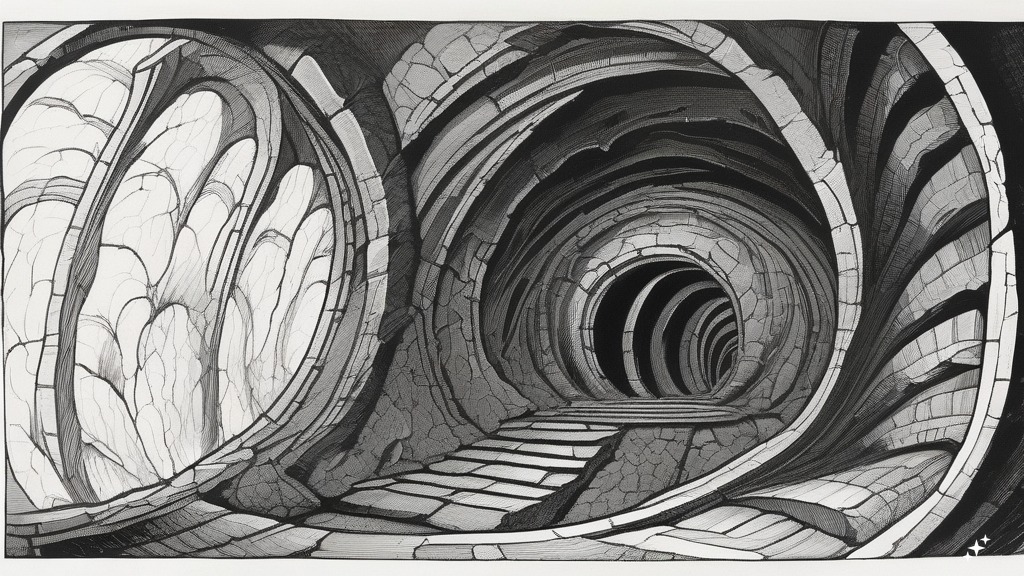
What Makes Junji Ito’s Manga Panels Unforgettable
Junji Ito (伊藤 潤二), born July 31, 1963, has spent decades perfecting something no other horror manga artist has achieved at quite the same scale: panels so visually striking that they function as standalone pieces of horror art, completely independent of their surrounding story.
His work achieves this through a combination of hyper-detailed linework, masterful use of the page-turn reveal, and body transformations that exploit the static nature of manga in ways that animation simply cannot replicate. When a character transforms in an Ito manga, you see every stage frozen in excruciating detail. There’s no motion blur to soften it. No cut-away. Just the image, waiting for you.
The cultural impact is hard to overstate. “This is my hole — it was made for me” became one of the internet’s most recognized horror memes, spawning countless parodies and references. Panels from Uzumaki are among the most shared manga images online, period. No other horror manga artist has been as widely memed, referenced, tattooed, and studied for visual technique alone.
But you don’t need awards or internet fame to understand the appeal. Any reader already knows after one page turn: this art gets under your skin and stays there.
The Most Iconic Junji Ito Manga Panels Across His Works
Let’s walk through the panels that made Junji Ito a household name — even in households that don’t read manga. If you’re new to manga as a format, here’s the quick version: manga books are read right-to-left (you open the book from what Western readers would consider the “back” cover, and panels on each page flow from right to left instead of left to right). Each book, called a volume, typically collects several chapters of a story. That’s all you need to know to follow along.
“This Is My Hole” — The Enigma of Amigara Fault
This is probably the most recognized single panel in horror manga.
The Enigma of Amigara Fault is a short story first published in 2002, appended to the end of Gyo (2 volumes, published by Viz Media — the largest American publisher of Japanese manga in English). The premise is deceptively simple: after an earthquake, a mountainside splits open to reveal hundreds of human-shaped holes. People are drawn to the holes that match their exact silhouettes — and they can’t resist walking in.
The panel of a man standing before his hole, declaring “This is my hole — it was made for me,” has become internet shorthand for existential dread, inevitability, and the horror of something designed specifically for you.
But it’s the final panel that truly devastates. On the other side of the mountain, we see what emerges: bodies stretched and compressed into impossibly deformed shapes, still alive, still moving. The horror isn’t the holes themselves — it’s the irreversible transformation that happens inside them.
What makes this work as a panel is the contrast. The holes are drawn with clean, precise outlines. The mountain itself is rendered in heavy, scratchy detail. The human figures are small against the vast rock face. Everything about the composition tells you these people are insignificant against whatever force carved those shapes. And the final reveal uses dense, almost suffocating linework to show bodies that no longer look human but are recognizably derived from humans.
For a short story of only about 30 pages, it has an outsized cultural footprint — and it all comes down to those panels.
The Spiral Transformations — Uzumaki
Uzumaki is Ito’s masterwork, and it contains more iconic panels per page than almost any other manga in existence. Originally published as 3 volumes (19 chapters), the story follows the town of Kurouzu-cho as it becomes infected by spirals — the shape itself becoming a malevolent, consuming force.
Here are the panels that define the series:
Mr. Saito in the Bathtub (Chapter 2) — Shuichi’s father becomes obsessed with spirals, and in one of the most reproduced images in all of horror manga, we see him contorted into a spiral shape inside a round wooden bathtub. His body is twisted like a cinnamon roll, his expression frozen somewhere between ecstasy and agony. The level of anatomical detail in this panel is staggering — you can trace every muscle and tendon as the body wraps impossibly around itself. This is often the first Uzumaki image people encounter, and it’s the one that sells them on the series instantly.
The Snail Transformation (Chapter 8) — A slow-burn body horror sequence — “body horror” being a genre term for horror that focuses on disturbing transformations or violations of the human body — where a bullied student gradually transforms into a giant snail. What makes the panels here so effective is the pacing. Ito doesn’t jump to the final form. He gives you stages: the spine curving, the skin taking on a gelatinous quality, the shell growing from the back. Each panel is slightly more wrong than the last, and because you’re reading at your own pace, you choose when to confront the next stage. It’s excruciating.
Twisted Lovers (Chapter 5, “Twisted Souls”) — Two young lovers are found dead, their bodies intertwined in a double spiral. The panel is simultaneously beautiful and horrifying — there’s an almost decorative, ornamental quality to the flowing lines of their merged bodies, which makes the grotesqueness even harder to process. Your brain wants to see it as elegant. Your stomach knows better.
The Spiral City (Final Chapters) — A massive image spread across two facing pages reveals what lies beneath Kurouzu-cho: an ancient spiral structure, a city built in concentric coils, the source of the infection. After 19 chapters of escalating horror, this panel recontextualizes everything. The scale is overwhelming. The detail is obsessive. It’s the visual climax of the entire series, and it earns every square centimeter.
Tomie’s Regeneration Scenes
Tomie was Ito’s first published work, spanning 20 chapters, and it introduced the character that would become his most enduring creation: Tomie Kawakami, an impossibly beautiful girl who cannot die. She regenerates from any injury. Cut her into pieces, and each piece grows into a new Tomie.
The regeneration panels are where Ito’s genius for the beauty-to-grotesque shift is on full display. In one panel, you see Tomie’s lovely face. In the next, that face is splitting open, new faces budding from the wound, each one perfect and terrible. The panels showing multiple Tomies growing from severed limbs are drawn with the same care and detail that he gives to her beauty — the horror is beautiful, and that’s what makes it so deeply unsettling.
Across 20 chapters, Ito finds new ways to depict this cycle of death and rebirth. Tomie grows from a kidney. From a drop of blood. From an eye. Each iteration pushes the visual horror further while maintaining that core tension between attraction and revulsion.
Hanging Balloons — The Deflating Head
Hanging Balloons is a standalone short story (collected in Shiver: Junji Ito Selected Stories), and it contains one of Ito’s most emotionally disturbing single panels.
The premise: giant balloon-like heads appear in the sky, each one a perfect replica of a specific person. They descend on nooses to kill their human originals. The concept alone is nightmarish, but it’s a specific panel of the character Chiharu — her balloon double deflating, the features collapsing and distorting — that hits hardest.
Ito renders the deflation in meticulous detail. The skin wrinkles. The eyes sink. The mouth stretches into something no longer resembling a face. It’s drawn with such precision that you can almost hear the air escaping. The panel works because it takes something that sounds almost silly — a giant floating head — and renders it with absolute anatomical seriousness. Ito never winks at the camera. He draws the absurd with the same commitment he brings to the tragic, and that commitment is what transforms silly into terrifying.
Lovesickness — The Rib Woman
From the collection Lovesickness (winner of the 2022 Eisner Award — the Eisner Awards are essentially the Oscars of the American comics industry), this story features a villain who has become one of Ito’s most visually striking creations: a fortune teller with exposed ribs and festering wounds, her body a map of obsessive, self-inflicted damage.
The panels showing her full form are genuinely hard to look at — not because they’re gratuitously gory, but because Ito draws the wounds with medical textbook precision. You can see layers of tissue. The ribs are anatomically correct. The surrounding skin is rendered with different textures depending on the stage of decay. It’s horror that comes from accuracy, not exaggeration.
Why Junji Ito’s Panel Art Works — Techniques Explained
Understanding how these panels achieve their effect makes re-reading them even more rewarding. Here are the core techniques Ito uses.
The Page-Turn Reveal
This is Ito’s signature move, and it’s the reason his horror works better on paper than on a screen (though it still works on a screen — it’s just perfect on paper).
The technique works like this: Ito builds tension across several small, restrained panels. Characters talk. They notice something wrong. They approach a door, or look over a cliff, or pull back a curtain. These panels are deliberately understated — minimal backgrounds, tight framing on faces, conventional panel layouts.
Then you turn the page.
And there it is. A massive, often full-page image with no dialogue, no sound effects, just the horror rendered in overwhelming detail. The Amigara Fault holes. Mr. Saito in the bathtub. Tomie’s regenerating face.
This is manga’s answer to the cinematic jumpscare — but with a crucial difference. In a movie, the timing belongs to the director. In an Ito manga, you turn the page. You participate in your own scare. Your hand does the work. And that physical involvement makes the impact deeper.
Because manga is read right-to-left, Ito places the tension-building panels so that the horrific reveal always falls on the left page of a two-page spread — the page you see after turning. It’s precise. It’s calculated. And it works every single time.
Extreme Detail in Black and White
Ito works exclusively in black and white, and his approach to creating depth and texture is distinctive: he relies heavily on crosshatching — a shading technique where the artist draws many overlapping sets of parallel lines by hand to build up shadow and texture — rather than screentone, which is a pre-made pattern of tiny printed dots that manga artists can apply to areas for quick, uniform shading.
This matters because crosshatching creates a hand-drawn, organic quality that screentone simply can’t match. When Ito draws rotting flesh, you can see individual lines representing every fiber of decaying tissue. When he draws hair, each strand is individually rendered. When he draws the interior of a spiral, the crosshatching itself follows the spiral pattern, pulling your eye inward.
His character work uses an interesting baseline: faces are drawn without the typical manga blush marks or warm details. Skin is pale, almost blank. This creates a lifeless, unsettling quality even before anything horrific happens — characters look subtly wrong from page one.
But the eyes. The eyes get everything. Ito gives his characters’ eyes more rendering detail than the rest of the face combined. Iris textures, reflections, dilated pupils, the slight asymmetry of genuine terror — the eyes become the emotional anchor of every panel. You look at the eyes first, read the fear or madness there, and then your gaze moves outward to whatever is causing that expression.
This is why his panels work even as isolated images. The eyes tell you the emotional story. The surrounding horror tells you why.
The Beauty-to-Grotesque Shift
This technique is most obvious in Tomie but runs through virtually all of Ito’s work.
Characters begin drawn in a clean, attractive style. Faces are symmetrical. Lines are smooth. The art looks almost gentle. Then, as the horror takes hold, the linework itself transforms. Lines become more aggressive — thicker, more jagged, more densely packed. Smooth curves give way to sharp angles. Clean faces develop textures that shouldn’t be there.
The genius is that Ito often places beautiful and grotesque elements in the same panel. A lovely face with one eye rotting. A graceful body with a spiral growing from the ear. By forcing beauty and horror to coexist within a single frame, he creates a visual dissonance that the brain can’t resolve. You can’t categorize the image as simply “beautiful” or simply “horrific,” so it lingers. It nags.
The linework itself becomes a storytelling tool. Early chapters in any Ito manga feature cleaner, more restrained art. As the story progresses and the horror escalates, the density of lines increases, backgrounds become more cluttered and oppressive, and white space gradually disappears. By the final chapters, pages feel claustrophobic — there’s no visual breathing room left. The art is consuming the page the same way the horror is consuming the characters.
Where to Read These Panels — Beginner’s Buying Guide
Ready to experience these panels for yourself? Here’s where to start. All of Ito’s major works are completed and published in English by Viz Media (the largest American publisher of Japanese manga in English), so you won’t get stuck waiting for new volumes.
Best Starting Points
Uzumaki (3-in-1 Deluxe Edition) — This is the single best book to start with if you want to understand why Junji Ito’s panels are legendary. All 19 chapters, 648 pages, one oversized hardcover. The larger format does justice to the detailed artwork in a way that standard-size volumes simply cannot. Contains the bathtub panel, the snail transformation, the twisted lovers, and the spiral city — basically a greatest hits of iconic horror imagery.
Uzumaki (3-in-1 Deluxe Edition)
Gyo (2-in-1 Deluxe Edition) — Two volumes of fish-on-mechanical-legs body horror, plus — and this is key — The Enigma of Amigara Fault is included as a bonus story. If you want to read “This is my hole” in its original context, this is where you find it.
Tomie: Complete Deluxe Edition — All 20 chapters in one volume. The regeneration scenes, the multiplication horror, the beauty-to-grotesque transformations that defined Ito’s career. This collects every Tomie story in one place.
Short Story Collections
If you want concentrated doses of iconic panels without committing to a longer narrative, Ito’s short story collections are the way in. Each one contains multiple standalone stories, and almost every story has at least one panel that will sear itself into your memory. These are also great if you’re testing the waters — shorter, lower commitment, and you’ll know within a few pages whether Ito’s style clicks for you.
Shiver: Junji Ito Selected Stories — This is where you’ll find Hanging Balloons (the deflating head discussed above), along with several other standout stories. A strong sampler of Ito’s range if you want a taste before committing to a full-length work.
Smashed: Junji Ito Story Collection — Another collection of short stories packed with memorable panel work. Like Shiver, it showcases the breadth of Ito’s horror imagination across multiple standalone tales.
Junji Ito Story Collection 3-Book Set (Lovesickness, Deserter, Fragments of Horror) — Three collections bundled together. Lovesickness alone won the 2022 Eisner Award, and it contains the rib woman panels discussed above. Fragments of Horror is one of the most visually intense short story collections he’s produced. This bundle is a strong value if you want to dive deep.
Note: this is a multi-book set put together by a third-party seller, not an official publisher box set.
Junji Ito Story Collection 3 books set: Lovesickness, Deserter, Fragments of Horror
Stitches — A story collection that showcases Ito’s range. The title story alone contains panels that will make you wince, and the supporting stories demonstrate just how many different flavors of horror Ito can render.
Stitches (Junji Ito)
Alley: Junji Ito Story Collection — Another strong collection of short stories with standout panel work throughout.
Alley: Junji Ito Story Collection
Dissolving Classroom — A shorter, punchier work about a brother and sister whose apologies literally dissolve the people around them. The “melting” panels in this one are uniquely disgusting — Ito finding yet another way to make the human body do things it absolutely should not.
Dissolving Classroom (Junji Ito)
Moan: Junji Ito Story Collection — One of Ito’s more recent English-language releases. Fresh story collection with the same incredible panel work.
Moan: Junji Ito Story Collection
For Art Appreciation
The Art of Junji Ito: Twisted Visions — This is a 150-page art book published by Viz Media in April 2020, featuring 130+ illustrations with artist commentary. If you’re specifically interested in Ito’s panel art as art — composition, technique, process — this is invaluable. It includes full-color pieces you won’t find in the manga volumes, plus Ito’s own notes on how he approaches horror imagery.
Quick Comparison: Where to Find Specific Iconic Panels
| Iconic Panel | Found In |
|---|---|
| “This is my hole” (Amigara Fault) | Gyo (2-in-1 Deluxe Edition) |
| Mr. Saito in the bathtub | Uzumaki (3-in-1 Deluxe Edition) |
| Snail man transformation | Uzumaki (3-in-1 Deluxe Edition) |
| Twisted lovers spiral | Uzumaki (3-in-1 Deluxe Edition) |
| Spiral city beneath Kurouzu-cho | Uzumaki (3-in-1 Deluxe Edition) |
| Tomie’s regeneration | Tomie: Complete Deluxe Edition |
| Hanging Balloons (deflating head) | Shiver: Junji Ito Selected Stories |
| Rib woman (Lovesickness) | Lovesickness (or 3-Book Story Collection Set) |
| Dissolving faces | Dissolving Classroom |
Buying Tips
- Go for the Deluxe Editions when available. The oversized format makes a real difference for Ito’s work. The detail in his crosshatching rewards a larger page size — you see things at full size that get lost in standard paperback printing.
- Start with Uzumaki if you want the full experience. It’s a complete narrative with escalating horror, and it contains the highest concentration of iconic panels.
- Start with Gyo if you want the meme. Amigara Fault is there, plus Gyo itself is a wild ride.
- Start with a short story collection if you want variety or a lower-risk entry point. You’ll encounter multiple types of panel work across different stories, and if you’re unsure whether horror manga is for you, a shorter collection lets you find out without a big commitment.
Frequently Asked Questions
What is Junji Ito’s most famous manga panel?
The most widely recognized single panel is almost certainly the “This is my hole — it was made for me” moment from The Enigma of Amigara Fault. It became a massive internet meme and is frequently referenced in horror communities, art discussions, and general pop culture. The Mr. Saito bathtub spiral from Uzumaki is a close second — it’s probably the most iconic panel from his longest-form work.
What manga should I read first to see his best artwork?
Uzumaki (3-in-1 Deluxe Edition) is the strongest recommendation. It contains the highest concentration of iconic, stunning panels in any single Ito book, and the oversized hardcover format shows off his detailed linework beautifully. At 648 pages, it’s also substantial enough to give you a full understanding of his range. If you want something shorter first, grab Gyo — it includes The Enigma of Amigara Fault as a bonus.
Uzumaki (3-in-1 Deluxe Edition)
Has Junji Ito won any awards?
Yes, quite a few. His major awards include:
- 2019 Eisner Award — Best Adaptation from Another Medium (for Frankenstein)
- 2021 Eisner Awards — Two awards, for Remina and Venus in the Blind Spot
- 2022 Eisner Award — For Lovesickness
- 2023 Inkpot Award — Presented at San Diego Comic-Con (the Inkpot Award is a lifetime achievement honor given to individuals who have made outstanding contributions to comics and pop culture)
The Eisner Awards are essentially the Oscars of the American comics industry, so winning four of them is a significant achievement — particularly for a Japanese manga artist working in translation.
Is Junji Ito still making manga?
Ito’s major long-form works (Uzumaki, Tomie, Gyo) are all completed. He continues to produce short stories and collections, and new English-language releases from Viz Media appear regularly. Recent collections like Moan, Stitches, and Alley are proof that he’s still actively creating and still at the top of his game. Viz Media has been steadily translating more of his catalog into English, so there’s a good chance that works not yet available in English will eventually get releases.
Do I need to read Junji Ito’s manga in any specific order?
Not at all. Almost all of Ito’s works are standalone. Tomie has recurring characters across its 20 chapters, but even those chapters can largely be read independently. Uzumaki is a continuous narrative that should be read from beginning to end. Everything else — the short story collections, Gyo, standalone stories — can be picked up in any order. Grab whatever sounds most interesting to you and go from there. Even if you’ve never read manga before, Ito’s visual storytelling is so clear and immediate that you’ll have no trouble following along — the images do most of the work.