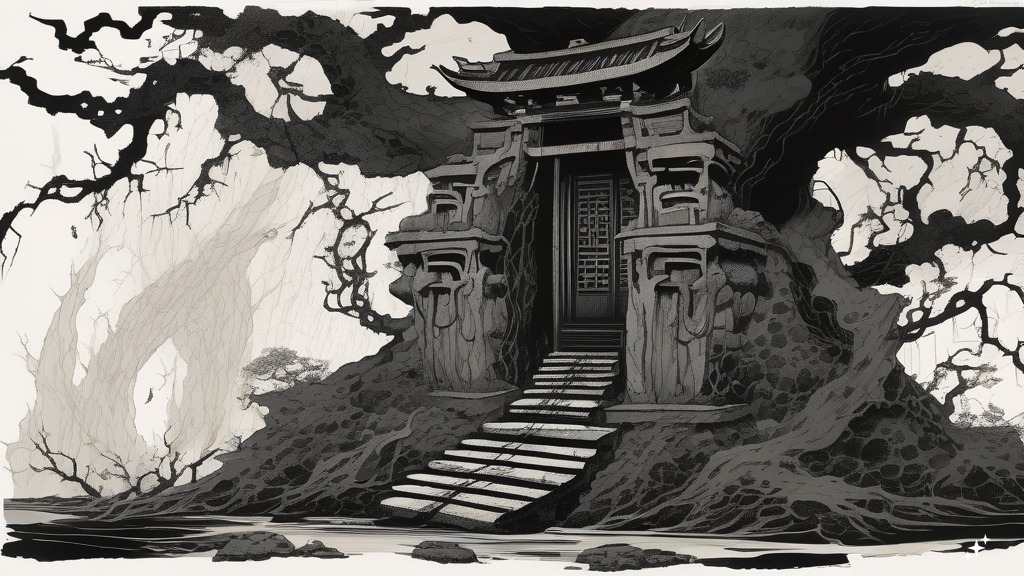
What Is Japanese Horror Manga?
Japanese horror manga refers to horror comics created by Japanese artists and published in Japan’s manga tradition. These comics are printed in black and white (as nearly all manga is), and they share roots with the broader wave of Japanese horror that gained worldwide attention in the 1990s and 2000s through films like Ringu (the original version of The Ring) and Ju-On (the original The Grudge). But the manga medium allows creators to do things that movies simply can’t.
A few things set Japanese horror manga apart from Western horror comics:
- Slow-burn pacing — Many of the best horror manga build tension gradually across chapters (the individual installments that are later collected into paperback volumes) rather than relying on constant shocks. The dread accumulates.
- Body horror — Japanese horror manga has a long tradition of distorting the human body in deeply unsettling ways. Body horror means exactly what it sounds like: horror that comes from the human form itself being twisted, mutated, or transformed. Spirals, parasites, grotesque mutations — the body becomes the source of terror.
- Psychological dread — Rather than monsters jumping out of closets, many titles focus on paranoia, obsession, and the feeling that something is fundamentally wrong with the world.
- Atmospheric artwork — Black-and-white artwork with heavy ink work creates a visual tone that color comics rarely achieve. Shadows and negative space do a lot of heavy lifting.
- Standalone accessibility — Many horror manga are short, self-contained stories or collections, making them easy to pick up without committing to a 50-volume series.
If you’re coming from horror movies or Western horror comics, Japanese horror manga will feel familiar in some ways and completely alien in others. That tension is part of what makes it so compelling.
Best Japanese Horror Manga for Beginners
Starting with horror manga can feel overwhelming — there are decades of titles to choose from. These four are fantastic entry points because they’re widely available in English, reasonably short, and showcase different flavors of horror.
Uzumaki by Junji Ito
The single best starting point for Japanese horror manga. No contest.
Uzumaki follows the residents of Kurouzu-cho, a small coastal town that becomes obsessed with spirals. That premise sounds almost silly — until Ito shows you what spiral obsession actually looks like. People contorting their bodies into spirals. Snail transformations. A lighthouse that twists reality itself. The horror escalates relentlessly, and Ito’s meticulous artwork makes every grotesque detail impossible to look away from.
What makes Uzumaki great for beginners is its structure. Each chapter works almost like a self-contained horror story, connected by the overarching mystery of the spirals. You’re hooked from chapter one, but the bigger picture keeps pulling you forward.
- Author: Junji Ito
- Length: 3 volumes (available as a single 3-in-1 Deluxe Hardcover Edition)
- Publisher: Viz Media
- Status: Completed
The 3-in-1 Deluxe Edition collects the entire story in one oversized hardcover with larger pages that show off Ito’s detailed artwork. It’s the best way to read it.
Uzumaki (3-in-1 Deluxe Edition)
Tomie by Junji Ito
Before Uzumaki, there was Tomie — Junji Ito’s debut work and one of the most iconic characters in horror manga.
Tomie is an impossibly beautiful girl who drives every man around her to obsessive love — and eventually, murder. But Tomie can’t die. She regenerates, multiplies, and returns again and again, leaving a trail of madness and dismemberment behind her. Each chapter follows a different encounter with Tomie (or one of her many copies), so the series reads like a collection of separate horror stories linked by the same terrifying character.
Tomie is less visually intense than Uzumaki but more psychologically disturbing. The horror comes from watching rational people completely unravel in Tomie’s presence. It’s a masterclass in obsession as horror.
- Author: Junji Ito
- Length: Complete Deluxe Edition (single hardcover, 752 pages)
- Publisher: Viz Media
- Status: Completed
Parasyte by Hitoshi Iwaaki
If you prefer your horror with a side of sci-fi action, Parasyte is the one.
Alien parasites arrive on Earth and burrow into human brains, taking over their hosts completely. High schooler Shinichi Izumi gets partially infected — the parasite takes over his right hand instead of his brain, and the two are forced into an uneasy partnership. Together, they fight other parasites while Shinichi grapples with what it means to be human when part of you literally isn’t.
Parasyte moves faster than most horror manga on this list. There’s genuine action, body horror that’s creative rather than just grotesque, and philosophical questions about humanity that don’t feel heavy-handed. The 2014 anime adaptation is excellent too, but the manga’s black-and-white artwork gives the horror scenes a different kind of impact.
- Author: Hitoshi Iwaaki
- Length: 8 volumes
- Publisher: Kodansha USA
- Status: Completed
Eight volumes is a very manageable commitment, and the story is complete with a satisfying ending.
Mieruko-chan by Tomoki Izumi
Not ready for full-throttle nightmare fuel? Mieruko-chan is a wonderful gateway horror manga that balances genuine scares with humor and heart.
Miko is an ordinary high school girl who suddenly starts seeing horrifying ghosts and spirits everywhere — on the street, at school, hovering behind her friends. Her survival strategy? Pretend she can’t see them. The comedy comes from her poker face as terrifying apparitions loom inches from her face. The horror comes from the fact that the spirits are genuinely well-designed and deeply unsettling.
What starts as a comedy-horror premise gradually deepens into something more serious, with actual stakes and lore building behind the scares. It’s a great pick if you want to ease into horror manga without immediately jumping into body horror and existential dread. The first volume or two work well as a standalone taste of the series, so you can try it without committing to the full run.
- Author: Tomoki Izumi
- Length: 14 volumes (as of early 2026)
- Publisher: Yen Press
- Status: Ongoing (new volumes still being released)
Classic Japanese Horror Manga Every Fan Should Read
These titles helped define the genre. They’ve influenced countless creators and remain powerful reads decades after their original publication.
The Drifting Classroom by Kazuo Umezu
Published in the 1970s, The Drifting Classroom is foundational — one of the earliest horror manga to achieve widespread recognition, and it still hits hard today.
An entire elementary school is suddenly transported to a barren, apocalyptic wasteland. No adults can be trusted (they lose their minds almost immediately), and the children are left to survive on their own against starvation, monsters, and each other. Imagine a group of children trapped together with no adults, no rules, and dwindling resources — then add monsters. That’s the relentless energy of this manga.
The pacing never lets up. Umezu doesn’t give characters (or readers) time to breathe. Every chapter introduces a new crisis, a new betrayal, a new nightmare. The art looks different from modern manga — more exaggerated, more raw — but that roughness adds to the panic.
- Author: Kazuo Umezu
- Length: 11 volumes (also available in hardcover editions that collect multiple volumes into single oversized books)
- Publisher: Viz Media
- Status: Completed
Berserk by Kentaro Miura
Berserk is primarily a dark fantasy epic, but its horror elements are among the most visceral and emotionally devastating in all of manga.
The story follows Guts, a lone mercenary with a massive sword, as he battles demons and the consequences of a catastrophic betrayal. The world of Berserk is brutal — medieval warfare, monstrous beings that defy comprehension, body horror, and psychological trauma woven together into a narrative that somehow also contains genuine beauty and tenderness.
A word of warning: Berserk contains extremely graphic violence, sexual assault, and disturbing imagery. It earns its reputation as one of the darkest manga ever created. But it’s also one of the most artistically accomplished — Miura’s detailed pen work is staggering.
Creator Kentaro Miura passed away in May 2021. His long-time assistants are continuing the series under his studio name, Studio Gaga, with guidance from Miura’s close friend Kouji Mori, using notes and conversations Miura left behind. The story is being completed as faithfully to his vision as possible.
- Author: Kentaro Miura (continued by Studio Gaga)
- Length: 41+ volumes (ongoing)
- Publisher: Dark Horse Comics
- Status: Ongoing (being continued posthumously; new volumes still releasing)
The Deluxe Edition hardcovers collect three volumes each in oversized format — a beautiful way to experience Miura’s artwork at a larger size.
Berserk Deluxe Volume 5
Monster by Naoki Urasawa
Monster stretches the boundaries of horror manga — there are no monsters, no ghosts, no supernatural elements whatsoever. But the horror it creates through pure human evil is more unsettling than most creature features.
Dr. Kenzo Tenma, a brilliant Japanese surgeon working in Germany, saves the life of a young boy over the city’s mayor. Years later, that boy grows up to become Johan Liebert — a serial killer of almost supernatural charisma and intelligence. Tenma sets out to stop the monster he saved, and the story becomes a sprawling thriller across Europe.
The pacing is deliberate, the character work is extraordinary, and Johan Liebert is one of the most chilling antagonists in any medium. If you prefer psychological horror over visual horror, Monster is the title.
- Author: Naoki Urasawa
- Length: 18 volumes (also available as 9 oversized two-in-one hardcovers called Perfect Edition volumes)
- Publisher: Viz Media
- Status: Completed
Modern Japanese Horror Manga Worth Reading
These titles were published in the 2000s and beyond, bringing fresh perspectives to the genre while building on the foundations laid by the classics.
Tokyo Ghoul by Sui Ishida
College student Ken Kaneki survives a date gone horribly wrong — his date turns out to be a ghoul, a creature that survives by eating human flesh. After emergency surgery using his attacker’s organs, Kaneki becomes a half-ghoul, straddling the line between human and monster.
Tokyo Ghoul is action-horror with a strong emotional core. The fight scenes are fast-moving and brutal, but the real draw is Kaneki’s psychological deterioration and the moral complexity of the ghoul society. Neither humans nor ghouls are entirely sympathetic, and the story forces you to sit with that discomfort.
The original series is 14 volumes. A direct sequel called Tokyo Ghoul:re continues the story for another 16 volumes, for 30 volumes total. You should read the original series first, and it works as a complete story on its own if you decide not to continue.
- Author: Sui Ishida
- Length: 14 volumes (original) + 16 volumes (Tokyo Ghoul:re)
- Publisher: Viz Media
- Status: Completed
The Complete Box Set covering volumes 1–14 of the original series is a solid way to start.
Tokyo Ghoul Complete Box Set (Vols. 1-14)
I Am a Hero by Kengo Hanazawa
Japan doesn’t have a long tradition of zombie fiction, which is part of what makes I Am a Hero so interesting — it approaches the zombie apocalypse from a distinctly Japanese perspective.
The protagonist, Hideo Suzuki, is a struggling manga artist with delusions and anxiety issues. When a zombie outbreak hits Japan, Hideo is one of the least equipped people to survive — which is exactly what makes the story compelling. This isn’t a power fantasy. It’s a deeply human (and often darkly funny) survival story where the main character’s greatest weapon is a shotgun he’s barely qualified to own.
The zombie designs are genuinely disturbing — Hanazawa’s hyper-detailed realistic art style makes the infected look like actual decaying human beings rather than cartoon monsters.
- Author: Kengo Hanazawa
- Length: 22 volumes (available in collected editions that bundle multiple volumes together)
- Publisher: Dark Horse Comics
- Status: Completed
The Summer Hikaru Died by Mokumokuren
One of the most talked-about horror manga of the 2020s — the series has sold over 3 million copies in Japan and sparked widespread discussion among manga readers online.
Yoshiki discovers that his best friend Hikaru has been replaced by something inhuman — a being wearing Hikaru’s face and using Hikaru’s memories, but fundamentally not Hikaru. The twist? Yoshiki decides to keep this a secret and continue their friendship anyway. What follows is a deeply unsettling exploration of love, grief, identity, and the question of whether the thing wearing your friend’s face can still be your friend.
The horror here is emotional as much as supernatural. The creature pretending to be Hikaru genuinely seems to care about Yoshiki, which makes the situation more disturbing, not less.
- Author: Mokumokuren
- Length: 8 volumes (as of late 2025), planned for 10 volumes total
- Publisher: Yen Press
- Status: Ongoing (expected to conclude at 10 volumes)
The Summer Hikaru Died, Vol. 1
The Summer Hikaru Died, Vol. 1
Gantz by Hiroya Oku
Gantz is not subtle. It’s not quiet. It’s not for the faint of heart.
When people die in Tokyo, some of them wake up in an apartment with a mysterious black sphere called Gantz. The sphere gives them weapons and suits and sends them to fight bizarre, deadly aliens — and if they die during these missions, they die for real this time. The premise is wild, the violence is extreme, and the alien designs range from absurd to genuinely terrifying.
Gantz has some tonal inconsistencies — it can swing from genuinely profound moments to gratuitous content (both extreme gore and sexual content) within the same chapter. That unevenness is worth knowing about upfront. But when it works, it’s an adrenaline-soaked nightmare that’s hard to put down. The story gains significant momentum in its second half, where the stakes and scale expand dramatically.
- Author: Hiroya Oku
- Length: 37 volumes
- Publisher: Dark Horse Comics
- Status: Completed
Blood on the Tracks by Shuzo Oshimi
Blood on the Tracks 1
This one is a slow, deeply immersive read that builds tension until it becomes almost unbearable — and that’s what makes it so effective.
Blood on the Tracks follows Seiichi, a middle schooler whose mother seems loving and attentive on the surface. But something is deeply wrong. The story gradually reveals the extent of his mother’s psychological manipulation and control, building a horror that comes entirely from human behavior rather than anything supernatural.
Shuzo Oshimi’s art is minimalist and precise, using empty space and facial expressions to create an atmosphere of constant unease. If you’ve ever felt uncomfortable around someone but couldn’t articulate why, this manga captures that exact feeling and stretches it across hundreds of pages.
- Author: Shuzo Oshimi
- Length: 17 volumes
- Publisher: Vertical (Kodansha USA)
- Status: Completed
Junji Ito — The Master of Japanese Horror Manga
You can’t talk about Japanese horror manga without talking about Junji Ito. His name has come up multiple times already in this guide, and there’s a reason for that — he’s the single most recognizable horror manga creator in the world.
Why Ito Dominates the Genre
Junji Ito’s genius lies in his ability to find horror in the mundane. Spirals, fish, balloons, grease — ordinary things become sources of inescapable dread under his pen. His artwork is meticulous, rendering grotesque transformations and impossible geometries with a technical precision that makes the impossible look terrifyingly plausible.
He’s also remarkably accessible. Unlike many manga creators who require you to read hundreds of chapters to appreciate their work, many of Ito’s best stories are self-contained short pieces. You can pick up almost any Ito collection and get a complete, satisfying horror experience.
Ito has won four Eisner Awards — the most prestigious honor in the comic book industry, awarded annually in the United States and recognized worldwide.
Key Works Beyond Uzumaki and Tomie
- Gyo — Dead fish with mechanical legs invade the land. The premise is absurd. The execution is genuinely nightmarish.
- Remina — A planet heading toward Earth becomes an object of worship — and then terror.
- Shiver — A short story collection that showcases Ito’s range, from body horror to quiet dread.
- Fragments of Horror — Another strong short story collection, featuring some of his most unsettling standalone pieces.
- Sensor — A woman encounters a mysterious volcanic village and becomes entangled in horror on a cosmic scale.
Where to Start with Junji Ito
Two paths:
- Uzumaki (3-in-1 Deluxe Edition) — His masterpiece, complete in one volume. Start here if you want his best long-form work.
- Shiver or Fragments of Horror — Start here if you want a sampler of his short stories before committing to a longer narrative.
Uzumaki (3-in-1 Deluxe Edition)
You really can’t go wrong either way.
How to Choose Your First Japanese Horror Manga
With so many options, here’s a quick breakdown to help you find the right starting point.
By Horror Subgenre
| Subgenre | Best Pick | Why |
|---|---|---|
| Body horror | Uzumaki | The defining body horror manga — spiral transformations that haunt your dreams |
| Psychological horror | Monster | Pure human evil, no supernatural elements, masterful tension |
| Supernatural horror | Mieruko-chan | Accessible tone with genuinely creepy spirit designs |
| Action-horror | Tokyo Ghoul | Fast-paced combat with strong emotional stakes |
| Sci-fi horror | Parasyte | Alien parasites, philosophical questions about humanity |
| Slow-burn dread | Blood on the Tracks | Domestic horror that builds unbearable tension |
| Dark fantasy horror | Berserk | Medieval nightmare fuel with staggering artwork |
| Survival horror | I Am a Hero | Realistic zombie apocalypse with a deeply human protagonist |
By Length
| Commitment Level | Title | Volume Count |
|---|---|---|
| One sitting | Uzumaki (Deluxe Edition) | 1 book (collects all 3 volumes) |
| Short series | Parasyte | 8 volumes |
| Medium series | Tokyo Ghoul (original) | 14 volumes |
| Long series | Berserk | 41+ volumes (ongoing) |
By Availability
All titles in this guide are published in English and available at major bookstores and online retailers. Physical volumes and digital editions are both widely accessible. For digital manga, retailers like Amazon Kindle, Apple Books, and the Viz Media app carry most of these titles.
Quick-Reference Comparison Table
| Title | Author | Volumes | Horror Type | Tone | Status |
|---|---|---|---|---|---|
| Uzumaki | Junji Ito | 3 (1 Deluxe book) | Body / cosmic | Dread, escalating | Completed |
| Tomie | Junji Ito | 1 (Deluxe book) | Psychological / body | Obsessive, disturbing | Completed |
| Parasyte | Hitoshi Iwaaki | 8 | Sci-fi / body | Tense, philosophical | Completed |
| Mieruko-chan | Tomoki Izumi | 14 | Supernatural | Comedy-horror | Ongoing |
| The Drifting Classroom | Kazuo Umezu | 11 | Survival / psychological | Frantic, claustrophobic | Completed |
| Berserk | Kentaro Miura | 43+ | Dark fantasy | Brutal, epic | Ongoing |
| Monster | Naoki Urasawa | 18 (9 two-in-one books) | Psychological thriller | Slow-burn, cerebral | Completed |
| Tokyo Ghoul | Sui Ishida | 14 (+16 sequel) | Action-horror | Dark, emotional | Completed |
| I Am a Hero | Kengo Hanazawa | 22 | Zombie / survival | Grounded, darkly funny | Completed |
| The Summer Hikaru Died | Mokumokuren | 8 (10 planned) | Supernatural / emotional | Unsettling, tender | Ongoing |
| Gantz | Hiroya Oku | 37 | Sci-fi / action horror | Extreme, visceral | Completed |
| Blood on the Tracks | Shuzo Oshimi | 17 | Psychological / domestic | Suffocating, quiet | Completed |
A note on status: “Completed” means the full story has been published and all volumes are available to buy. “Ongoing” means new volumes are still being released — you can start reading now, but the story isn’t finished yet.
Frequently Asked Questions About Japanese Horror Manga
What is the scariest manga ever?
This is genuinely subjective, but a few titles come up in almost every conversation:
- Uzumaki by Junji Ito is the most commonly cited answer. The spiral imagery burrows into your brain and stays there.
- The Drifting Classroom by Kazuo Umezu is relentless and claustrophobic in a way that few other manga achieve.
- Blood on the Tracks by Shuzo Oshimi gets mentioned frequently for a different kind of scary — the horror of recognizing real-world psychological abuse rendered in unflinching detail.
“Scariest” depends on what scares you. If body horror gets you, Junji Ito is king. If human evil terrifies you, Monster or Blood on the Tracks will keep you up at night. If atmosphere and mounting dread are your thing, Uzumaki and Berserk deliver in different ways.
Is horror manga appropriate for younger readers?
Most of the titles in this guide are aimed at older teens and adults. Here’s a rough breakdown:
- Older teens (16+): Mieruko-chan, Parasyte, Tokyo Ghoul
- Mature readers (18+): Uzumaki, Monster, The Summer Hikaru Died, Blood on the Tracks, I Am a Hero
- Adults only: Berserk, Gantz (extreme violence and sexual content in both)
If you’re looking for horror manga suitable for younger teens, Mieruko-chan is probably the gentlest option on this list, though it still contains creepy imagery. Always check content warnings and reviews for specific volumes before purchasing for younger readers.
What is the difference between horror manga and Junji Ito manga?
Junji Ito is the most famous horror manga creator, but horror manga is a huge genre with many voices. Ito’s work tends toward body horror and dread on an incomprehensible scale, with a specific visual style — highly detailed linework, impossible anatomy, ordinary settings that become nightmarish.
Other horror manga creators bring completely different approaches:
- Kazuo Umezu pioneered survival horror with raw, expressive art
- Naoki Urasawa creates psychological thrillers with realistic, grounded storytelling
- Shuzo Oshimi focuses on domestic and psychological horror with minimalist art
- Sui Ishida blends action and horror with stylish, fast-moving artwork
- Mokumokuren creates emotional horror rooted in relationships and identity
Thinking of horror manga as “Junji Ito manga” is like thinking of horror movies as only one director’s work. Ito is a fantastic starting point, but there’s a whole world beyond him.
Where should I start if I’ve never read any manga before?
If you’re completely new to manga (not just horror manga), keep two things in mind:
- Manga reads right to left. The first panel is in the top-right corner, and you read across to the left, then down. Most English editions have a note on the back cover explaining this. It feels natural after about ten pages.
- Start short. The Uzumaki 3-in-1 Deluxe Edition or Parasyte (8 volumes) are manageable lengths that won’t overwhelm a first-time reader.
Uzumaki (3-in-1 Deluxe Edition)
Don’t overthink it. Grab a volume, start reading, and your brain will adjust to the format faster than you expect.
Physical or digital?
Both work great, but horror manga has a slight edge in physical format. The larger page size of oversized hardcover editions (like Uzumaki’s or Berserk’s) lets you appreciate the detailed artwork that makes horror manga so effective. Junji Ito’s intricate linework in particular benefits from being seen at full size.
That said, digital is perfectly fine — especially for sampling a series before committing to physical volumes. Most titles on this list are available digitally through Amazon Kindle, Apple Books, and the Viz Media app.
—
Japanese horror manga is one of those genres where the deeper you go, the more incredible stuff you find. The titles in this guide are a strong starting lineup, but they’re really just the beginning. If you want a single recommendation to start with right now, grab the Uzumaki 3-in-1 Deluxe Edition — it’s one book, one complete story, and the best introduction to the genre there is.
Uzumaki (3-in-1 Deluxe Edition)
Happy reading — and maybe keep the lights on for the first few chapters.