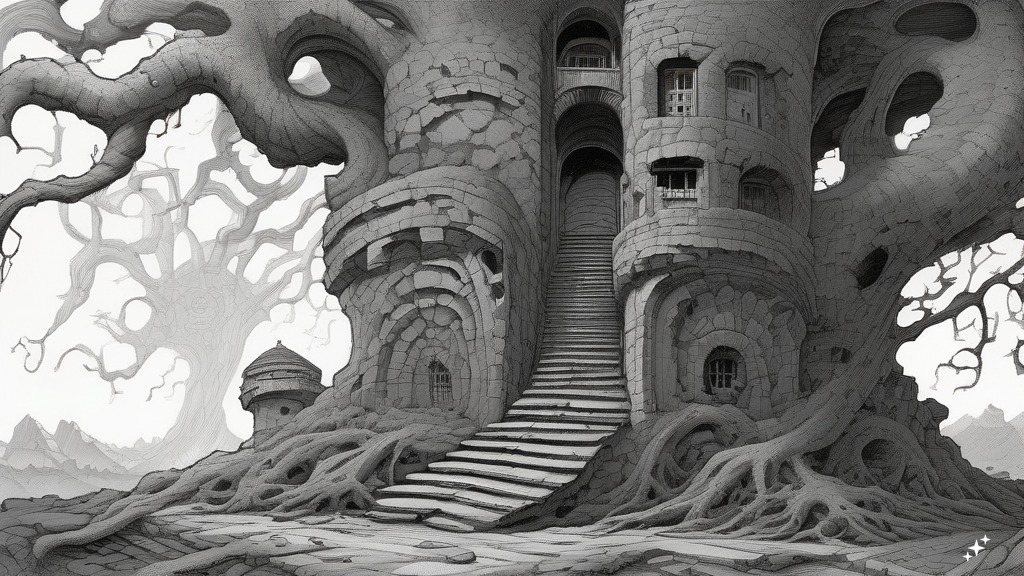
What Is the Junji Ito Manga Uzumaki?
Uzumaki is a horror manga by Junji Ito about a small coastal town called Kurōzu-cho that becomes infected by spirals. If you’re new to the term, manga is a style of comic book from Japan — read right to left in the original format, though collected English editions are designed to be easy to follow. Uzumaki is not about a monster, a ghost, or a killer. The spiral pattern itself becomes a force of horror — driving people to obsession, warping their bodies, and slowly consuming everything in town.
It’s a completed series, widely considered Junji Ito’s masterpiece, and it’s the single best place to start if you’ve never read his work before. The whole story is collected in one book, it doesn’t require any background knowledge, and it hits like a freight train. If you’ve seen horror films like Hereditary or read stories by H.P. Lovecraft and liked the feeling of slow, creeping dread where something is deeply wrong but no one can stop it, Uzumaki will feel familiar — and it may unsettle you even more.
Here’s a quick-reference overview:
| Detail | Info |
|---|---|
| Author / Artist | Junji Ito |
| Volumes | 3 (collected in one book) |
| Chapters | 20 |
| Demographic | Seinen (aimed at adult readers) |
| Original Serialization | January 1998 – August 1999 (published in installments in a Japanese manga magazine before being collected into book form) |
| Original Magazine | Big Comic Spirits (a Japanese manga magazine published by Shogakukan) |
| English Publisher | Viz Media (the company that publishes it in English) |
| Status | Completed |
| Narrator | Kirie Goshima |
Story and Setting — What Uzumaki Is About
The story takes place in Kurōzu-cho, a fictional town surrounded by hills and bordered by the sea. Our narrator is Kirie Goshima, a high school student who begins noticing something wrong with her town — starting with her boyfriend Shuichi Saito’s father.
Shuichi’s father becomes obsessed with spirals. Not in a quirky-hobby way. In a staring-at-snail-shells-for-hours, collecting-every-spiral-shaped-object-in-the-house way. He’s the first sign that something deeply wrong has taken hold of Kurōzu-cho.
From there, Uzumaki unfolds in a structure that mirrors the spiral itself. The early chapters work as standalone short horror stories — each one focused on a different person in town who encounters the spiral curse in a different way. A girl’s hair starts curling on its own. A boy’s body begins to twist. A potter becomes consumed by the shape in his clay.
But as the story progresses through its three volumes, those standalone episodes start connecting. The curse spreads from individuals to the town itself. Buildings warp. Weather patterns change. Escape becomes impossible. By the final volume, what started as creepy episodes has become a full-scale apocalypse — ending with a cosmic revelation buried deep underground.
Key themes running through the whole series:
- Obsession — how a fixation can consume and destroy a person
- Bodily autonomy — the horror of your own body changing against your will
- Cosmic horror — the idea that some forces are too vast and ancient to fight or understand
- The inescapable nature of patterns — spirals are everywhere in nature, and once you start seeing them, you can’t stop
Ito never explains the spiral curse with neat rules or backstory. It simply is. That ambiguity is a huge part of why the horror works so well.
Volume-by-Volume Breakdown
Uzumaki was originally published across three volumes. Both collected editions (described in the editions section below) combine all three into a single physical book — meaning “3-in-1” refers to three original volumes bound together. Here’s what each volume covers, kept spoiler-light so you can still experience the story fresh.
Volume 1 — Chapters 1–7
This is where the spiral obsession begins. The opening chapters focus on Shuichi Saito’s family — his father’s growing fixation on spirals, and then his mother’s desperate phobia of them (she begins destroying anything curved or coiled in her home). These two chapters establish the core horror: the spiral isn’t something you can simply avoid, because spirals are everywhere.
After that, Volume 1 moves into a series of standalone horror stories, each focused on a different Kurōzu-cho resident:
- The Scar — a girl’s forehead scar begins to spiral
- Medusa — a classmate’s hair takes on a terrifying life of its own
- Jack-in-the-Box — one of the most physically disturbing chapters in the whole series, featuring body horror where a character’s form is twisted and contorted in ways that feel deeply wrong
The tone here is episode-by-episode — each chapter is its own self-contained nightmare. You could almost read them out of order (though you shouldn’t — the slow build matters). The connective tissue is Kirie and Shuichi, who appear in every chapter and watch the town deteriorate around them.
If you read Chapter 1 and feel that creeping unease, you’re in for the whole ride.
Volume 2 — Chapters 8–13
Volume 2 is where the curse stops being about individuals and starts swallowing the town itself. The horror scales up significantly.
Key chapters include:
- The Snail — students at Kirie’s school begin transforming in one of Ito’s most iconic and disturbing sequences, their bodies slowly and grotesquely reshaping into something inhuman
- Mosquitoes — pregnant women in the town begin exhibiting horrifying behavior involving blood and predatory instincts (this chapter contains graphic imagery related to pregnancy and violence — readers sensitive to those subjects should be aware)
- The Storm — a perpetual hurricane settles over Kurōzu-cho, cutting the town off from the outside world
The tone shifts here from episode-by-episode to interconnected. Characters from earlier chapters reappear. Events reference each other. You start to feel the noose tightening — the sense that no one is getting out of this town. The spiral is no longer just affecting people. It’s reshaping reality.
Volume 2 is where a lot of readers go from “this is really good horror” to “I cannot put this down.”
Volume 3 — Chapters 14–20
Everything collapses. The town’s row houses begin to coil and twist into spiral shapes, forcing residents into increasingly cramped, nightmarish living conditions. Infrastructure breaks down. Society within Kurōzu-cho fractures into hostile factions.
The final act takes Kirie and Shuichi underground, where they discover an ancient spiral city beneath Kurōzu-cho — the source (or perhaps the destination) of everything that’s been happening.
The last chapter, titled “Lost,” resolves Kirie and Shuichi’s story in a way that’s haunting, quiet, and deeply unsettling. It’s not a twist ending. It’s something worse: an ending that feels inevitable.
Volume 3 abandons the standalone chapter format entirely. It’s a continuous apocalyptic narrative — pure dread from start to finish. The escalation from Volume 1’s quirky short horror stories to Volume 3’s cosmic collapse is one of the best-executed story progressions in horror manga.
Why Uzumaki Works — What Makes It Special
There are a lot of good horror manga out there. Uzumaki stands apart for a few specific reasons.
The spiral as a horror device is genius. Most horror stories give you a monster, a ghost, a killer — something you can point at and say “that’s the threat.” Uzumaki’s threat is a geometric shape. A pattern that exists everywhere in nature — in seashells, in whirlpools, in your own inner ear. Ito takes something you see every day and makes it terrifying. After reading Uzumaki, you will notice spirals in the real world, and you will feel a small, irrational twinge of unease. That’s how effective this manga is.
Ito’s art is doing things no other horror artist does. His linework is hyper-detailed — every strand of hair, every crack in a wall, every contortion of a body is rendered with obsessive precision. The body horror in Uzumaki — meaning scenes where characters’ bodies physically transform, stretch, and distort in disturbing ways — works because Ito draws the human form so realistically that when it starts to warp, your brain rejects what it’s seeing. He also uses page layout as a horror tool. Manga panels (the individual framed images that make up each page, like frames in a comic strip) tighten as tension builds. Spiral motifs creep into borders. Some full-page spreads are genuinely difficult to look at for long.
The slow escalation mirrors the spiral itself. Volume 1 is quirky and creepy. Volume 2 is unsettling and oppressive. Volume 3 is apocalyptic and cosmic. The structure tightens like a coil — each chapter pulls you deeper, and by the time you realize how dark things have gotten, you’re already at the center. This isn’t accidental. Ito designed the pacing to do exactly this.
There are no fight scenes, no supernatural villain, no heroes. Kirie and Shuichi don’t battle the spiral. They endure it. There’s no moment where someone figures out the weakness and saves the day. Uzumaki is horror in the truest sense — it’s about characters trapped in something they cannot overcome. That powerlessness is what makes it stick with you.
Which Edition Should You Buy?
All 20 chapters of Uzumaki are available in English from Viz Media. Here’s how the editions break down:
| Edition | Format | Pages | Year | Notes |
|---|---|---|---|---|
| 3-in-1 Deluxe Edition | Hardcover | 648 | 2013 | Complete story in one volume — typically under $35 |
| Original 3 Volumes | Individual paperbacks | ~200 each | 2001–2002 | Out of print, collectors only |
The 2013 hardcover (3-in-1 Deluxe Edition) contains the exact same 20 chapters and 648 pages. It’s lighter, more affordable, and perfectly readable. If you just want to experience the story without spending extra on binding, this is a great choice.
Uzumaki (3-in-1 Deluxe Edition)
The original 3 individual volumes from 2001–2002 are out of print and hard to find at reasonable prices. Unless you’re a collector, skip these — you’re not missing any content by going with either collected edition.
The 3-in-1 Deluxe Edition hardcover contains the complete story. One purchase, one complete manga.
Anime and Film Adaptations
Uzumaki has been adapted twice — once as a live-action film and once as an anime. Here’s what to know about both.
Live-Action Film (2000)
Directed by Higuchinsky, this 90-minute film came out while the manga was still being published in installments. It covers material from the early chapters — primarily the spiral obsessions and some of the standalone horror stories. It doesn’t attempt to adapt the full story.
The film has a dedicated fanbase and some genuinely creative visual moments, but it’s very much a product of its era. Worth watching after you’ve read the manga if you’re curious, but it’s not a substitute for the source material.
Anime: Uzumaki: Spiral into Horror (2024)
This was one of the most anticipated horror anime in years. Directed by Hiroshi Nagahama and aired on Adult Swim/Toonami (American television programming blocks), the anime ran for 4 episodes and attempted to adapt the complete manga.
Episode 1 was widely praised for its stunning black-and-white art style that faithfully captured Ito’s linework. It felt like the manga had come to life.
Episodes 2–4, however, had a notable quality drop — likely due to production difficulties. The animation became inconsistent, and the later episodes couldn’t maintain the visual standard that Episode 1 set. It was a disappointing outcome for a project that spent years in development.
The recommendation: read the manga first. Neither adaptation captures the full Uzumaki experience. The manga’s pacing, Ito’s detailed artwork, and the way the story uses the physical page are things that don’t fully translate to screen. If you watch the anime or film afterward as companion pieces, you’ll enjoy them more with the original story already in your head.
Where Uzumaki Fits in Junji Ito’s Manga Career
A little context on the creator behind the spirals.
Junji Ito published his first manga in 1987 with Tomie, a story about an immortal girl who drives people to murderous obsession. Before becoming a full-time manga artist, he worked as a dental technician — which honestly explains a lot about his comfort with drawing the human body in deeply uncomfortable detail.
Uzumaki, published from 1998 to 1999, is his most structurally ambitious work. While Tomie is a collection of loosely connected stories and his short story collections are anthologies (books containing separate, unconnected stories), Uzumaki is a single sustained narrative with a beginning, middle, and end. It builds toward something. That structural commitment is what elevates it above his other (also excellent) work.
What to Read After Uzumaki
If Uzumaki grabs you and you want more Junji Ito, here’s where to go next. All of the titles below are available as English-language print books.
- Gyo — Ito’s other long-form work. Fish with mechanical legs invade a coastal city. It’s body horror meets sci-fi, faster-paced than Uzumaki, and wonderfully disgusting. Two volumes.
- Tomie — His first series. An immortal girl who regenerates from any injury and drives those around her to obsession and violence. Each chapter is a standalone story — you can dip in and out.
- Remina — A planet-sized cosmic horror hurtles toward Earth. Shorter than Uzumaki (one volume) and more overtly apocalyptic. Great if you liked Volume 3 of Uzumaki most.
- Short story collections — Ito has published several in English, including Shiver, Smashed, Fragments of Horror, Deserter, and Alley. These are perfect for sampling his range. Each collection contains standalone stories, so you can read them in any order.
For a curated set of Ito’s short fiction, there’s a 3-book collection that bundles Lovesickness, Deserter, and Fragments of Horror together — a solid way to explore his range after finishing Uzumaki.
Note: this is a multi-book set put together by a third-party seller, not an official publisher box set.
Junji Ito Story Collection 3 books set: Lovesickness, Deserter, Fragments of Horror
FAQ
Is Uzumaki scary?
Yes. But it’s not the kind of scary that makes you jump. Uzumaki builds dread — a slow, creeping sense that something is deeply wrong and getting worse. The body horror is vivid and unsettling (Ito draws people twisting, stretching, and transforming in ways that feel viscerally wrong). Some pages are genuinely hard to look at. If you’re sensitive to body horror — meaning graphic depictions of human bodies being physically deformed, stretched, or transformed — be aware that Uzumaki leans heavily into it. The “Mosquitoes” chapter in Volume 2 also contains disturbing content involving pregnant women and blood.
The fear in Uzumaki is the kind that stays with you after you close the book. You’ll find yourself noticing spiral patterns in the real world and feeling just a little uneasy about them.
How long does it take to read?
The complete book is 648 pages. Most readers finish it in 3–5 hours. It reads fast because Ito’s visual storytelling does so much of the heavy lifting — you’re absorbing the horror through the art as much as through the text. A lot of people end up reading it in a single sitting because the escalation makes it very hard to stop.
Is the Junji Ito manga Uzumaki good for horror manga beginners?
It’s widely considered the best entry point for horror manga, period. The story is self-contained (one book, no sequels needed), the horror concepts are universal (you don’t need to know Japanese folklore), and the quality is consistently high from start to finish. If you’ve never read manga before at all, Uzumaki also works as a great first manga — the panel layouts are intuitive and easy to follow even if you’ve never picked up a comic book.
Do I need to read anything before Uzumaki?
No. Uzumaki is completely standalone. It’s not connected to any of Ito’s other works. You don’t need to know anything about Junji Ito, horror manga, or manga in general to pick this up and enjoy it. Just grab the book and start reading.
Should I watch the anime instead of reading the manga?
You may have heard about the 2024 anime adaptation. The manga is the definitive version of this story. The anime’s first episode was beautiful, but the remaining three episodes suffered from production issues. More importantly, Ito’s art style — the obsessive detail, the way horror unfolds across a page turn — is something that works best in print. The manga gives you full control over pacing, letting you linger on disturbing images or turn the page quickly. That experience is hard to replicate in animation. Start with the manga, and treat the anime as an optional companion piece afterward.
Which edition should I buy if I’m on a budget?
The 3-in-1 Deluxe Edition hardcover (2013) is the most affordable way to get the complete story, typically available for under $25. It contains all 20 chapters across 648 pages. The content is identical to the more expensive hardcover edition — you’re only missing the premium binding and updated cover art.
Uzumaki (3-in-1 Deluxe Edition)