What Is the Mystery of Amigara Fault About?
The Enigma of Amigara Fault is a standalone horror short story — meaning it tells a complete story in a single sitting, with no connection to any larger series. It was originally published in 2002 as a bonus story included at the end of Gyo volume 2 in Japan.
Here’s the spoiler-free setup:
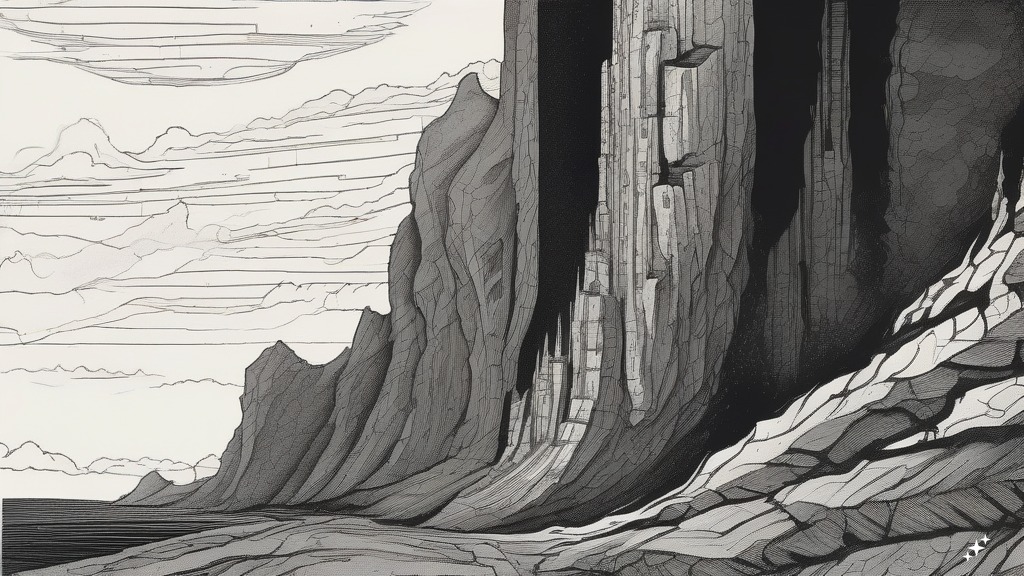
A massive earthquake strikes Japan, and when the dust settles, something impossible is revealed on the exposed fault line of Amigara Mountain — hundreds of human-shaped holes bored directly into the rock face. Not rough outlines. Perfect silhouettes, as if each one was carved to match a specific person.
News coverage draws crowds to the site. And that’s when things get disturbing. Visitors start finding holes that match them — their exact height, exact build, exact outline. And they feel an overwhelming, irrational compulsion to climb inside.
That’s the premise. It requires zero knowledge of manga, zero knowledge of Junji Ito, and zero setup. You can hand it to someone who has never read a comic in their life and it will unsettle them. That’s a big part of why it became the gateway horror manga story for an entire generation of English-speaking readers.
Plot Summary (Spoilers Ahead)
If you haven’t read the story yet, skip to the next section. It’s only about 32 pages long and the experience of reading it cold — not knowing what’s coming — is genuinely worth preserving. Come back to this after.
Already read it and came here for a deeper breakdown? Keep going — that’s exactly what this section is for.
The Setup
Two strangers, Owaki and Yoshida, meet at Amigara Mountain. Both were drawn there after seeing news reports about the mysterious holes. They’re curious, a little nervous, and clearly unsettled by what they see — row after row of human-shaped openings in the rock, each one unique.
The authorities have no explanation. Scientists are baffled. The holes appear ancient, far older than any recorded civilization, yet they are unmistakably shaped like modern human beings.
The Compulsion
People in the growing crowd begin to identify their own holes. One by one, they find a silhouette that matches their body exactly. And once they find it, they can’t stay away.
The compulsion is the story’s engine. Characters describe it differently — some say they feel the hole is calling to them, others say they just know it’s theirs. The rational part of their brain screams not to go in. They go in anyway. They strip off their clothes, press themselves against the rock, and slide into the darkness.
Nobody comes out.
Scientists and workers try to intervene. They can’t stop people from entering. The pull is too strong.
Yoshida’s Hole
Yoshida discovers her matching hole. She becomes increasingly agitated, drawn to it against her will. Owaki tries to hold her back, tries to reason with her, but the story makes it clear that reason has no power here. The compulsion is absolute.
The Other Side
Workers eventually investigate the opposite side of the mountain. They find tunnel openings — exit points that correspond to the entrance holes. But the shapes emerging from these exits are no longer human.
The final pages reveal the exit tunnels: the formerly human silhouettes have been stretched, compressed, and twisted into grotesque, elongated forms. The bodies that emerge are distorted beyond recognition — limbs impossibly long, torsos warped, faces pulled into agonized shapes.
The last panel shows these mangled forms slowly pressing out of the rock, accompanied by the now-iconic sound effect:
DRR… DRR… DRR…
There is no rescue. No explanation. No reversal. The story simply ends.
Why Junji Ito’s Mystery of Amigara Fault Became a Global Phenomenon
The Enigma of Amigara Fault is, without exaggeration, one of the most widely circulated manga stories on the English-speaking internet. Here’s how that happened — and why it stuck.
The Perfect Length for Sharing
At roughly 32 pages, the entire story can be read in a single sitting of maybe 10–15 minutes. In the mid-2000s, when the story started spreading across Western forums, that brevity was crucial. Someone could link the whole thing and say “read this” and the person on the other end would actually finish it.
Compare that to recommending a 30-volume series. The friction is almost zero.
Fan Translations and Forum Culture
Early fan translations spread across English-language forums in the mid-2000s, well before Junji Ito had significant name recognition in the West. These were fan-produced projects where people would scan the manga pages and translate the Japanese text into English — often called “scanlations” in manga communities. For a huge number of readers, Amigara Fault was their introduction to Junji Ito — and to horror manga as a concept.
These fan translations bounced across internet forums and social platforms, picking up momentum with each wave of new readers. The story became a kind of initiation rite: “Have you read the one with the holes in the mountain?”
Two Lines That Entered the Cultural Lexicon
“This is my hole! It was made for me!” became one of manga’s most quoted lines, period. It works as a meme precisely because it’s so eerie out of context — and even more eerie in context.
The sound effect “DRR… DRR… DRR…” similarly became a viral shorthand for creeping, inevitable dread. You’ll see it referenced in horror communities, in video game discussions, in completely unrelated threads where someone wants to invoke that specific flavor of slow, inescapable doom.
No Barrier to Entry
The story requires no knowledge of Japanese culture, no familiarity with manga conventions, no context from a larger series. It’s a self-contained horror scenario with a universal premise: what if something was specifically designed for you, and you couldn’t resist it, even though entering it would destroy you?
That universality is rare and powerful.
What Makes It So Effective — Themes and Horror Analysis
If you just finished the story and you’re sitting there thinking “why does this bother me so much?”, you’re not alone. The Enigma of Amigara Fault operates on several levels of horror simultaneously, which is part of why it lingers.
The Horror of Compulsion
The most disturbing element isn’t the grotesque imagery — it’s the compulsion. Characters know they shouldn’t enter the holes. They’ve seen others go in and not come out. They understand, intellectually, that this is dangerous.
They go in anyway.
Ito strips away every comforting narrative we tell ourselves about willpower and rationality. In this story, knowing something is dangerous doesn’t protect you. Understanding the threat doesn’t save you. The compulsion overrides everything. That’s a deeply uncomfortable idea because it attacks our sense of agency — the belief that we would be the ones smart enough, strong enough, to resist.
Claustrophobia and Body Horror
The physical horror works on a primal level. Body horror — a subgenre of horror focused on the violation, transformation, or destruction of the human body — is one of Ito’s greatest strengths, and this story is a masterclass in it.
Imagine pressing yourself into a narrow rock tunnel that fits your body exactly. No room to turn around. No room to raise your arms. Total darkness. And then the tunnel begins to change shape — slowly, over what might be hours or days or centuries — compressing and stretching your body into something unrecognizable.
The story never shows the transformation happening. It only shows the before (a person entering a hole) and the after (the distorted forms emerging from the other side). Your imagination fills in everything in between, which is almost certainly worse than anything Ito could have drawn.
Cosmic Indifference
The holes are ancient. They predate any civilization capable of carving them. No explanation is ever given for their existence. No villain is behind them. No curse caused them. They simply are.
This aligns with a tradition in horror fiction called cosmic horror — the idea that the universe contains things that are hostile or destructive to human beings, not out of malice, but out of sheer indifference. It’s a recognized genre with roots in the work of writers like H.P. Lovecraft, and Ito draws from it frequently. The mountain doesn’t care about the people entering it. The holes aren’t punishing anyone. They’re just… there. And they always have been.
No Resolution
Junji Ito gives you no escape hatch. There’s no character who figures out the mystery and saves the day. There’s no explanation that makes the horror manageable. There’s no “it was all a dream” or “they found a way to seal the holes.”
The story ends with the distorted bodies emerging. That’s it. You’re left with the image and the implication: this has always been happening, and it will presumably continue happening.
The Metaphorical Reading
Many readers have interpreted the holes as a metaphor for self-destructive compulsions — addiction, toxic relationships, self-harm, the pull toward things we know will damage us. The idea that something could be “made for you” and yet be the worst possible thing for you resonates on a psychological level that goes beyond simple scary-story mechanics.
Others read it as a story about fate or identity — the terrifying notion that your path is already carved out, and following it will transform you into something monstrous.
Ito himself tends not to over-explain his stories, which is part of what keeps them rich. The metaphor is there if you want it. The surface-level horror works even if you don’t.
Where to Read The Enigma of Amigara Fault
This is the question that brings most people here, so let’s be direct.
Gyo (2-in-1 Deluxe Edition) — The Best Way to Own It
The Enigma of Amigara Fault has never been published as a standalone volume. It was originally a bonus story appended to Gyo, and it’s still collected that way.
The best way to read it in English is through the Gyo (2-in-1 Deluxe Edition) published by VIZ Media:
Gyo (2-in-1 Deluxe Edition)
- Format: Hardcover, typically priced around $20–28
- Pages: 400
- Contents: Both volumes of Gyo, plus bonus stories including The Enigma of Amigara Fault
- Reading direction: Right-to-left — this means you open the book from what would be the “back” of a Western book, and read panels from right to left across each page. It feels natural after a few pages, and this is how the art was originally composed.
One important thing to understand: Gyo itself is a completely different story. It’s a full-length manga (spanning two volumes, roughly 370 pages of main story) about fish with mechanical legs invading a coastal town. It’s weird, it’s wild, it’s very much Junji Ito — but it has nothing to do with Amigara Fault thematically or narratively. The Enigma of Amigara Fault is included as a bonus appendix.
So when you buy the Gyo Deluxe Edition, you’re getting two things: the Gyo manga (which is a fun read in its own right — more on that below) and the Amigara Fault story you came for. That’s a lot of horror manga in a single hardcover.
Is It Available Digitally?
Yes — The Enigma of Amigara Fault is available digitally through several platforms, but only as part of the Gyo collection. There is no standalone digital purchase option for just the Amigara Fault story.
If you want to read it digitally, your main options are:
- Kindle / Amazon — purchase the digital Gyo volume
- VIZ Manga app — VIZ Media’s own reading platform, which carries their full catalog
- Apple Books and other major digital storefronts
The digital version is typically cheaper than the hardcover, often under $15. If you just want to read Amigara Fault tonight on your phone or tablet, this is the fastest route.
A Note on Fan Translations Online
Let’s be honest: many readers first encountered this story through unofficial fan translations floating around the internet. That’s how it went viral in the first place.
A couple of things worth knowing if you’ve only read a fan version:
- Some fan translations are flipped to read left-to-right, which reverses all the panel compositions. The official VIZ version reads right-to-left, as Ito originally drew it. The visual experience is noticeably better in the intended reading direction.
- Translation quality varies significantly between fan versions. The official translation is clean and well-done.
If the fan translation is what got you hooked, that’s great — it got a lot of us hooked. But if you want the best version of the story, the official release is worth picking up.
Has The Enigma of Amigara Fault Been Adapted into Anime?
No. As of 2025, The Enigma of Amigara Fault has never been adapted into anime.
It was not included in either of the two major Junji Ito anime adaptations:
- Junji Ito Collection (2018 anime series)
- Junji Ito Maniac: Japanese Tales of the Macabre (2023, Netflix)
The story’s cultural impact has been achieved entirely through the manga and its spread online. Given how much of the horror relies on still images — particularly that final reveal — it’s honestly hard to imagine an anime version improving on the original. The static, frozen quality of the distorted bodies emerging from the rock is part of what makes it so effective. Animation might actually undermine that.
If You Loved Amigara Fault — What to Read Next
If the Amigara Fault left you shaken in the best way and you want more, here’s where to go. These are organized roughly by how close they are to the Amigara Fault experience.
Uzumaki by Junji Ito
If Amigara Fault was your first taste of Junji Ito, Uzumaki is the main course. It’s widely considered Ito’s masterpiece — a full-length manga (three volumes, collected in one book) about a town slowly consumed by an obsession with spirals.
It shares Amigara Fault’s DNA: the same cosmic indifference, the same unstoppable compulsion, the same sense that ordinary people are being destroyed by something ancient and inexplicable. But Uzumaki unfolds over a much longer narrative, giving the dread time to build and escalate.
The Uzumaki (3-in-1 Deluxe Edition) collects the entire series in a single hardcover volume. It’s gorgeous, it’s hefty, and it’s the definitive way to read the story.
Uzumaki (3-in-1 Deluxe Edition)
Junji Ito Short Story Collections
If what you loved about Amigara Fault was the format — a tight, self-contained horror story you can finish in one sitting — Ito has produced several collections of similar short works. In manga, a single volume can contain multiple unrelated stories, so each of these books gives you several complete horror tales:
- Fragments of Horror — a collection of standalone horror shorts, each with a different premise
- Shiver — another short story collection, curated to showcase Ito’s range
- Dissolving Classroom — a short, deeply unsettling story about a boy whose apologies literally melt people
- Alley — a more recent Junji Ito story collection
- Stitches — another collection featuring some of Ito’s creepiest standalone work
- Moan — a Junji Ito story collection
Dissolving Classroom (Junji Ito)
Alley: Junji Ito Story Collection
Stitches (Junji Ito)
Moan: Junji Ito Story Collection
Any of these will scratch the same itch. They’re all published by VIZ Media in English.
Gyo
You’ll end up with this anyway since it’s in the same book as Amigara Fault — and it’s worth your time. Gyo is tonally very different from Amigara Fault — it’s more action-oriented, more grotesque, and frankly more bizarre. It’s about fish with mechanical spider-legs emerging from the ocean and invading Japan, and it escalates into something much stranger and more disturbing than that premise suggests.
Where Amigara Fault is quiet dread, Gyo is screaming chaos — but it still delivers Ito’s signature body horror and that same unsettling feeling that something fundamentally wrong is happening to the world. It makes the Gyo Deluxe Edition one of the better value purchases in horror manga: you get a full-length story plus the short that brought you here.
Tomie by Junji Ito
Tomie is Ito’s longest-running series — the story of an impossibly beautiful girl who can regenerate from any injury and who drives everyone around her to obsession, violence, and madness. It’s a different flavor of horror — more focused on the psychology of obsession and the disturbing dynamics between characters — but it shares Ito’s signature ability to find the deeply disturbing in seemingly simple premises.
Beyond Junji Ito
If you’ve caught the horror manga bug and want to branch out beyond Ito:
- Blood on the Tracks by Shuzo Oshimi — psychological horror (horror driven by mental and emotional disturbance rather than monsters) about a mother’s suffocating love. Slow, creeping dread that gets under your skin in a completely different way than Ito’s work.
- Goodnight Punpun by Inio Asano — not horror in the traditional sense, but deeply dark and psychologically devastating. If the metaphorical reading of Amigara Fault resonated with you (the idea of being drawn inexorably toward self-destruction), Punpun explores similar territory through realism rather than supernatural horror. Asano is known for blending beautiful, photorealistic backgrounds with emotionally brutal storytelling.
- Dorohedoro by Q Hayashida — if you want horror mixed with dark comedy and wild worldbuilding. It’s got body horror, it’s got violence, and it’s got a surprisingly warm heart buried under all the grime.
Blood on the Tracks 1
Goodnight Punpun, Vol. 1
Dorohedoro, Vol. 1
Final Thoughts
The Enigma of Amigara Fault is one of those rare stories that earns its widespread reputation completely. It’s not famous because of marketing or franchise power — it’s famous because someone read it, was disturbed by it, and immediately sent it to a friend. And then that friend sent it to someone else. And it kept going.
At 32 pages, it’s one of the most efficient horror stories ever created. Every panel serves the escalation. Every piece of dialogue tightens the noose. And that final image — those distorted, elongated forms pressing out of the mountain — is the kind of thing that takes up permanent residence in your brain.
If you’ve only read a fan translation, grab the official Gyo Deluxe Edition and experience it the way it was meant to be read. And if you’re new to Junji Ito entirely, congratulations — you’ve just found one of horror’s most consistently inventive creators. There’s a lot more where this came from.
Gyo (2-in-1 Deluxe Edition)
DRR… DRR… DRR…