What Makes Made in Abyss Manga Panels Stand Out
Most manga pick a lane. They’re cute or they’re horrifying. They focus on characters or on environments. Made in Abyss refuses to choose, and that refusal is the entire point.
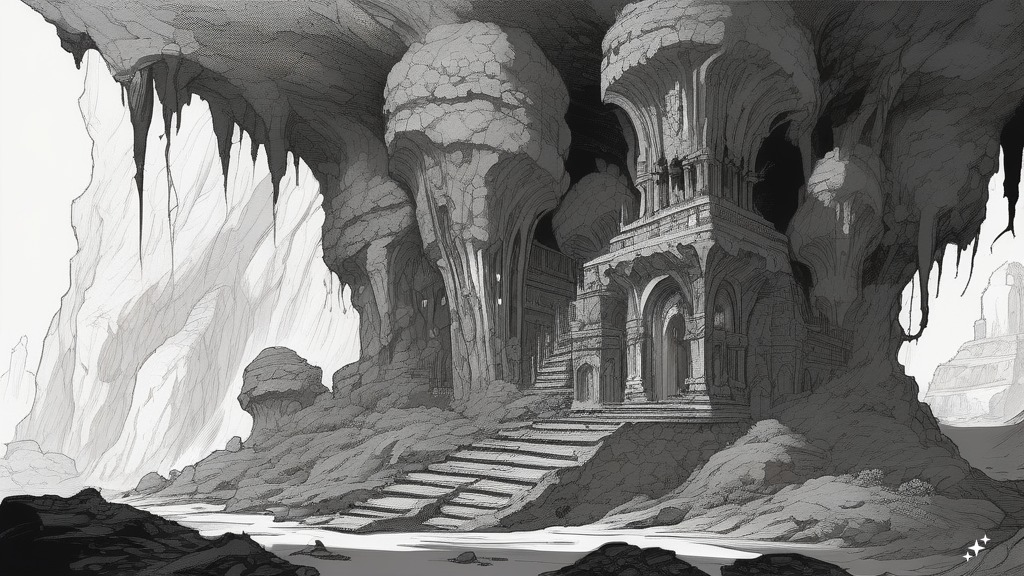
Tsukushi draws his child characters — Riko (the protagonist, a young girl obsessed with exploring the Abyss), Reg (her robot companion), and Nanachi (a rabbit-like survivor they meet deeper down) — with big eyes, soft lines, and rounded proportions. They look like they belong in a gentle all-ages adventure. The environments around them, though, are rendered with obsessive crosshatching (a drawing technique where overlapping lines create texture and shadow), intricate biological detail, and a sense of scale that makes every panel feel like a window into an actual place.
This contrast isn’t a quirk. It’s a deliberate artistic strategy. When horror arrives, it arrives to characters you’ve been trained to see as soft and vulnerable. The gap between how the characters look and what happens to them is where the emotional impact lives.
The anime adaptation (produced by the animation studio Kinema Citrus) is genuinely excellent — high production values, gorgeous backgrounds, a haunting soundtrack by composer Kevin Penkin that elevates everything. But the manga panels contain a density of environmental detail and a rawness in the horror sequences that animation can only partially replicate. The anime has to keep moving. The manga lets you sit with a single image for as long as you need — or as long as you can stand.
Made in Abyss Manga Panels: Landscape Spreads and the Abyss as a Character
The Abyss has 7 layers, and each one has a distinct visual identity that Tsukushi renders in painstaking detail. The double-page spreads that introduce each new layer are among the most celebrated panels in the series — and honestly, among the most impressive landscape illustrations in manga as an art form.
These aren’t just pretty backgrounds. Each layer’s visual design communicates something about the danger level, the atmosphere, and the psychological state of the characters entering it. Here’s how the visual language shifts as the descent continues:
1st Layer — Open sky, cliff edges, visible sunlight. The linework is relatively light and airy. It feels hospitable, almost inviting. This is the Abyss saying “come on in.”
2nd and 3rd Layers — The article focuses on the layers with the most dramatic visual shifts, but the 2nd Layer (Forest of Temptation) and 3rd Layer (Great Fault) are worth noting. The 2nd Layer introduces denser, more threatening flora and fauna, while the 3rd Layer is a massive vertical drop — basically an enormous pit within the pit. The visual tone darkens incrementally through these layers, setting up the dramatic shift that comes next.
4th Layer (Goblets of Giants) — Enormous chalice-shaped rock formations tower over the characters. The flora is lush, alien, and impossible — plants that couldn’t exist anywhere outside the Abyss. Some of the most beautiful spreads in the entire series live here. The beauty is real, but it’s also a mask — the 4th Layer’s curse is savage.
5th Layer (Sea of Corpses) — A crystallized graveyard. The tone shifts dramatically — suddenly the linework becomes stark and oppressive. The organic lushness of the 4th Layer gives way to something mineral and dead. You can feel the temperature drop just looking at the panels.
6th Layer (Capital of the Unreturned) — The environment becomes organic again, but wrong. Fleshy architecture. Surfaces that look like they’re breathing. The environment itself feels alive and hostile, as though the Abyss has stopped pretending to be a place and revealed itself as a living thing. These panels are deeply unsettling even when nothing violent is happening.
7th Layer — As of Volume 14, this layer has only been glimpsed. Tsukushi is saving it.
The progression tells a story all on its own: welcoming → darkening → beautiful → dead → alive-in-the-wrong-way. Each layer’s spread is worth pausing on, and that’s one reason the physical manga format works so well for this series.
How Tsukushi Uses Scale in Panel Composition
One of Tsukushi’s most effective techniques is scale manipulation. In the landscape panels — the individual drawn frames that make up each page — characters are drawn tiny, sometimes barely visible specks against enormous cavern walls, towering creatures, or impossible geological formations. This isn’t laziness (the characters are still carefully drawn even at small scale). It’s a constant visual reminder that the Abyss is vast and the characters are fragile.
Then, without warning, the composition flips. A full page that was showing an enormous environment cuts to a tight close-up of a character’s face — eyes wide, tears forming, expression crumbling. The shift from macro to micro is jarring every time, and it works every time.
Tsukushi also uses vertical panel layouts during descent sequences. Instead of the typical horizontal or grid arrangement, panels stack vertically on the page, pulling your eye downward. You physically read in the direction the characters are traveling. It’s a subtle technique, but it creates a sensation of depth that horizontal layouts can’t match.
The contrast between dense environment panels (packed with crosshatching, textures, and biological detail) and sparse emotion panels (just a face, minimal background, maximum expression) gives the manga a rhythm that keeps you turning pages even when part of you doesn’t want to see what’s next.
The Horror Panels — Where Cute Art Becomes a Weapon
This is what most people are looking for when they search for Made in Abyss manga panels, and honestly, it’s hard to blame them. These scenes are seared into the memory of anyone who’s read the manga.
Tsukushi’s cute character designs aren’t accidental, and they aren’t a mismatch with the horror content. They’re the setup for the horror. You care about these round-faced kids. You instinctively want to protect them. And then the manga shows you, in meticulous detail, that you can’t.
A quick note on the term “body horror” — it’s a genre where the horror comes from disturbing transformations or destruction of the human body. Made in Abyss leans into this heavily, and it’s a big part of why the panels discussed below hit so hard.
Below are the major horror sequences discussed by volume and chapter, so you can find them (or avoid them) as needed.
Riko’s Arm on the 4th Layer (Volume 3, Chapters 17–18)
⚠️ SPOILERS for Volume 3
This is the scene that redefines the series. Up to this point, Made in Abyss has been dangerous but survivable — close calls, scary creatures, tense moments. Then Riko is poisoned by an Orb Piercer (a predatory creature with quills that inject venom), and suddenly the danger becomes real and irreversible.
The panel of Reg desperately attempting to sever Riko’s arm is one of the manga’s most iconic horror images. It’s drawn with unflinching detail — the wound, the blood, the improvised tools. Nothing is obscured or implied. Tsukushi commits fully to showing what’s happening.
And then there’s the Curse of the 4th Layer. In Made in Abyss, ascending even slightly causes physical damage to your body — and the deeper you are, the worse the effects. At the 4th Layer, ascending triggers bleeding from every orifice, the body turning against itself. The panels showing Riko suffering the curse’s effects are some of the most viscerally uncomfortable pages in the series.
What makes this sequence hit so hard isn’t just the gore — it’s the realization. This is the moment readers understand that Made in Abyss will not protect its child characters. The cute art style didn’t come with a safety guarantee. From this point forward, every panel carries genuine dread.
Mitty’s Transformation (Volume 5, Chapter 30)
⚠️ SPOILERS for Volume 5
If Riko’s arm scene is the series’ first major shock, Mitty’s transformation is its cruelest.
Bondrewd — a White Whistle (the highest rank of Abyss explorer, marked by a special whistle crafted from human remains) and one of the manga’s most terrifying antagonists — conducts an experiment. He forces two children, Mitty and Nanachi, into an elevator that ascends from the 6th Layer, deliberately triggering the curse. The experiment transfers the curse’s full effect onto one child — Mitty — while sparing the other.
Tsukushi doesn’t let you experience this as a concept. He draws the full process of Mitty’s body warping and distorting, panel by panel, without cutaways. The reader is forced to witness exactly what Nanachi witnesses.
The panel sequence showing Mitty’s body losing its human shape is widely considered one of the most disturbing scenes in manga as a whole — not just in Made in Abyss. The transformation is slow, detailed, and biologically specific. You can see the progression. You can see the moment Mitty stops being human.
And then the emotional layer: Nanachi’s reaction panels are placed directly alongside Mitty’s distortion. The juxtaposition of Nanachi’s anguish and Mitty’s physical destruction creates an emotional one-two punch that’s devastating. The art tells you everything — Nanachi’s face says what words can’t.
This sequence is a masterclass in how panel layout and character art can work together to create horror that’s simultaneously physical and emotional.
Prushka’s Cartridge (Volume 5, Chapters 35–38)
⚠️ SPOILERS for Volume 5
Bondrewd’s cruelty reaches its peak with Prushka — his adopted daughter, a young girl who genuinely loves her father despite what he is. She is reduced to a “cartridge” — a device where a living human body is compressed and sealed into a small container, used to absorb the curse of ascending in place of the user. Prushka’s own father does this to her.
The reveal panel is deliberately understated. There’s no dramatic full-page image. The horror is in the quiet recognition of what you’re looking at — the moment your brain connects what a cartridge is with who Prushka was. Tsukushi trusts the reader to feel the full weight without being told how to feel.
And then comes one of the manga’s most complex images: Riko’s new White Whistle, crafted from Prushka’s remains. A White Whistle — the mark of the Abyss’s most elite explorers — can only be made from the calcified remains of someone who willingly gives themselves. The panel is beautiful. The whistle is elegantly designed, lovingly rendered. It’s also made from a dead child. That simultaneous beauty and horror — holding both in a single image — is something Tsukushi does better than almost anyone working in manga.
Irumyuui and the Village (Volumes 7–10)
⚠️ SPOILERS for Volumes 7–10
If the earlier horror sequences are sharp shocks, the Irumyuui story arc (a self-contained storyline spanning multiple volumes) is a slow, creeping nightmare.
This section follows the Ganja squad — a group of explorers from the surface who descended into the Abyss generations before Riko’s journey. Their story is told through flashback, and it’s bleak.
The Cradle of Desire — a relic from the Abyss that reshapes its user’s body to fulfill their deepest wish, at horrific biological cost — transforms a girl named Irumyuui over the course of many chapters. This is body horror as a slow build. The changes are incremental, and Tsukushi draws each stage with the same careful detail he gives everything else. You watch it happen gradually, which somehow makes it worse than if it happened all at once.
The biggest visual reveal in this storyline — arguably in the entire manga — is the revelation that Ilblu, the Village of the Hollows (Hollows being humans who were warped beyond recognition by the Abyss’s curse), is Irumyuui’s transformed body. The panel where this becomes clear recontextualizes every environment panel from the preceding chapters. Every wall, every structure, every organic surface the characters walked through — it was all her. Going back and re-reading the village panels with this knowledge is a genuinely disturbing experience.
The Ganja squad’s deterioration throughout this storyline also deserves mention. The panels depicting their suffering — starvation, disease, desperation — are some of the most detailed and carefully rendered suffering Tsukushi has drawn. The art doesn’t flinch, and it doesn’t let you flinch either.
Manga-Only Panels the Anime Can’t Fully Capture
The Made in Abyss anime is a faithful and high-quality adaptation. But there are specific things the manga panels do that animation, as a medium, simply can’t replicate — and this matters whether you’ve seen the anime or not.
Pacing control is yours. In the manga, you can stare at a horrific panel for thirty seconds or thirty minutes. You can flip back and forth. You can sit with it. The anime keeps moving — a disturbing image appears and then it’s gone, replaced by the next shot. The manga lets the horror linger at your own pace, which is both a gift and a curse.
Environmental texture. Tsukushi’s crosshatching and hand-drawn texture work is incredibly dense. Every surface in the Abyss has a specific feel — rough stone, slick organic tissue, crystallized remains. In animation, some of this nuance is inevitably simplified or smoothed out. The manga panels reward close inspection in a way that anime frames, even paused, often don’t.
Graphic detail in body horror. The anime occasionally obscures or softens certain scenes to comply with Japanese television broadcasting restrictions on graphic content. The manga contains the full, unedited versions. If you’ve seen the anime and felt like certain moments were almost too much — the manga versions are more. And if you haven’t seen the anime, this is the complete, unfiltered version of Tsukushi’s vision.
Double-page spreads have no anime equivalent. The physical act of turning a page and being confronted with a massive landscape spread — or a massive horror image — creates a specific emotional response. It’s the manga equivalent of a jump scare, except instead of startling you, it overwhelms you. You can’t scroll past it. It’s just there, filling your entire field of vision. When two facing pages form a single continuous illustration, the effect in print is something no screen can fully reproduce.
Post-Season 2 content. As of 2025, Volumes 13 and 14 contain story material that has not been adapted into anime. If you’ve watched everything available and want to continue the story, the manga is your only option. And if you’re coming to the manga fresh, these volumes represent the furthest point of the story so far. Either way, these volumes push deeper into the Abyss — both literally and in terms of what Tsukushi is willing to put on the page.
Made in Abyss Vol.1
Made in Abyss Season 1 Box Set
Made in Abyss Vol. 14
Where to Read These Made in Abyss Manga Panels — Buying the Manga
If the panels discussed above have you curious (or morbidly fascinated), here’s what you need to know about getting the manga.
The English edition is published by Seven Seas Entertainment, with 14 volumes currently available. Individual volumes typically retail for around $11–$14 USD each, so collecting all 14 volumes runs roughly $130–$170 depending on where you buy. The series is ongoing, though Tsukushi works on an irregular schedule — new chapters come out approximately every 2–3 months, so don’t expect the rapid release pace of weekly manga.
Physical vs. digital: For Made in Abyss specifically, physical volumes are worth considering. The double-page landscape spreads — which are a huge part of the manga’s appeal — display properly in print without the binding-margin issues that can split the image in half on digital readers. The art detail is also easier to appreciate at the standard paperback manga size (about 5 × 7.5 inches) than on a phone screen. That said, digital works fine if shelf space is an issue — just make sure your reading app handles two-page spreads well.
Where to start — whether you’ve seen the anime or not:
- New to Made in Abyss entirely: Start with Volume 1. The manga’s pacing in the early chapters is slightly different from the anime, and the art is worth experiencing from the beginning. This is the best way to see how Tsukushi builds the visual trap described throughout this article.
- Watched Season 1 only: You could start at Volume 4 to pick up where the anime left off, but Volume 5 is where the Bondrewd storyline really hits — consider starting there if you want to experience those panels firsthand.
- Watched everything (Season 1 + the Dawn of the Deep Soul film + Season 2): Start at Volume 11 (through Vol. 14 available) for completely new content.
Whether you’re here for the breathtaking landscapes, the devastating horror sequences, or both — the Made in Abyss manga delivers panels that stick with you long after you close the book. The first big landscape spread is waiting. Let the descent begin.