Who Is the Made in Abyss Mangaka?
A mangaka is a manga creator — the person who writes and draws a manga series. The Made in Abyss mangaka is Akihito Tsukushi (つくしあきひと), and he’s the sole creator, handling both writing and art by himself.
Made in Abyss has been serialized — meaning published chapter by chapter over time — on Web Comic Gamma since 2012. Web Comic Gamma is an online manga publishing site run by Japanese publisher Takeshobo, where readers can follow ongoing series as new chapters are released. The manga is classified as seinen, a label that means it’s targeted at adult readers rather than teens. That classification might surprise anyone who’s only glanced at the character designs. More on that contrast below.
As of mid-2024, there are 12 volumes (collected books of chapters) published in Japan. The English edition is published by Seven Seas Entertainment, a company that licenses, translates, and releases Japanese manga in English. Eleven volumes are currently available, with Volume 12 scheduled for 2025.
Here’s what makes Tsukushi’s accomplishment striking: Made in Abyss is his only commercially published manga series. He has no prior series. His debut work became one of the most acclaimed adventure manga of the 2010s, earned a score of 8.74 on MyAnimeList (a major anime and manga community database where users rate series on a 10-point scale), was ranked in “Kono Manga ga Sugoi!” (an annual Japanese industry guide that spotlights the best manga of the year — think of it as a “best of” list that carries real weight in the manga world), and spawned a multi-season anime franchise. For a first and only series, that’s an extraordinary track record.
Note for readers coming from a horror perspective: Made in Abyss is typically shelved under adventure and fantasy, but it contains significant horror elements — body horror, cosmic dread, and deeply disturbing story beats. We’ll cover exactly why it belongs on a horror manga guide later in this article.
Akihito Tsukushi’s Background and Career
Tsukushi is a notably private creator. There’s limited public biographical information available compared to many mangaka of his stature, and he rarely gives interviews or makes public appearances.
What we do know:
- Self-published roots — Before Made in Abyss, Tsukushi was active as a doujin creator. Doujin means self-published — these are independent works that creators produce and sell outside the commercial manga industry. He participated in Comiket (short for Comic Market), a massive convention held twice a year in Tokyo where thousands of independent manga creators sell their self-published works. Comiket is the largest event of its kind in the world, and it’s a common proving ground for creators who later move into commercial serialization.
- No other commercial series — Made in Abyss, which began in 2012, remains his only commercially published manga. Everything he’s known for traces back to this single work.
- Meticulous work ethic — His painstaking approach to illustration (particularly the staggeringly detailed environments and creatures of the Abyss) is well-documented through his irregular publication schedule, which we’ll cover in detail below.
The path from self-publishing at Comiket to landing a commercial series is well-established in the manga industry, but Tsukushi’s case stands out because his very first commercial work achieved such extraordinary recognition.
What Makes Tsukushi’s Art Style Unique
If you’ve seen even a single page of Made in Abyss, the art probably left an impression. Tsukushi’s visual style is one of the most distinctive in modern manga, and it’s built on a deliberate contradiction.
The Signature Contrast
The characters — particularly protagonist Riko (a young girl who descends into the Abyss) and her companions — are drawn in a round, soft, almost childlike style. Big eyes, simple expressions, small bodies. At first glance, you might mistake this for a children’s adventure manga.
Then you look at the backgrounds.
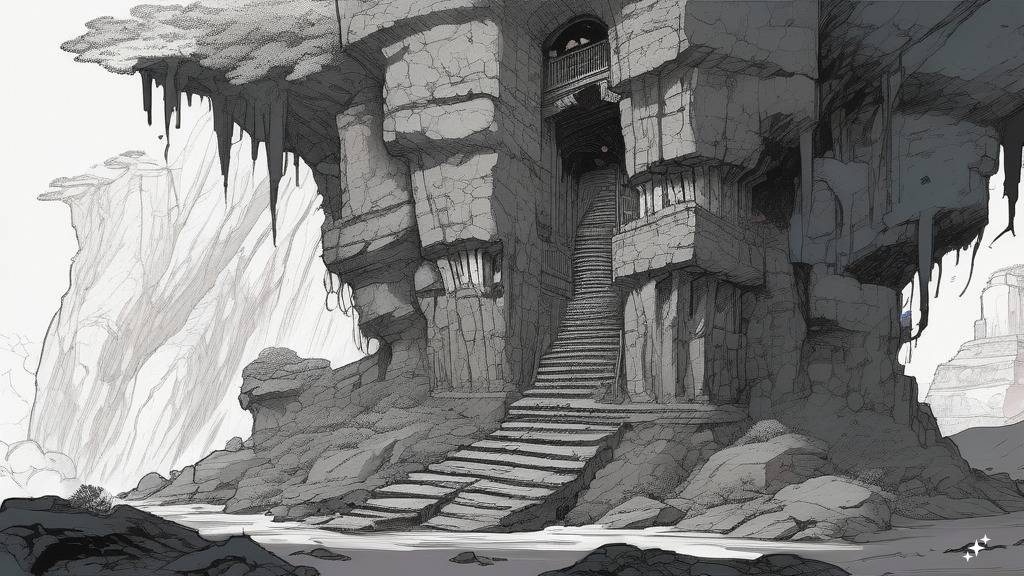
The Abyss itself is rendered with obsessive, hyper-detailed environmental art. The rock formations, the bizarre flora, the alien ecosystems of each layer — every panel set in the Abyss feels like it was drawn by someone who genuinely believes this place exists and wants to document it faithfully. The creatures that inhabit the Abyss are drawn with a completely different hand than the characters: grotesque, anatomically intricate, unsettling in how real they feel.
This contrast is entirely deliberate. The cute character designs create a sense of safety and innocence. When the story turns brutal — and it does, repeatedly — the gap between how the characters look and what’s happening to them makes the impact exponentially worse. You’re watching something terrible happen to characters who look like they belong in a gentle children’s story, and your brain doesn’t know how to reconcile those two things.
Cinematic Scale
Tsukushi’s double-page spreads — single wide illustrations that span two facing pages when you open the book — are genuinely breathtaking when depicting the Abyss environments. They have a panoramic quality that’s rare in manga. These aren’t just background art — they’re worldbuilding, meaning they communicate the rules, geography, and atmosphere of the story’s setting through visual detail alone. Each layer of the Abyss has its own distinct visual ecosystem, and Tsukushi communicates the scale, danger, and alien beauty of these environments through art alone, often with minimal or no dialogue.
The level of detail in these spreads goes a long way toward explaining his irregular release schedule. These pages simply cannot be produced quickly.
Why It Works for Horror
This art style is a major reason Made in Abyss works so well as horror. Body horror — a subgenre focused on the violation, transformation, or destruction of the human body — is central to the series. Moments like Mitty’s forced transformation into something no longer human, the physical effects of the Curse of the Abyss, and the experiments conducted by the antagonist Bondrewd all land with devastating force precisely because the art style has trained you to expect softness and warmth. The sharp shift in tone isn’t a flaw. It’s the engine that drives the entire emotional experience.
Tsukushi’s Irregular Release Schedule
If there’s one thing Made in Abyss fans discuss almost as much as the story itself, it’s the wait between chapters.
How the Schedule Works (or Doesn’t)
Made in Abyss publishes on Web Comic Gamma, but it does not follow a weekly or monthly schedule. New chapters appear irregularly, and gaps of several months between releases are common. Some waits have stretched past six months.
To put this in perspective:
| Detail | Made in Abyss | Typical Weekly Manga |
|---|---|---|
| Schedule | Irregular (months between chapters) | Weekly (roughly 48 chapters/year) |
| Volumes in 12+ years | 12 | 25–30+ |
| Pages per chapter | Often 40–60+ pages | ~18–20 pages |
There’s an important tradeoff here. Tsukushi’s chapters tend to be significantly longer than standard manga chapters, often running 40 to 60+ pages. And the art quality on each page is extraordinarily high. He’s essentially producing mini-volumes with each release rather than standard chapter installments.
Why the Gaps Happen
Tsukushi appears to be a perfectionist when it comes to page quality. Given the level of environmental detail in his art — those massive double-page Abyss spreads, the intricate creature designs, the careful composition — rapid serialization simply isn’t compatible with his artistic standards.
There’s no public indication of the specific reasons behind each pause in publication. Health, perfectionism, creative process — fans speculate, but Tsukushi doesn’t typically explain the gaps.
What This Means for Readers
For new readers, this is actually good news in one sense: you can pick up all 11 currently available English volumes and read them back-to-back without waiting. You’ll only hit the waiting game once you’re caught up.
For long-term fans, the irregular schedule is a known quantity at this point. Volume 12 released in Japan in July 2024 after a considerable wait, and the English edition is expected in 2025. The volumes are available through Amazon, most bookstores, and manga retailers.
Going in with the right expectations helps. This isn’t a series you follow week to week. It’s one you check in on periodically and get rewarded with substantial, beautifully crafted chapters when they arrive.
Made in Abyss — From Manga to Anime
The anime adaptations are a huge part of why Made in Abyss reached international audiences. The anime significantly boosted the manga’s international readership and reputation, bringing Tsukushi’s work to viewers who might never have encountered it otherwise. Here’s the full breakdown of what’s been produced and what each adaptation covers.
Anime Season 1 (2017)
- Studio: Kinema Citrus (the animation studio that produced the series)
- Episodes: 13
- Aired: July–September 2017
- Manga coverage: Roughly Volumes 1–3 (Chapters 1–26)
- What it covers: Riko and Reg’s descent into the Abyss, through the encounter with Nanachi and the devastating events of the Fourth Layer (the Abyss is divided into numbered layers, each deeper and more dangerous than the last)
Season 1 is what put Made in Abyss on the map for most Western fans. Kinema Citrus did an outstanding job translating Tsukushi’s environmental art into animation — the Abyss looks gorgeous and terrifying in motion.
Recap Movies (2019)
- Journey’s Dawn (January 2019) and Wandering Twilight (January 2019)
- These are recap compilations — they re-edit the existing Season 1 episodes into movie-length format rather than presenting new story content
- Useful if you want to revisit Season 1 in a condensed format, but not required viewing
Movie 3 — Dawn of the Deep Soul (2020)
- Released: January 2020
- Manga coverage: The Bondrewd story arc (a self-contained storyline segment within the larger series), roughly Volume 5 (Chapters 27–38)
- Why it matters: This is not a recap. It’s a full continuation of the story after Season 1
Dawn of the Deep Soul covers one of the most intense arcs in the entire series. Bondrewd’s arc contains some of the most disturbing content in Made in Abyss — which is saying a lot — and the movie does not shy away from it. If you’re watching the anime in order, this movie is essential. Don’t skip it thinking it’s another recap.
Anime Season 2 — The Golden City of the Scorching Sun (2022)
- Episodes: 12
- Aired: July–September 2022
- Manga coverage: The Village of the Hollows arc, roughly Volumes 6–9+ (Chapters 39–60ish)
- What it covers: Riko’s party reaches the Sixth Layer and encounters the bizarre civilization of Ilblu (a village with deeply disturbing secrets)
Season 2 adapted one of the manga’s most complex and unsettling arcs. The Village of the Hollows is strange, disturbing, and emotionally devastating in ways that are different from the Bondrewd arc but equally powerful.
Season 3 (Announced)
As of 2024, a third season has been confirmed. Specific details about studio, episode count, and air date are still pending. Given the manga’s slow publication pace, Season 3 may cover content from Volumes 10–12.
Anime Watch Order (Quick Reference)
| Order | Title | Type | Year |
|---|---|---|---|
| 1 | Made in Abyss Season 1 | TV (13 eps) | 2017 |
| 2 | Dawn of the Deep Soul | Movie (part of the main story) | 2020 |
| 3 | The Golden City of the Scorching Sun (Season 2) | TV (12 eps) | 2022 |
| 4 | Season 3 | TV (announced) | TBA |
Skip the two recap movies unless you specifically want a condensed Season 1 refresher.
Where to Start Reading After the Anime
If you watched the anime and want to continue in the manga, here’s what you need to know.
After Season 2
Season 2 covers through approximately Chapter 60 of the manga. To continue the story, pick up from Volume 10.
That said — consider starting from Volume 1 even if you’ve watched the entire anime. Here’s why:
- Tsukushi’s manga art is extraordinary in ways that animation can’t fully replicate. The double-page environmental spreads are a completely different experience on the printed page.
- The manga contains worldbuilding details, character moments, and narrative nuance that the anime necessarily compresses.
- The pacing in manga form lets you sit with individual panels in a way that animated scenes don’t allow. For a series this visually rich, that matters.
If time is limited and you just want to continue the story, Volume 10 is your entry point. But if you’ve got the time, Volume 1 is the better starting place.
English Availability
All English volumes are published by Seven Seas Entertainment, which translates and releases the series for English-speaking markets:
- Volumes 1–11 are currently available in English
- Volume 12 is scheduled for release in 2025
The volumes are standard manga-sized paperbacks, available through Amazon and most bookstores. There’s no deluxe or collected edition (multiple volumes in a single book) available as of this writing.
Is Made in Abyss Horror?
This is a horror manga guide, so let’s address this directly: yes, Made in Abyss absolutely qualifies as horror.
It’s typically categorized as adventure, fantasy, or sci-fi. Those labels are accurate. But the horror elements aren’t decorative or occasional — they’re structural to the entire work.
Where the Horror Lives
Body horror — horror focused on the violation, mutation, or destruction of the human body — is central to Made in Abyss. The Curse of the Abyss, which inflicts escalating physical punishment on anyone who tries to ascend back toward the surface, is one of the most effective body horror mechanisms in manga. It’s not just a plot device. It’s a constant, inescapable presence that colors every scene with dread. The characters are always descending, and every step down means the return trip gets worse.
Specific moments that are unambiguously horror:
- Mitty’s transformation — One of the most viscerally disturbing sequences in modern manga. A character is subjected to the Curse in a way that destroys their humanity, and the process is shown in detail. The emotional context makes it devastating.
- Bondrewd’s experiments — The Idofront arc reveals systematic, calculated cruelty toward children that’s presented with chilling matter-of-factness. Bondrewd is one of the most unsettling antagonists in manga precisely because he is calm and methodical.
- The Curse effects throughout the series — Bleeding from every orifice, loss of humanity, irreversible physical mutation. The manga does not look away.
- The Village of the Hollows — The entire Ilblu arc is steeped in existential horror, with a civilization built on grotesque sacrifice and transformation.
Why It Belongs on a Horror Manga Guide
Made in Abyss isn’t marketed as horror because its scope is broader — it’s also a story about wonder, exploration, friendship, and the human drive to discover the unknown. But the horror isn’t a side note. It’s baked into the premise.
The Abyss is a place that punishes you for trying to leave. The deeper you go, the more the world itself tries to destroy you. That’s not adventure seasoning. That’s a horror framework built on the idea that humans are small and fragile against forces they cannot comprehend or control.
If you enjoy horror manga and haven’t read Made in Abyss because it looks like a cute adventure story, that contrast between appearance and reality is exactly the point — and exactly why it hits so hard.
Honestly, just grab Volume 1 and see for yourself. The first few chapters seem gentle. They’re setting a trap. And it’s one of the best traps in manga.
Made in Abyss Vol.1
Made in Abyss Season 1 Box Set
Made in Abyss Vol. 14