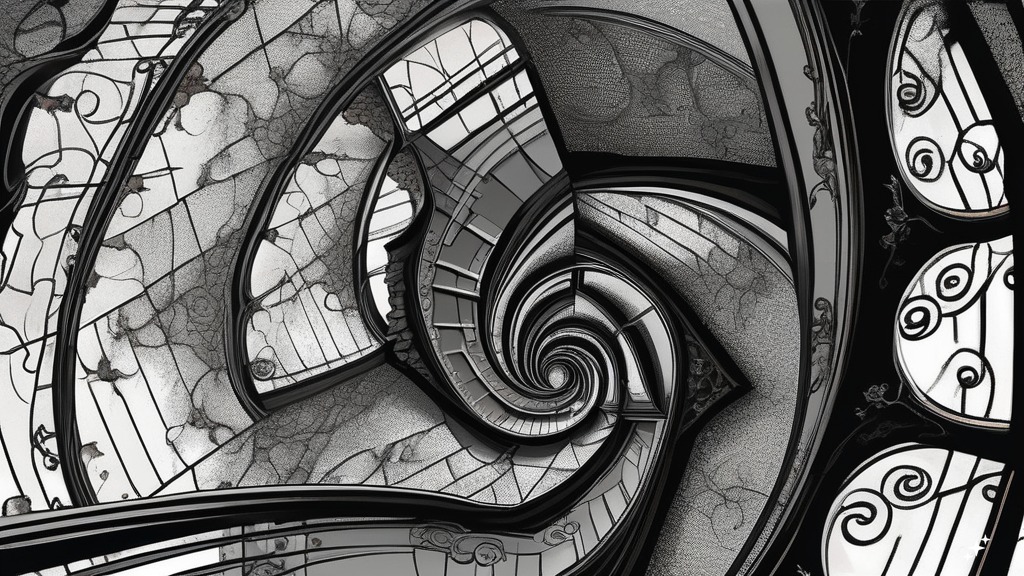
Uzumaki — Junji Ito
The setup: The small town of Kurouzu-cho becomes infected by spirals. Not a metaphorical obsession — a literal one. People begin seeing spirals everywhere. They become fixated on them. They contort their bodies into them. And the madness spreads like a contagion, consuming the entire town one person at a time.
Why it’s here: Uzumaki takes a single, absurd concept — spirals are terrifying — and commits to it with such relentless escalation that by the final chapters, you’ll never look at a snail shell the same way. Junji Ito’s genius is making the irrational feel inevitable. Each chapter introduces a new manifestation of the spiral obsession, and each one is more disturbing than the last. The horror isn’t really about spirals, though. It’s about how an entire community loses its grip on reality, and how quickly the familiar can become grotesque.
What to expect: The series is only 3 volumes (20 chapters — chapters are individual installments collected into volumes), making it one of the most efficient horror experiences in manga. It’s self-contained, visually iconic, and doesn’t waste a single page. The artwork is stunningly detailed — Ito’s intricate pen work in the spiral transformations is some of the most reproduced imagery in all of manga for good reason.
Format: Available as a single hardcover deluxe edition collecting all three volumes. It’s a beautiful object on a shelf and the easiest way to read the complete story in one go.
Uzumaki (3-in-1 Deluxe Edition)
Who should start here: If you’ve never read horror manga before, Uzumaki is one of the strongest starting points available. It’s short enough to finish in a weekend, weird enough to be unlike anything you’ve read before, and horrifying enough to tell you immediately whether psychological horror manga is for you.
Monster — Naoki Urasawa
The setup: Dr. Kenzo Tenma, a brilliant Japanese neurosurgeon working in Germany, makes a career-defining choice: he saves a young boy’s life instead of a politically important patient. Years later, that boy — Johan Liebert — has grown into one of the most dangerous psychopaths in Europe. Tenma, now a suspect in Johan’s murders, abandons his career to hunt down the monster he saved.
Why it’s here: Monster is psychological horror through the lens of a detective thriller, and it’s one of the greatest manga ever created in any genre. The horror here isn’t jump scares or grotesque imagery — it’s the slow, creeping realization of what Johan is and what he represents. Naoki Urasawa builds dread through moral ambiguity and the banality of evil. Johan doesn’t need to be physically threatening. He manipulates, corrupts, and destroys people through words and charisma alone. Every character who crosses his path is changed, and not for the better.
What to expect: This is an 18-volume commitment (available in 9 Perfect Edition volumes — these are oversized hardcovers that each collect two original volumes into one book with the same complete story, just in a larger, premium format). Urasawa is a master of pacing — the story moves across multiple European countries, introduces dozens of characters with their own storylines, and weaves them all into a tapestry of conspiracy, trauma, and philosophical horror. It’s a slow burn. There are stretches where the tension is almost unbearable precisely because nothing overtly violent is happening. You just know something terrible is coming.
Who should start here: If you love thriller novels, crime dramas, or tense detective stories where every conversation carries weight, Monster is going to hit perfectly. It’s also one of the most accessible psychological horror manga for readers who don’t typically read manga — the storytelling is so grounded and cinematic that it transcends medium expectations.
Goodnight Punpun — Inio Asano
The setup: Punpun Onodera is drawn as a simple, cartoonish bird — a visual metaphor in a world of photorealistic backgrounds and normally-drawn humans. We follow him from elementary school through adulthood as his family disintegrates, his relationships curdle, and his mental state deteriorates. There are no supernatural elements. No villains. Just life, rendered with brutal honesty.
Why it’s here: Goodnight Punpun is the most psychologically devastating manga on this list, and it achieves that without a single monster, ghost, or curse. The horror is entirely human — depression, family abuse, toxic relationships, and the way childhood trauma echoes through every decision a person makes for the rest of their life. Inio Asano’s artwork is jaw-dropping. The contrast between Punpun’s simple bird design and the hyperrealistic world around him creates a constant visual dissonance that mirrors his psychological disconnect from reality.
Goodnight Punpun, Vol. 1
What to expect: 7 omnibus volumes covering the complete story. This is not a light read. Punpun’s journey goes to genuinely dark places, and Asano doesn’t offer easy redemption or comforting resolutions. Chapters can shift from darkly funny to deeply unsettling within pages.
A note on content: This series deals heavily with depression, suicide, domestic abuse, and sexual content. It’s powerful and worth reading, but go in with your eyes open.
Who should start here: If you want psychological horror that feels uncomfortably real — horror that comes from recognizing parts of yourself or people you know in these characters — Goodnight Punpun is unmatched.
Blood on the Tracks — Shuzo Oshimi
The setup: Seiichi lives with his mother Seiko, who loves him. She really, really loves him. She loves him so much that she smothers every aspect of his existence. She loves him so much that when a threat to their relationship appears, she does something unthinkable — and then acts as though nothing happened. And Seiichi, trapped in the distortion field of her love, begins to question what he actually saw.
Why it’s here: Blood on the Tracks is toxic maternal love rendered as psychological horror, and it’s one of the most deeply uncomfortable reading experiences in manga. Shuzo Oshimi — who appears three times on this list for very good reason — uses silence, empty space, and subtle facial expressions to create dread that big, dramatic horror manga can’t match. The horror is in the quiet moments. A mother’s smile that lasts half a second too long. A memory that doesn’t quite match what we saw happen. The gradual realization that Seiichi’s understanding of reality has been shaped and distorted by someone who claims to love him more than anything.
Blood on the Tracks 1
What to expect: 17 volumes, completed in 2023. The pacing is deliberately slow — this is a manga that trusts its readers to sit in discomfort. Panels often stretch across pages with minimal dialogue, forcing you to study characters’ faces and body language for meaning. It rewards patience enormously.
Who should start here: If psychological manipulation — where someone in a position of trust systematically distorts another person’s perception of reality — sounds more frightening to you than supernatural threats, Blood on the Tracks is one of the best things you’ll ever read. It’s also Oshimi’s most mature and controlled work, representing the peak of his craft.
The Flowers of Evil — Shuzo Oshimi
The setup: Middle schooler Takao Kasuga steals the gym clothes of the girl he has a crush on. His classmate Nakamura witnesses the theft and begins blackmailing him — not for money or favors, but to force him to confront the person he really is beneath his carefully maintained exterior. What starts as adolescent embarrassment spirals into moral degradation, social destruction, and genuine psychological collapse.
Why it’s here: The Flowers of Evil uses a simple act of shame as the entry point for a devastating exploration of social conformity as psychological prison. Nakamura isn’t just a bully — she’s a catalyst who strips away every comfortable lie Kasuga tells himself. The horror is watching a person’s self-image shatter and realizing they can’t put it back together. Oshimi draws adolescent anxiety and self-loathing with an intensity that borders on physically painful. If you’ve ever felt trapped by the expectations of the people around you — and who hasn’t — this manga will get under your skin.
What to expect: 11 volumes (57 chapters), completed and available in English. The series is divided into two distinct halves — the middle school storyline and a time-skip to young adulthood — and both are essential. The art evolves significantly as the series progresses, becoming more expressive and psychologically charged.
Who should start here: If you want a gateway into both Shuzo Oshimi’s work and the psychological horror genre more broadly, The Flowers of Evil is a fantastic starting point. It’s shorter than Blood on the Tracks, more grounded than Homunculus, and hits with surprising emotional force.
Homunculus — Hideo Yamamoto
The setup: Nakoshi, a homeless man living in his car between a luxury hotel and a shantytown, agrees to undergo trepanation — a surgical procedure where a hole is drilled in the skull, historically believed to expand consciousness. It’s a real (and controversial) practice, and in this story it’s performed as a paid medical experiment. Afterward, Nakoshi discovers he can see other people’s psychological trauma manifested as grotesque physical distortions. A businessman’s face melts into a mask of anxiety. A woman’s body twists into a shape that reveals her self-hatred. But the more Nakoshi uses this ability, the less certain he becomes about what’s real — including his own identity.
Why it’s here: Homunculus takes the concept of “seeing people’s true selves” and pushes it to its most disturbing extreme. The horror isn’t in the distorted visions themselves — it’s in the dissolution of the boundary between perception and reality. As Nakoshi tries to help others by confronting their hidden traumas, his own sense of self crumbles. Who was he before the trepanation? Does it matter? Can you trust anything you see when your brain has been literally opened up? Hideo Yamamoto’s artwork renders the psychological distortions with visceral, surreal detail that makes each encounter feel like a waking nightmare.
What to expect: 15 volumes in the original Japanese, available as 5 English omnibus editions from Seven Seas Entertainment. The series starts as a fascinating psychological thriller and gradually becomes something much stranger and more unsettling. It demands active reading — you’ll need to track what’s real, what’s perception, and what’s outright delusion.
Homunculus (Omnibus) Vol. 1-2
Who should start here: If you’re drawn to mind-bending narratives — stories where you can never fully trust what the main character sees or remembers — Homunculus delivers like few other manga. It’s also one of the more unique entries on this list, occupying a space that no other series quite fills.
Parasyte — Hitoshi Iwaaki
The setup: Alien parasites descend on Earth, burrowing into human brains and taking over their bodies. Teenager Shinichi Izumi gets partially infected — the parasite, named Migi, takes over his right hand instead of his brain. Now Shinichi and Migi must coexist in the same body while other, fully-converted parasites hunt them both. The parasites look human. They walk among us. And they’re hungry.
Why it’s here: Parasyte is identity horror at its most fundamental — what makes you human when part of you literally isn’t? As Shinichi and Migi develop a reluctant partnership, Shinichi begins to change. He becomes colder, more calculating, more efficient at violence. Is that the parasite’s influence, or was that always inside him? The series asks uncomfortable questions about the boundary between self and other, human and animal, empathy and survival instinct. It’s also a genuinely thrilling action manga, but the psychological weight is what elevates it beyond its premise.
What to expect: 8 volumes in the current English edition. Originally published in the late 1980s and early 1990s, the art style reflects its era — bolder lines, less refined backgrounds compared to modern manga — but it holds up beautifully. If you’ve enjoyed classic anime or older manga, you’ll feel right at home, and the storytelling transcends any visual datedness. The pacing is tight — no padding, no unnecessary detours. The story knows exactly where it’s going and gets there efficiently.
Who should start here: If you want psychological horror blended with sci-fi action — or if you’ve seen the anime adaptation and want the original experience — Parasyte is a fast, gripping read. It’s also a historically important title that influenced decades of horror and sci-fi manga that followed.
Happiness — Shuzo Oshimi
The setup: Makoto Okazaki, a quiet and unremarkable high school student, is attacked by a vampire. He doesn’t die — instead, he begins to transform. Slowly. He develops a thirst he can’t control, a sensitivity to sunlight, and a growing awareness that the person he was is being replaced by something else. This isn’t glamorous vampire fiction. This is body-and-mind horror disguised as a supernatural story.
Why it’s here: Oshimi uses vampirism as a metaphor for addiction, isolation, and the terror of watching yourself become someone unrecognizable. Makoto doesn’t want to hurt people. He doesn’t want to change. But the transformation isn’t something he can negotiate with or resist through willpower. Happiness is Oshimi’s most atmospheric work — long stretches of silence, dreamlike panel compositions, and a pervading sense of melancholy that makes the horror feel almost gentle until it suddenly, violently isn’t.
What to expect: 10 volumes, completed. It’s Oshimi’s most visually striking manga — the artwork reaches moments of genuine beauty, which makes the horror land even harder when it arrives. The shorter length compared to Blood on the Tracks makes it a more manageable commitment while still delivering a complete, satisfying story.
Who should start here: If you’ve read The Flowers of Evil or Blood on the Tracks and want to see Oshimi work in a more supernatural register, Happiness is the natural next step. It’s also a strong choice if you want something that balances beauty and horror in equal measure.
Tomie — Junji Ito
The setup: Tomie Kawakami is a beautiful young woman who inspires obsessive, consuming love in everyone around her — followed inevitably by homicidal rage. She is killed. She comes back. She is killed again. She comes back again. The men who love her are destroyed by her. The cycle never ends. The pattern never changes.
Why it’s here: Tomie is the horror of repetition made manifest. Unlike Uzumaki’s escalating spiral, Tomie’s horror comes from the sickening realization that nothing will change. People will continue to be destroyed by their obsession with her. She will continue to return. There’s no cure, no final defeat, no escape from the cycle. Ito uses this structure to explore jealousy, possession, and the way obsessive desire annihilates rational thought. Each story in the collection approaches the concept from a different angle, but the outcome is always the same — and that sameness is the point.
What to expect: The complete collection is available as a single deluxe hardcover edition at 752 pages. It’s a collection of standalone stories — individual tales that share Tomie as the central figure but can largely be read independently. You can read a story or two at a time without losing the thread. The art quality varies somewhat across the collection since it spans Ito’s early career, but the later stories showcase his fully developed style.
Who should start here: If you want Junji Ito’s psychological horror specifically (as opposed to his more surreal or body-focused horror), Tomie is the essential pick. The single-volume format also makes it an easy purchase decision — one book, complete story, done.
The Drifting Classroom — Kazuo Umezu
The setup: An entire elementary school — building, students, teachers, and all — is suddenly transported to a barren, lifeless wasteland. No explanation. No way back. Food and water are limited. The adults break first. Then the children begin to turn on each other. Survival demands cooperation, but fear and desperation make cooperation almost impossible.
Why it’s here: Published in the 1970s, The Drifting Classroom pioneered psychological horror manga as a genre. Its core insight — that the real danger in any survival scenario is human behavior under extreme stress — predates and influences countless works that followed. Picture a group of children stranded without adults, where every social rule they’ve ever known collapses overnight and survival instinct overrides morality. The children don’t just face external threats (and there are external threats). They face the collapse of every social structure they’ve ever known, with no adults they can trust and no rules that still apply.
What to expect: 11 volumes, also available in Perfect Edition hardcovers (same story, larger premium format). The art style is distinctly retro — bold, expressive, and deliberately exaggerated in its depictions of fear and violence. It reads differently from modern manga, and that rawness is part of its power. The pacing is relentless; Umezu doesn’t give his characters (or readers) much room to breathe.
Who should start here: If you’re interested in the history of horror manga and want to see where many of the genre’s ideas originated, The Drifting Classroom is essential reading. It’s also a gripping survival story on its own merits — the kind of manga you’ll finish in a feverish weekend because you physically cannot stop turning pages.
Choosing the Best Psychological Horror Manga for You
With 10 titles on this list, here’s a quick guide to matching your mood and preferences:
Short and Intense
- Uzumaki (3 volumes / 1 deluxe edition) — The single most efficient horror experience on this list
- Tomie (1 volume, 752 pages) — Standalone stories, easy to dip in and out
Slow-Burn Realism
- Goodnight Punpun (7 omnibus volumes) — No supernatural elements, just devastating human psychology
- Blood on the Tracks (17 volumes) — Quiet domestic horror that builds unbearable tension
Thriller Pacing
- Monster (9 Perfect Edition volumes) — Cat-and-mouse suspense across Europe
- Parasyte (8 volumes) — Sci-fi action with deep identity horror
Mind-Bending Concepts
- Homunculus (5 omnibus editions) — Reality itself becomes unreliable
- Happiness (10 volumes) — Transformation horror through a metaphorical lens
Genre Foundations
- The Drifting Classroom (11 volumes) — Where psychological horror manga began
- The Flowers of Evil (11 volumes) — Gateway to Shuzo Oshimi and the genre
A Note on Content Warnings
These titles deal with heavy themes across the board — suicide, abuse, manipulation, graphic violence, sexual content, and the unvarnished depiction of mental illness. That’s the nature of psychological horror: it goes to dark places because that’s where the horror lives. None of these manga handle these subjects carelessly, but all of them handle these subjects unflinchingly. Read at your own pace. Take breaks if you need them. There’s no rush.
Worth Exploring Next
If you finish everything on this list and want more, here are a few adjacent picks:
- The Summer Hikaru Died, Vol. 1 — A more recent entry that blends supernatural horror with the psychological horror of losing someone you love and not knowing if the thing that replaced them is still them.
- PTSD Radio Omnibus 1 — Atmospheric, fragmented horror that gets under your skin through mood rather than narrative.
The Summer Hikaru Died, Vol. 1
PTSD Radio Omnibus 1 (Vol. 1-2)
Psychological horror manga is a genre that rewards patience, attention, and a willingness to sit with discomfort. The best titles on this list won’t just scare you — they’ll make you think about why you’re scared, and that’s a feeling that stays with you long after you close the book. Grab whichever title matches your mood, and enjoy the descent.